

What is additionality?
Additionality is central to carbon-credit integrity. A carbon credit is considered additional if the emissions reduction or removal it represents would not have happened without the incentive provided by carbon finance.
Assessing additionality means asking whether the mitigation activity behind a carbon credit would have occurred under a credible baseline scenario without carbon-credit revenues. If it would have, the project is unlikely to deliver additional emissions reductions or removals, and the credits may overstate its climate impact.
The answer is rarely straightforward. A project can be fully additional, partly additional or not additional at all. Because the baseline scenario cannot be directly observed, it must be estimated using available evidence and assumptions. As a result, additionality is assessed as a matter of probability rather than certainty.
How additionality is assessed
Assessments of additionality focus on two related questions:
- Is it likely that the project’s activities would have occurred without carbon credits?
- Does the project’s baseline scenario appear reasonable compared with other credible counterfactual outcomes?
To address these questions, several interrelated factors must be considered:
- Incentives without carbon credits: Does the project appear financially attractive or viable without carbon-credit revenues? Are there material barriers that credits help overcome?
- Common practice and regulation: Are similar activities already widely implemented in the relevant market? Is this activity required or strongly incentivized by law or policy?
- Baseline scenario reasonableness: Does the project’s baseline scenario, i.e. what would have happened without the project, appear reasonable compared to credible counterfactual outcomes, given the methodology used and the project’s context?
Together, these factors help estimate the likelihood that carbon credits played a decisive role in enabling the project’s emissions reductions or removals happen.
How additionality varies across project types
Additionality varies substantially across project types, driven by differences in technology costs, regulation, market maturity and alternative revenue streams.
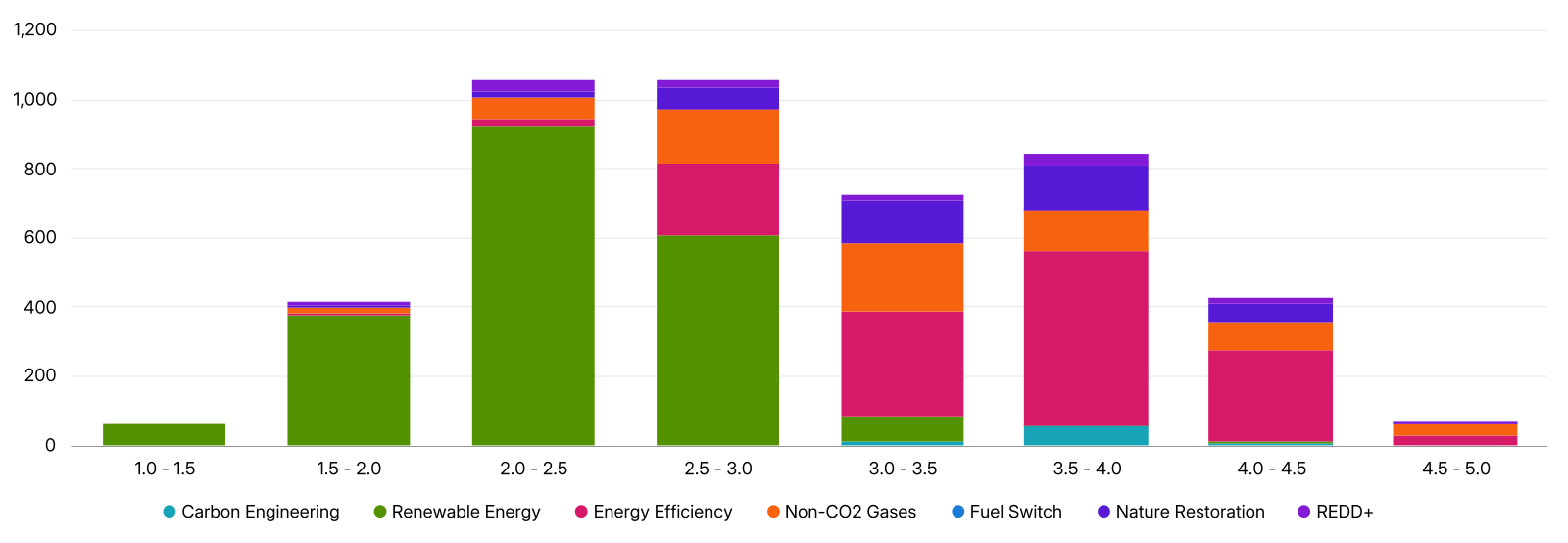
Common patterns observed across the market include:
- Grid-connected renewable energy projects generally exhibit lower additionality. Falling technology costs, widespread deployment and policy support mean many projects would likely have proceeded without carbon-credit revenues.
- Clean cooking projects often demonstrate higher additionality. Carbon finance often funds the subsidized or free distribution of improved technologies that end users could not otherwise afford.
- Non-CO₂ gas projects, such as landfill methane capture, show mixed outcomes. Additionality depends heavily on local regulation and enforcement.
- Nature-based and engineered carbon-removal projects tend to exhibit higher additionality on average, reflecting higher costs and fewer alternative revenue sources, though outcomes still vary by design and context.
Within each project type, however, variation is significant. Broad assumptions are a starting point, not a substitute for project-level assessment.
Case illustration: Additionality in avoided deforestation projects
Avoided deforestation projects, developed under the Reducing Emissions from Deforestation and Forest Degradation framework (REDD+), highlight how complex additionality can be to assess.
The central question is whether deforestation would likely have occurred without carbon finance. Assessments examine historical deforestation trends, economic incentives for alternative land uses, the strength of legal protections and how consistently they are enforced and whether the baseline deforestation model reflects a reasonable projection of what would have happened without the project.
In practice, outcomes vary widely. Some REDD+ projects demonstrate strong additionality where carbon revenues materially alter land-use outcomes. Others show weaker additionality where baseline scenarios overestimate deforestation risk, or where forests would likely have remained intact regardless.
The result is a wide spread of additionality scores within the same project type.
Conclusion
Additionality is one of the most consequential integrity factors in carbon markets. It determines whether credits represent real emissions reductions or removals that would have happened regardless of carbon finance.
Carbon Project Ratings
Investor-grade ratings for over 4,000 carbon projects grounded in granularity and backed by geospatial intelligence.

Projects and Transactions
Access roughly 30,000 projects spanning more than 15 registries and 1 million transactions.1

1 Data and coverage as of December 2024.