
Asset Owners Face Private Markets’ Transparency Test
- Transparency is the root problem. Liquidity pressure, uneven confidence in private market valuations and emerging stress in private credit all point to the same issue: Investors cannot see clearly enough into what they own.
- AI needs the right foundation. Consistent, reliable data can help turn AI from a productivity tool into a source of better private-market insight.
- A total-portfolio view starts with the data beneath it. Investors need to know what they own, what those investments are worth and where risk lies before they can manage public and private assets together.
"The asset class works,” said MSCI Head of Private Assets Luke Flemmer. “But the infrastructure supporting it has not kept pace with its scale.”
That was the dilemma facing more than 160 senior investment and operations leaders from institutional and private wealth limited partners (LPs) who gathered in Phoenix last week for MSCI’s inaugural Private Assets Summit.
Conversations centered on three questions: How is limited transparency affecting liquidity and valuations? How far can AI go in making private-market data usable? And what will it take to build a true total portfolio view?

Transparency is the root problem
Liquidity was the clearest sign of strain. Slower distributions, continued capital calls and uncertainty around valuations have made investment pacing and portfolio management more difficult for LPs and fundraising more challenging for general partners (GPs).
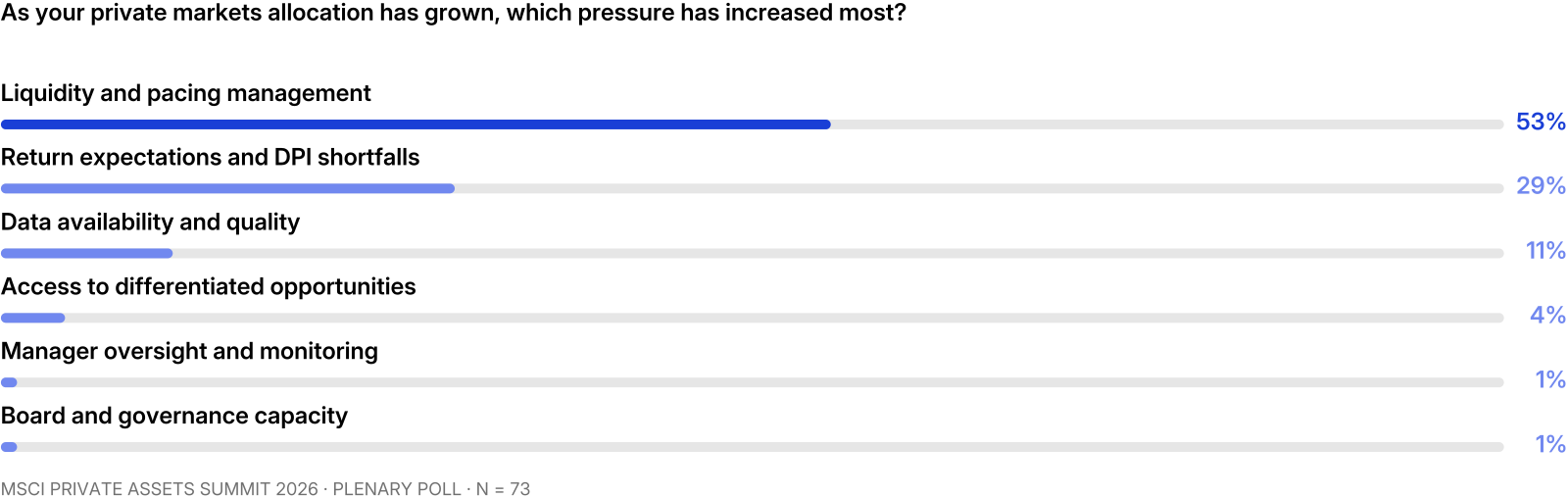
“We are in the hardest fundraising environment in the history of this industry,” said Brenda Rainey, EVP, Private Equity at Bain & Co. In a conference poll, 53% of attendees cited liquidity and pacing management as their single biggest pressure.
MSCI Chief Research & Development Officer Ashley Lester reframed the issue. “The cause of liquidity problems is not bad timing. It's not a temporary rise in interest rates. It's not poor investment decisions. The real cause is the structural absence of transparency…Illiquidity is an information problem,” Lester said. “And if the information problem isn’t resolved, it will come back each time some exogenous factor shocks the system.”
Many private market investors are still making decisions with three-month-old data, classifications that fail to reconcile across systems and outdated benchmarks not built for today’s allocations. The fix, Lester argued, starts with LPs demanding more transparency from their fund managers.
Liquidity problems hurt GPs too, trapping assets in a cycle where uncertain marks, limited price signals and uneven disclosure make investors less willing to commit new capital.
Private credit has the same transparency problem but experiences the strain unevenly. And there is concern that investors may not be seeing how risk is changing inside portfolios until it has already spread.
Some panelists noted that GPs have been extending and amending contracts rather than recognizing defaults. That raises a harder question for investors: whether reported default rates are providing accurate signals.

Patrick Warren, who leads private credit research at MSCI, pointed to another warning sign. “The compression between spreads at origination on senior loans and mezzanine loans has been remarkable, to the point that if you just gave me a spread, I would not be able to tell you whether it was subordinated or senior. Today, they’re almost indistinguishable,” he noted. Price is no longer clearly signaling risk.
Some LPs have used structures to create clearer expectations around information flow. Michael Viteri, CIO of Arizona State Retirement System (ASRS), described how ASRS built its private credit program through separately managed accounts, including the right to terminate after one year. “It makes managers very responsive to our requests,” he said.
Valuations showed the same trust problem. Only 5% of attendees said they had high confidence in private-market valuations, while 26% said confidence was low. Asked about current GP marks, nearly half said assets were being carried above intrinsic value.
The uncertainty, panelists stressed, is not just about whether marks are high or low. The same holding, they noted, can be simultaneously marked differently by different managers, depending on the manager’s methodology and view of the asset.

Assets that sell above their last mark may be the ones marked conservatively enough to trade. The rest remain locked, leaving investors with fewer true price signals than the headline data suggest. For Lester, the point was that pricing, valuation and liquidity cannot be separated.
Secondaries buyers hold a structural information advantage because they see real pricing data from actual transactions, Viteri said. It’s one reason ASRS recently moved meaningfully into secondaries, partnering with a manager that had that specific data capability.
AI can help investors make private-market data manageable
The dearth of data and reliance on manager-generated marks are not new issues in private markets. What has changed is the cost of failing to address those challenges given the tools now available.
Panelists described the evolution this way: Five years ago, owning your data meant having an Investment Book of Record and not being solely reliant on an administrator. Today it means a data warehouse, a data lake and complete control, not just a shadow book of record.

The institutions that have built these systems more than once came back to the same lesson: Rules should be decided before you build. How do you measure performance? How do you handle exposure transparency for illiquid holdings? Who owns the data when something goes wrong? Those decisions determine whether a “single source of truth” holds up.
The same is true for AI. Waiting for perfect data is unrealistic. “You’re never done” building the foundation, Charlie Smith, vice president in MSCI’s asset owner client coverage team, said. The institutions leading today were not necessarily building for AI five years ago. They were sourcing, centralizing and automating data, he added. That work made them AI-ready before they knew they would need to be. Once governance principles are in place, LPs can begin layering in AI tools on solid footing.
The clearest gains so far are operational. Aman Soni, MSCI’s head of platform and infrastructure for private assets, described how MSCI’s Private Assets Data Platform uses AI to turn fragmented GP documents into structured, analytics-ready data. The platform can ingest, normalize and classify emails and documents across myriad source types, then extract and validate the data against more than 1,500 systematized rules. Clients can also build custom rules within the platform. AI-generated reasoning and flags help reviewers identify validation breaks.
Jeffrey Fulk, head of private equity investment research at ALTi, described how the firm uses AI to support a distributed team of analysts. Documents that once had to be read and parsed manually are now extracted automatically, he explained. Analysts spend more time identifying what is missing, what matters and where GP follow-up is needed.
But speed does not solve the problem of missing information. A third of questions that LPs ask inside GP data rooms cannot be answered based on the data provided, Mason Lender, head of the MSCI Diligence Platform, found in analysis of more than 100,000 LP queries on the platform.
Richard Cheever, director of investment strategy and research at Three Bridge Wealth Advisors, pointed to a persistent gap in attribution data. “We have a real challenge getting down to the individual security level and getting any valuable information about the fundamentals of the underlying portfolio,” he said. “On the underlying fundamentals, we’re still taking the GPs at their word.” AI can identify those gaps faster, but it cannot fill them on its own.
AI may make data easier to handle but does not address the visibility issue: LPs still need the disclosure required to trust the outputs, and GPs have an interest in providing that transparency if they want capital to keep flowing.
A total-portfolio view is only as good as the data beneath it
A true total-portfolio view requires three things, explained Benjamin Page-Fort, head of Americas private assets at MSCI: Knowing what you own, what it is worth today and where the risk lies. Each step depends on the one before it.
For Clint Stone, CIO at the Larry H. Miller Company, the issue showed up in benchmarking. “Those two things — the sector mismatch and the timing — are probably the biggest factors that led me to ask: Why don’t I use the right benchmarks for my private assets?” Stone said he wanted benchmarks that matched the cadence of his actual private-book statements, rather than leaving his team to explain why performance and benchmark data were misaligned.
Once the right system was in place, Stone said, the conversation changed. “You’re spending your time not explaining differences in why the benchmark is looking so different than your performance but actually digging into your book and getting to real issues.”

Jim Costello, MSCI’s chief economist for real assets, said real estate investors face a similar need for clarity. With higher rates and shifting demand, commercial real estate investors need a clearer view into income, property quality, leasing, maintenance and capital-expenditure needs. “The data challenge is not just knowing the asset class, it’s knowing the asset,” he said.
Many investors at the summit said they are moving toward a total-portfolio view, aided in part by a new generation of tools for valuing and analyzing private assets. They pointed to hybrid indexes that bridge public and private allocations, daily nowcasting models for private-credit and private-equity valuations and factor-level look-through at exposures across asset classes. The challenge remains, they said, in getting clean data into those tools, then getting teams and managers to use the same definitions.
Ultimately, the consensus at MSCI’s inaugural Private Assets Summit was that private markets are at an inflection point. The industry has scaled, but the transparency and comparability required to manage that scale continue to lag — although increasingly the tools and data to close that gap exist. As Lester noted, information problems do not resolve themselves. Investors who treat a clearer view of what they own, what it is worth and where risk lies as a requirement will be better placed for whatever comes next.








Subscribe todayto have insights delivered to your inbox.
The State of Private Markets 2026
From the semi-liquid vision of investing to the ongoing challenges in distributions and AI’s spread across asset classes, this upcoming report examines the key forces influencing private capital.
Private Asset Data Platform
MSCI's AI-driven platform is built to streamline private capital data processing — enabling collection, extraction, validation and delivery of data across pre and post investment use cases, with traceability at its core.
MSCI Private Assets
Achieve greater transparency with our data, indexes and analytics for confident decision-making in private asset investing.
The content of this page is for informational purposes only and is intended for institutional professionals with the analytical resources and tools necessary to interpret any performance information. Nothing herein is intended to recommend any product, tool or service. For all references to laws, rules or regulations, please note that the information is provided “as is” and does not constitute legal advice or any binding interpretation. Any approach to comply with regulatory or policy initiatives should be discussed with your own legal counsel and/or the relevant competent authority, as needed.