
Greece's Journey Back to Developed Market Status
- MSCI will reclassify the MSCI Greece Index from emerging to developed markets in the May 2027 Index Review, reversing the 2013 downgrade triggered by the sovereign debt crisis, and restoring a status first attained in 2001.
- The Greece index re-entering DM in 2027 is fundamentally different from 2013's: From two securities, no banks and a market cap of ~USD five billion, to eight securities, a 75% financials weight and a 10x larger market cap.
- Greece's DM reclassification comes as global investors shift allocations from U.S. to European equities — making the expanded MSCI Europe opportunity set timely for those seeking differentiated regional exposure.
No market in MSCI's classification history has made this journey before. Greece was the first — and remains the only — developed market (DM) ever to be downgraded to emerging market (EM) status. The 2010 sovereign debt crisis left its equity market short of DM standards on securities borrowing and lending, short selling and transferability. When the downgrade occurred, only one security was large enough for index inclusion. Fast forward 13 years to a January 2026 MSCI consultation, which drew broad support from global investors, asset owners, asset managers and broker dealers alike, that Greece's market infrastructure had met with developed European standards following sustained reforms. Greece will return to DM status in the May 2027 Index Review. The reclassification causes a manageable but important adjustment for those invested in EM, and it also introduces a new opportunity in European equities for investors looking to diversify within DM.
A homecoming more than a decade in the making
Greece’s 2013 downgrade was unprecedented. The sovereign debt crisis — which began in earnest in 2010 — triggered capital controls, and a sharp deterioration in the market operating conditions led to Greece failing the accessibility standards test in MSCI’s 2013 Annual Market Classification Review. The consequences of the crisis were severe: The standard index was reduced to just two securities with no banks and a market cap of USD 5.5 billion, compared with 24 securities and USD 27.9 billion when Greece entered the DM in 2001.
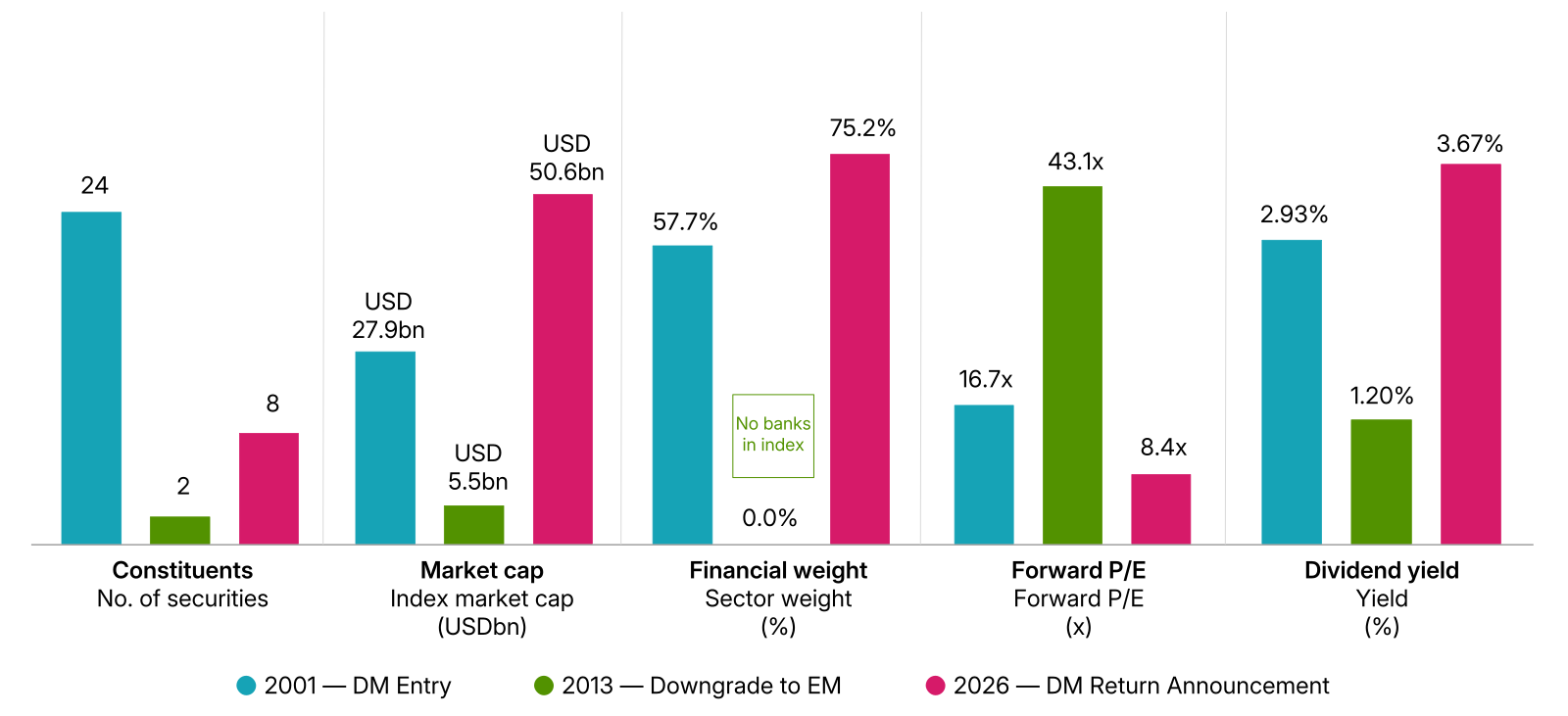
MSCI Greece Standard Index. Data as of June 2001, November 2013 and March 2026.
The intervening period has been defined by a fundamental rebuilding of the Greek economy. Greece regained its investment-grade sovereign credit rating in 2023, and since 2021 its economy has consistently outperformed the European average, with real GDP growth averaging 4.75% versus roughly 3% across Europe from 2021 to 2024. Government debt-to-GDP has also fallen sharply, from 209.9% in 2020 to 154.8% in 2024, and is projected to decline further to around 130% by 2030.1 This strengthening macroeconomic backdrop has been mirrored in equity market performance, with the MSCI Greece Index outperforming both the MSCI Emerging Markets and MSCI Europe Indexes over the 1-, 3-, 5- and 10-year periods ending March 31, 2026.
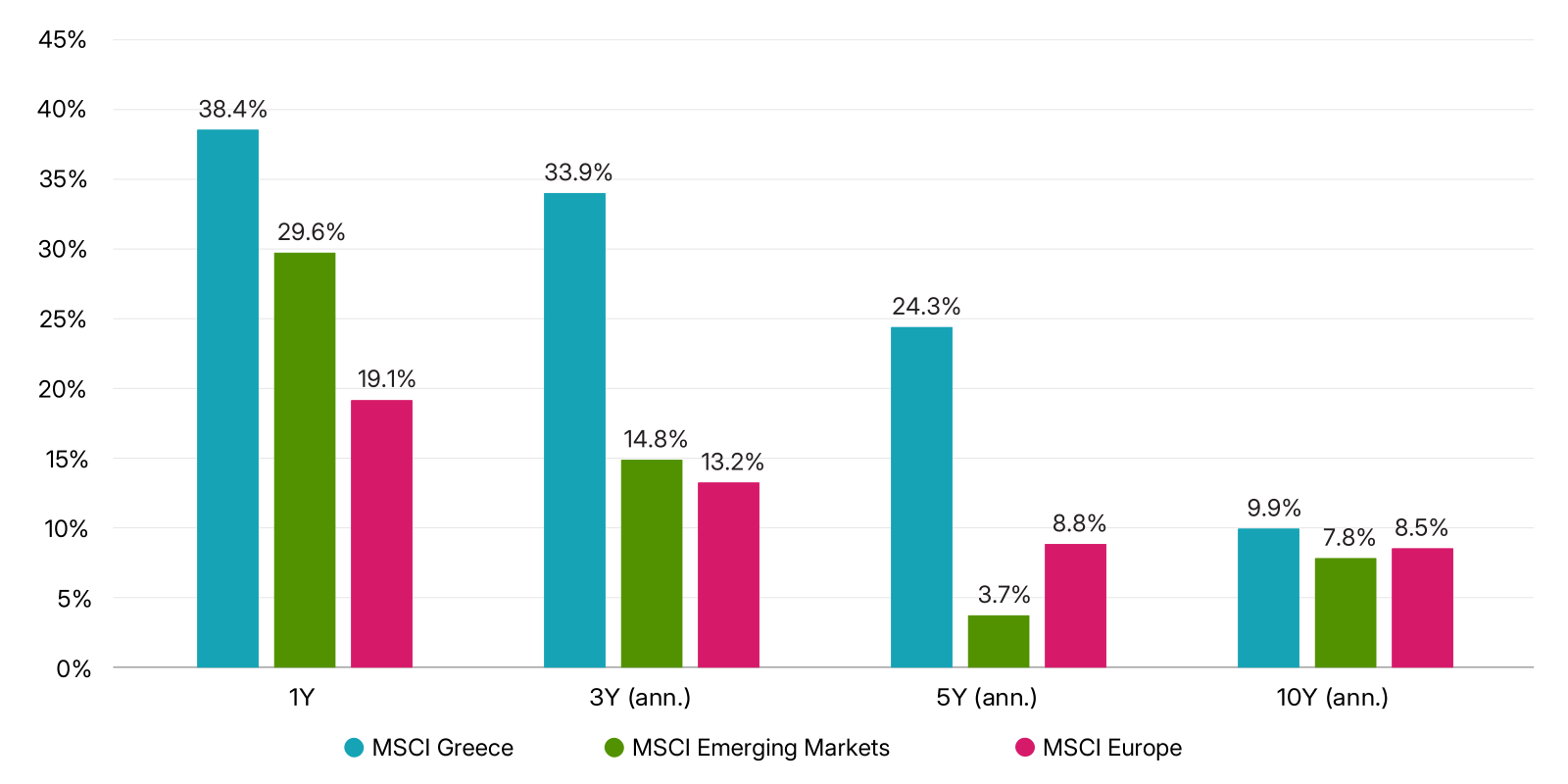
Net total return in USD as of March 31, 2026. Past performance is not indicative of future results.
In the 2025 Market Classification Review, MSCI noted that Greece had met both the economic development criteria and market accessibility standards for DM classification, but had not satisfied one remaining criterion: the Size and Liquidity persistency rule, which requires at least five companies to meet DM thresholds consistently across eight consecutive index reviews. The rule guards against markets flip-flopping between classifications due to short-term size and liquidity fluctuations rather than genuine changes in market quality. For a smaller market like Greece, however, a global equity universe increasingly dominated by large-cap technology stocks can push companies in and out of DM size thresholds without any underlying deterioration in the market itself. MSCI sought the investment community's view on whether to waive the rule for Greece, given its integrated treatment of developed Europe for index construction purposes. The majority of respondents supported the waiver, noting that Greece's market infrastructure had met developed European standards, and MSCI subsequently launched the formal reclassification consultation in January 2026, which resulted in Greece's upgrade to DM status.
A clearly defined rebalancing event with sufficient lead time for investors
In May 2027, MSCI will integrate MSCI Greece securities into the MSCI Europe Index using our standard eligibility rules to minimize turnover for investors. Based on simulated results using the February 2026 Index Review data, all current constituents of the MSCI Greece Investable Market Index (IMI) would move into the MSCI Europe IMI.
The simulated large and mid-cap MSCI Greece Index includes seven securities with a pro forma weight of approximately 40 basis points (bps) in the MSCI Europe Index, compared to eight securities and 57 bps weight in the MSCI Emerging Markets Index today.

Simulated results based on February 2026 Index Review with prices as of January 16, 2026, using DM requirements. For illustrative purposes only. Final constituents and weights will be confirmed at the May 2027 Index Review.
Implications for EM and European equity investors
For EM investors, the transition is modest in aggregate but most directly felt by those with dedicated passive emerging Europe allocations, where the removal of Greek banks will reduce financials exposure within that segment. For DM investors, simulations indicate Greece would add a concentrated diversified banks allocation to the MSCI Europe Index — a sub-industry representing approximately 13% of the index as of March 31, 2026 — compared to a European financials sector that is more broadly spread across banks, insurance and financial services.
Greece's simulated MSCI Europe weight of approximately 0.40% — comparable in scale to Austria and Portugal — reflects a distinct investment profile. Financials account for approximately 59% of the MSCI Greece IMI by market capitalization, nearly three times their weight in both the MSCI Europe IMI (22%) and the MSCI EAFE IMI (23%). Under DM requirements, the simulated MSCI Greece Standard Index would hold seven securities. The four qualifying banks — National Bank of Greece SA, Eurobank SA, Piraeus Bank SA and Alpha Bank SA — will together account for approximately 80% of the simulated standard index weight, with Public Power Corporation SA, Hellenic Telecommunications Organization SA and Allwyn AG rounding out the composition across utilities, communication services and consumer discretionary respectively.
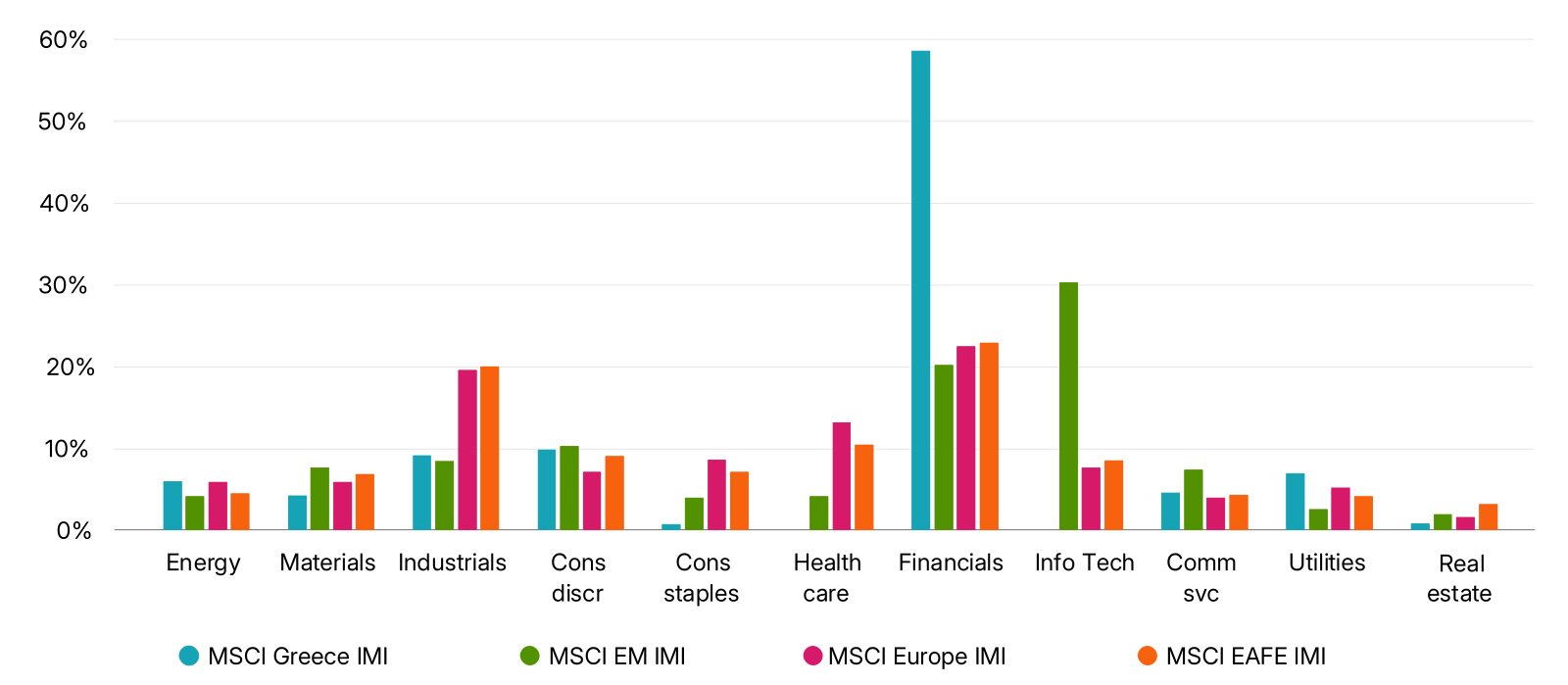
Sector weights (%) as of March 31, 2026.
Beyond the standard index, the MSCI Greece IMI provides exposure to marine ports & services, which is absent from the MSCI Europe IMI, and increases exposure to distributors, other specialty retail and oil & gas refining & marketing — each below 0.15% in the MSCI Europe IMI at that time. Greece’s reintegration into developed Europe also speaks to the durability of the EU’s institutional framework and its role in supporting economic recovery across member states. Greece's trajectory — from the depths of the sovereign debt crisis to investment-grade status and DM reclassification in just over a decade — reflects the extent to which its market infrastructure and accessibility standards have converged with those of developed Europe.
A landmark reclassification — and what comes next
Greece’s reclassification is the result of how a decade of reform, rebuilding and regulatory convergence led to a fundamental shift in how global institutional investors assess the Greek market. It creates a clear but manageable rebalancing event for EM investors, and some timely new additions to the European equity opportunity set for DM investors, notably to diversified banks, which represent 80% of the simulated MSCI Greece Index today. The move also completes an alignment with MSCI's Fixed Income Market Classification, where Greece has held DM status since 2023. Few classification events in MSCI's history carry implications for both EM and DM investors simultaneously — Greece's reclassification is one of them.



Subscribe todayto have insights delivered to your inbox.
MSCI to Consult on a Potential Reclassification of Greece to Developed Market status
New York – January 26, 2026 – MSCI Inc. (NYSE: MSCI) announced today the launch of a consultation on a proposal for the potential reclassification of Greece from Emerging Market status to Developed Market status in one step, with implementation targeted for the August 2026 Index Review.
MSCI to Reclassify the MSCI Greece Indexes from Emerging Market to Developed Market status
MSCI announced that the MSCI Greece Indexes will be reclassified from Emerging Market to Developed Market status in one step coinciding with the May 2027 Index Review
MSCI Market Classification
During the Annual Market Classification Review, MSCI analyzes and seeks feedback on those markets it has placed under review for potential market reclassification. MSCI communicates its conclusions from the discussions with the investment community on the list of countries under review and announces the new list of countries, if any, under review for potential market reclassification in the upcoming cycle.
1 IMF World Economic Outlook, October 2025
The content of this page is for informational purposes only and is intended for institutional professionals with the analytical resources and tools necessary to interpret any performance information. Nothing herein is intended to recommend any product, tool or service. For all references to laws, rules or regulations, please note that the information is provided “as is” and does not constitute legal advice or any binding interpretation. Any approach to comply with regulatory or policy initiatives should be discussed with your own legal counsel and/or the relevant competent authority, as needed.