
HELP Wanted: Using LLMs to Identify Adaptation Gaps
- A likely El Niño this summer makes drought preparedness among portfolio companies an immediate concern for investors, with 23% of exposed companies not reporting any relevant infrastructure-related adaptation actions.
- By matching adaptation activities against the hazards to which a company is most exposed, investors can identify holdings that face high exposure but show low preparedness (HELP).
- Half of climate-adaptation and resilience-related activities are not disclosed in sustainability reports. Large language models (LLMs) may offer an efficient way to identify them.
Mentioned in this blog post:
As 2026 is expected to face an increased risk of extreme weather conditions due to a high likelihood of an El Niño event, hazards such as drought, heavy rainfall and extreme heat may be top of mind for investors monitoring physical risks in their portfolios.1 This heightened risk may also increase the importance of assessing how prepared companies are to adapt to these hazards.
For drought and the resulting water scarcity, companies may face greater risk this year if infrastructure upgrades to address these challenges are not already in place.
Using MSCI GeoSpatial Asset Intelligence, we estimate that 49% (220 companies) of MSCI ACWI Index constituents exposed to water stress may face water scarcity or drought conditions through assets located in El Niño-impacted areas.2
Data as of June 9, 2026. This chart shows MSCI ACWI Index constituents that have water stress as a weighted key issue in MSCI ESG Ratings and at least 5% of their assets located in areas potentially affected by El Niño (n=220). The x-axis shows each company's average water-scarcity hazard level across its exposed assets, expressed as a percentile to other companies in the MSCI ACWI Index. Use the filters at the top left to view results by industry or issuer-country domicile. Hover over a data point to see the company's name, industry, number of related actions identified, example disclosure and source.
We found that 77% (170) of companies facing both water stress and operating in El Niño-affected areas disclosed at least one adaptation-related infrastructure investment to address water scarcity. For the remaining 23%, it is unclear whether water-efficiency protocols, water rights or other measures have been implemented to address potential drought-related impacts on their operations.
Which companies appear least prepared for their most significant physical risks?Focusing on a single climate hazard — in this case, drought — makes it relatively straightforward to compare risk exposure and adaptation activities across companies. Assessing exposure across all physical hazards is more complex. Unlike carbon emissions or revenue, there is no single metric that allows investors to compare companies' physical-risk profiles and adaptation activities.
Hazard-exposure metrics can add context by helping investors identify which hazards are most relevant to each company. Mapping adaptation activities to those hazards then provides a basis for comparing overall preparedness across companies.
These observations can be plotted on a hazard-adaptation matrix (HAM) to identify companies in a higher exposure, lower preparedness (HELP) category.3 Based on this approach, 52% of MSCI ACWI Index constituents did not appear to be taking adaptation-related actions aligned with their most significant physical risks.4 For asset owners, these companies could serve as an initial set of engagement targets.
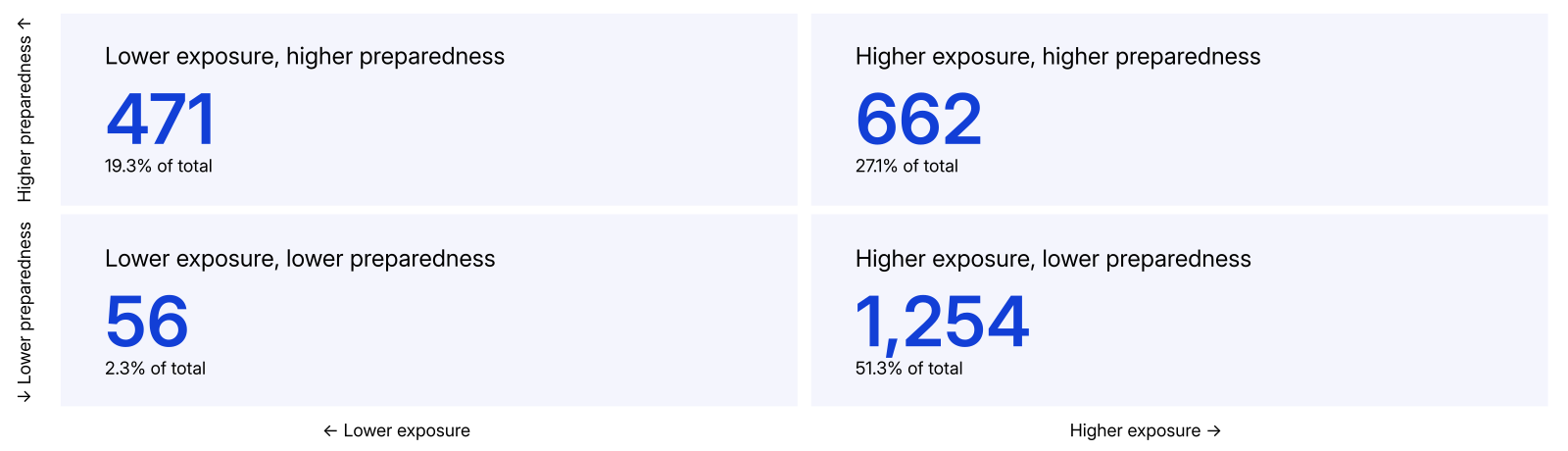
Data as of June 9, 2026. The top chart shows MSCI ACWI Index constituents grouped by hazard exposure and adaptation preparedness. Companies were classified as having higher or lower exposure using a hazard intensity value threshold of 7. For hazards with an intensity above 7, companies were classified as having higher preparedness if MSCI Research & Development identified adaptation actions related to those hazards. The bottom chart shows the distribution of companies across the four quadrants by GICS sector. Hover over each bar to see related counts and relevant percentages.
More than half of companies in the financials, industrials, information-technology and health-care sectors fell into the HELP category.5 Yet at least 20% of their sector peers disclosed relevant adaptation measures, suggesting that some companies are taking action despite facing similar levels of hazard exposure. Utilities was the only sector in which, among higher-exposure companies, more disclosed relevant adaptation measures than did not.
Adaptation data is spread across many sources — LLMs can help identify and classify itIdentifying adaptation-related risk-management activities presents additional challenges. Adaptation information rarely appears in a dedicated section of a sustainability report. Instead, it is often scattered across annual reports, quarterly filings and press releases.
Data as of June 9, 2026. This chart shows the adaptation-related activities identified across disclosures from 2,443 MSCI ACWI Index constituents. Hover over a bar segment to view the number of activities identified for each adaptation-activity type within a document category. "All other document types" includes sources such as investor presentations, regulatory filings and company policy documents.
The classification and natural-language-processing capabilities of large language models (LLM) can help address this challenge. MSCI Research & Development deployed an LLM trained on a taxonomy of adaptation actions co-developed by the MSCI Institute and the Global Adaptation & Resilience Investment Working Group (GARI) to review public documents and company websites for evidence of adaptation activities.
Our review of disclosures from 2,443 MSCI ACWI Index constituents identified 18,921 adaptation-related activities across 13,563 unique documents in FY2025. Sustainability and climate reports accounted for only half of the adaptation activities identified, suggesting that many company disclosures on adaptation are embedded in other public documents.
While sustainability reports captured most disclosures related to physical-risk assessments and infrastructure upgrades, information on adaptation-related opportunities was more evenly distributed across company websites, annual reports and sustainability reports.
LLMs can help unlock adaptation insights from unstructured dataAs extreme weather events become more frequent and severe, understanding which companies appear prepared for physical climate risks may become increasingly important for investors. Physical-risk data can be difficult to compare across companies, but mapping hazard exposure and then assessing adaptation actions can help investors focus on the risks most relevant to each company.
LLMs can expand the scope of adaptation-data collection beyond sustainability reports, helping investors draw insights from a broader set of public disclosures. Combined with hazard-exposure analysis, these tools may help identify potential engagement opportunities and better understand how companies are responding to physical climate risks.



Subscribe todayto have insights delivered to your inbox.
Hidden in Plain Sight: Physical Risk in Asset Owners' Portfolios
Where assets are located matters. MSCI and Swiss Re Risk Data Solutions uncover how physical hazards are reshaping asset-owner portfolios — and how insight can drive resilience.
Physical Risk Guide for Asset Owners and Asset Managers
A practical framework for asset owners and managers to measure physical climate risk exposure, assess materiality and integrate findings into investment decisions across functions.
GeoSpatial Asset Intelligence
GeoSpatial Asset Intelligence delivers asset-level nature and physical risk data to help investors, banks and insurers identify and manage risk.
1 “Prepare for El Niño,” World Meteorological Organization, June 2, 2026.
2 Areas that could experience drier conditions and increased water stress include Indonesia, the Philippines, eastern Australia, southern Africa, India, Central America and the Amazon. We applied a threshold requiring at least 5% of a company’s assets to be located in affected areas to identify potentially exposed companies. We then narrowed the sample to companies for which water stress was identified as a weighted key issue for them in MSCI ESG Ratings, as of June 9, 2026. For more information on key-issue selection, see “ESG Ratings Methodology”, MSCI Research, March 2026.
3 A detailed introduction to the hazard-adaptation matrix and its use cases is available in Chapter 5 of “Physical Risk Guide for Asset Owners and Asset Managers,” MSCI Research, April 2026.
4 We used a hazard-intensity value threshold of 7 to distinguish between higher and lower exposure. Hazard-intensity values are calculated at the issuer level for each hazard on a scale of 0 to 10, where 0 indicates that the hazard is not applicable to a company's locations and 10 indicates very high risk, see “MSCI Physical Risk Metrics – Issuer Level Methodology,” MSCI Research, April 2026.
5 Sector definitions based on GICS, the global industry-classification standard jointly developed by MSCI and S&P Dow Jones Indices.
The content of this page is for informational purposes only and is intended for institutional professionals with the analytical resources and tools necessary to interpret any performance information. Nothing herein is intended to recommend any product, tool or service. For all references to laws, rules or regulations, please note that the information is provided “as is” and does not constitute legal advice or any binding interpretation. Any approach to comply with regulatory or policy initiatives should be discussed with your own legal counsel and/or the relevant competent authority, as needed.