
How Climate-Transition Risks May Impact Lending Practices
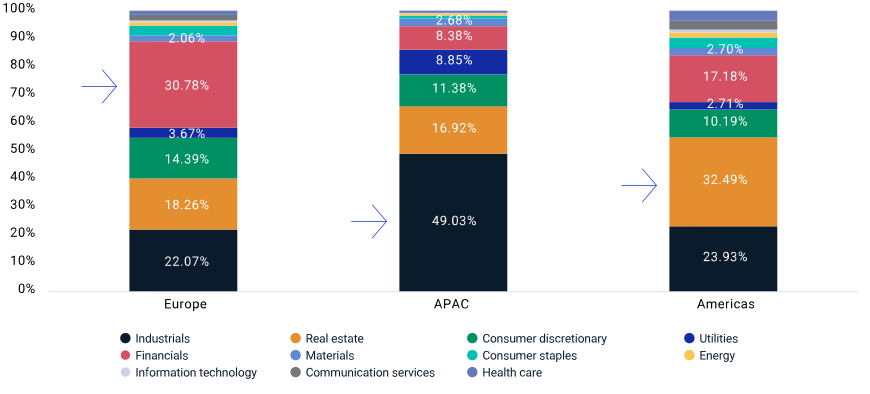
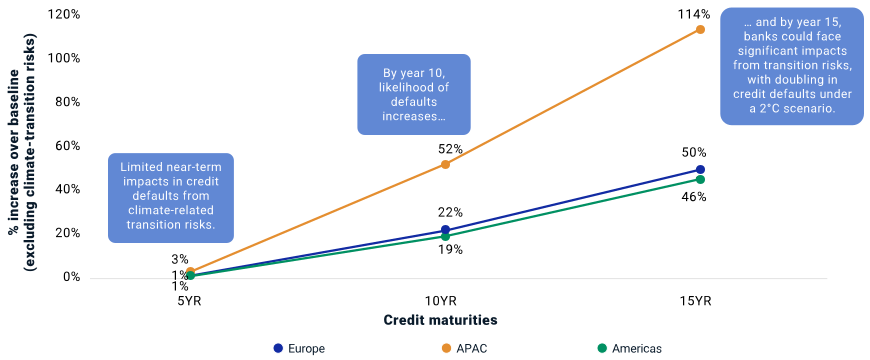
- APAC lenders’ default risk could more than double due to transition risks, driven by high industrials exposures. By contrast, banks in Europe and the Americas saw smaller increases, given their focus on financials and real estate.
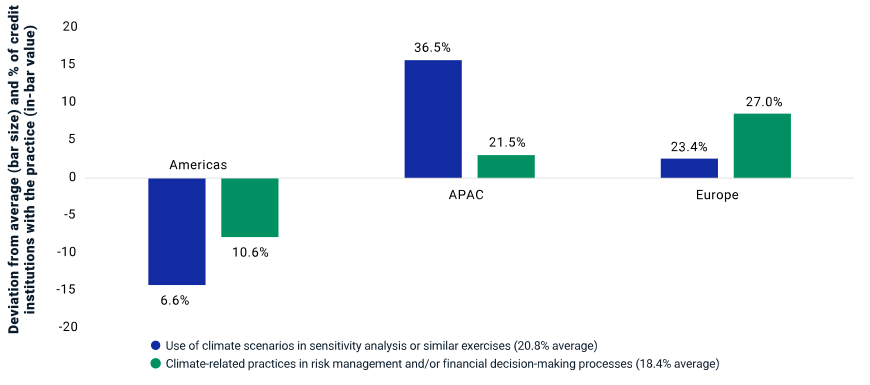
- Only 20% of banks reported using climate-scenario analyses, and only 18% integrated climate-related risks into their risk management.
- More regulators expect the integration of transition risks into processes around credit-risk management. Therefore, banks may need to adopt forward-looking approaches and longer time horizons to manage these emerging risks effectively.


Subscribe todayto have insights delivered to your inbox.
1 “Guide on climate-related and environmental risks - Supervisory expectations relating to risk management and disclosure,” European Central Bank, November 2020. “Climate Risk Management, Sound Business Practices and Prudential Limits,” Office of the Superintendent of Financial Institutions Canada, March 2023. “Final Report: Guidelines on the management of environmental, social and governance (ESG) risks,” European Banking Authority, January 2025.
2 Data was sourced from lenders classified as diversified banks, regional banks or diversified financial services under MSCI ESG Ratings coverage across the relevant regions.
3 Sectors refer to the Global Industry Classification Standard (GICS®) sectors. GICS is the industry-classification standard jointly developed by MSCI and S&P Global Market Intelligence. Carbon-intensive sectors were defined as industrials, utilities, materials and energy.
4 The model assumptions used in this analysis were that climate-related policy costs, while not currently priced in, will begin to be accounted for on a rolling five-year forward basis, continually pricing in the next five years of costs as the time progresses.
5 This scenario was chosen based on the results of MSCI Institute's risk survey of 350 industry professionals from the financial industry. Approximately 60% of respondents said that temperatures will rise between 2°C and 2.9°C with an overall expected mean temperature rise of 2.8°C.
6 Under the High Impact 2°C Delayed scenario, the maximum PD increase over the baseline due to climate-related adjustments was 161% for Europe, 165% for the Americas and 329% for APAC.
7 The analysis is based on MSCI ESG Ratings' Financing Environmental Impact Key Issue, applied to assessment of companies with significant lending and underwriting segment. Universe: 548 issuers across the different regions in scope. MSCI ESG Research, as of December 2024.
8 29% in Europe, 21% in APAC and 11% in the Americas.
9 “Climate risk, bank lending and monetary policy, Working paper No 2969,” ECB, August 2024.
The content of this page is for informational purposes only and is intended for institutional professionals with the analytical resources and tools necessary to interpret any performance information. Nothing herein is intended to recommend any product, tool or service. For all references to laws, rules or regulations, please note that the information is provided “as is” and does not constitute legal advice or any binding interpretation. Any approach to comply with regulatory or policy initiatives should be discussed with your own legal counsel and/or the relevant competent authority, as needed.