
How Index Inclusion Shapes Your Company's Investor Base
- As investment funds and portfolios are increasingly tracked or benchmarked to indexes, a company's index membership shapes how widely it is held and seen by investors worldwide.
- By understanding the rules-based criteria that drive index inclusions and deletions, companies can better monitor how capital may move toward or away from their stock as rebalancings happen throughout the year.
- To gain a full picture of a company's representation within an international investment ecosystem, market participants, including companies, can monitor these events for both new and existing indexes.
Mentioned in this blog post:
More than USD 21 trillion in AUM is benchmarked to MSCI's indexes globally as of Dec. 31, 2025, and a fast-growing share, USD 2.8 trillion as of July 2026, sits in ETFs.1
The AUM tracking a given benchmark can be described as its index-linked capital. There are thousands of indexes used by investors to reflect different investment strategies. The MSCI World Index, for example, has more than 50 ETFs tracking it globally, and the net assets of just one of the funds benchmarked to it is more than USD 150 billion.2 In addition to ETFs, mutual funds, pension mandates and separately managed accounts reallocate capital during scheduled index review dates. Index inclusion can potentially increase visibility and relevance of companies to a broader pool of global investors and investment portfolios. Index deletion can have the opposite effect.
Understanding index inclusion
Index inclusions (or additions) and deletions for a cap-weighted index like the MSCI USA Index follows MSCI's publicly-documented set of rules laid out in the Global Investable Market Indexes Methodology: check eligibility of company securities, rank eligible companies by market capitalization and include those based on their free-float market cap that are above a certain rank, as determined by the rules. A company's market cap, free float,3 liquidity and other characteristics such as foreign ownership determine its eligibility, eventual inclusion (or deletion) and weighting.
Because MSCI's index methodologies are rules-based and publicly documented, companies can assess their own standing against the published eligibility and ranking criteria at any time. MSCI's Index Inclusion Module gives companies visibility into where they currently stand relative to those criteria, and their current indexed AUM exposure and weights, using the same method applied at every scheduled review.
What happens when a company crosses the line
Research into index membership consistently finds that once a stock joins a widely tracked index, its behavior shifts. Correlation with benchmark returns tends to rise, and idiosyncratic risk, the part of a stock's movement driven by company-specific news, rather than the market, tends to fall.4 This pattern is consistent with the scale of assets that investors have chosen to manage against index-based strategies. A growing portion of shareholders holds the stock as a result of an index-tracking mandate or via index-based allocations, rather than a distinct fundamental view on the business at the security level. Indexed mutual funds and ETFs now account for the majority of long-term fund assets in the U.S. — USD 21.76 trillion versus USD 18.58 trillion in actively managed funds as of May 2026.5
The reverse pattern can hold in the other direction. When a stock exits a major index, following, say, a market-cap decline, demand from index-tracking mandates declines correspondingly.
These behaviors are visible in the data. The average idiosyncratic risk for the group of stocks added and deleted from the MSCI USA Index during its November 2025 review showed a clear trend. For the group of stocks added to the index, the average idiosyncratic risk dropped from 64% to 52% during the three months before and after the index review.6 For the group of deleted stocks, the average idiosyncratic risk rose from 24% to 27% over the same period. The asymmetry is aligned with indexing-related effects: Additions pick up liquidity and a broader ownership base, and as a result their idiosyncratic risk drops quickly upon inclusion, while the effects of removal take longer to fully show up in returns.
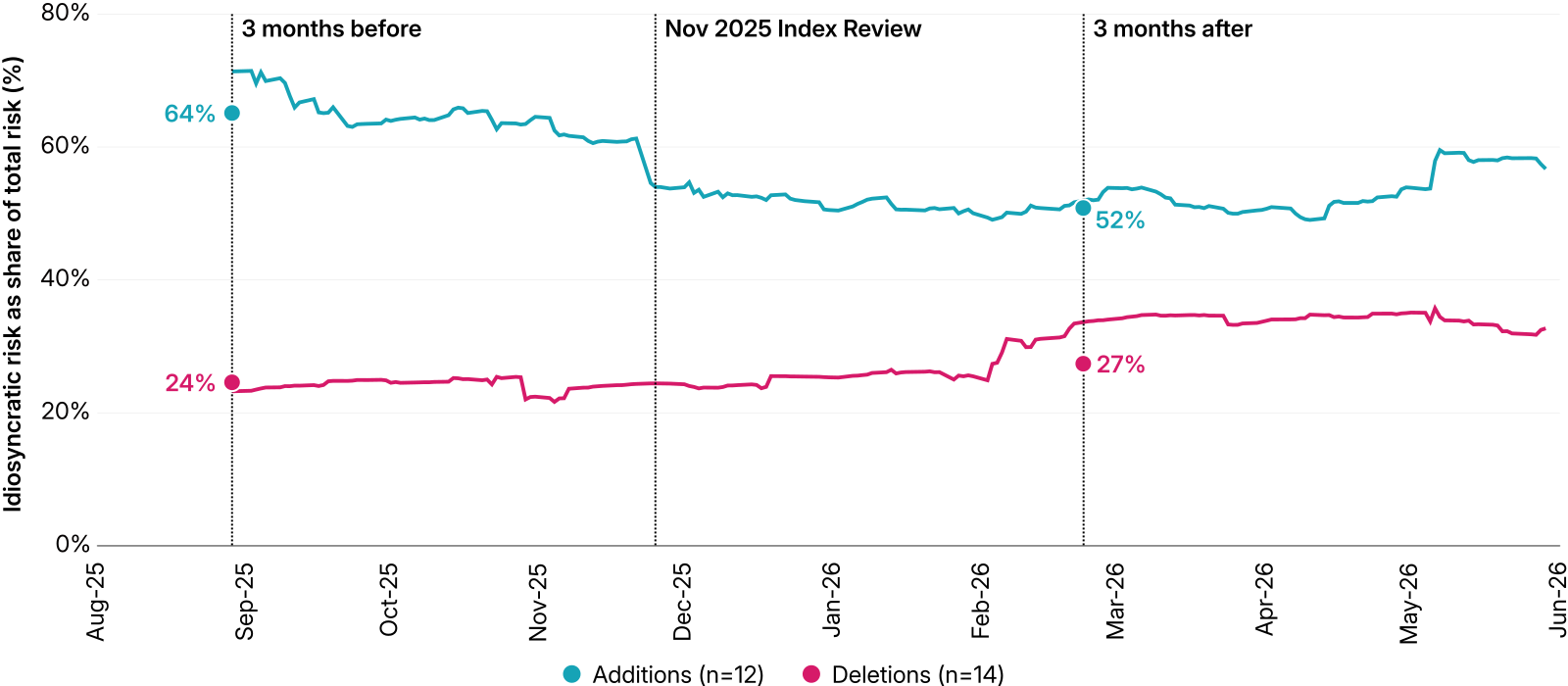
Idiosyncratic risk is shown here as a share of total risk rather than as a volatility level. For each stock, this share is the ratio of the covariance between its specific return and its total (gross) return to the variance of its total return, calculated over a rolling three-month window. The share was then averaged separately across the 12 stocks added to and 14 stocks deleted from MSCI USA around the November 2025 Index Review, from June 2, 2025 to May 29, 2026.
Three questions companies can use to explore indexes
Companies interested in understanding how their index membership shapes the way global investors may hold and view their stock can start with three practical questions:
- Which major indexes currently include our company, if any?
- What determines our eligibility and weight in indexes we're included in — and what's keeping us out of the indexes that we're not in?
- How much index-linked capital is associated with those positions?
Through each stage of this analysis, understanding how an individual company performs against its peer set across industry, size and region can provide a new source of insight into where it may be overperforming or underperforming relative to its peers and the broader market.



Subscribe todayto have insights delivered to your inbox.
MSCI Index Education
The MSCI Index Education hub is the right place to satisfy your curiosity and learn all about indexes and how they work.
Market Concentration and the Global Index Opportunity Set
We examine how MSCI’s GIMI™ methodology has adapted to market concentration, and flex four methodology dimensions to gauge how those scenarios affect breadth, liquidity, size integrity and resilience.
Corporate Solutions
Understand how investors assess your company and what drives index inclusion. MSCI helps corporate finance and sustainability leaders act with confidence.
1 https://www.msci.com/indexes Assets under management (AUM) as of Dec. 31, 2025, reported on or before March 31, 2026.
2 BlackRock, "iShares Core MSCI World UCITS ETF | SWDA," BlackRock, accessed Sept. 23, 2026.
3 MSCI defines the free float of a security as the proportion of shares outstanding that is deemed to be available for purchase in public equity markets by international investors.
4 See Nicholas Barberis, Andrei Shleifer and Jeffrey Wurgler, "Comovement," Journal of Financial Economics, Vol. 75, No. 2 (2005), pp. 283–317. For a more accessible summary of this and related research, see Jeffrey Wurgler, "On the Economic Consequences of Index-Linked Investing," NBER Working Paper No. 16376 (2010):
5 As of July 31, 2026. Investment Company Institute, "Release: Active and Index Investing, July 2026," Statistical Report.
6 Stock-level idiosyncratic risk was measured as the volatility of stock's specific return — the portion of a stock's return left over once the market's move and other systematic factors such as industry and style are stripped out. A stock's specific returns were estimated by the MSCI Barra equity factor model (EFMUSALT). Volatility of specific return was calculated as annualized volatility of daily specific return over a rolling window of three months. Average idiosyncratic risk was calculated separately for the groups of stocks added to (Addition) and deleted from (Deletion) the index.
The content of this page is for informational purposes only and is intended for institutional professionals with the analytical resources and tools necessary to interpret any performance information. Nothing herein is intended to recommend any product, tool or service. For all references to laws, rules or regulations, please note that the information is provided “as is” and does not constitute legal advice or any binding interpretation. Any approach to comply with regulatory or policy initiatives should be discussed with your own legal counsel and/or the relevant competent authority, as needed.