
Is Mortgage Portability Viable for US RMBS? Investors’ Feedback on Our Research
- The Trump administration is reportedly considering portable mortgages to boost housing affordability. Our previous research shows a portability exercising fee from borrowers to investors can benefit both borrowers and RMBS investors.
- The fee, as a percentage of the outstanding principal, would be made as an increasing function of mortgage-rate savings and could be further optimized to other loan attributes and the capital structures of individual deals, in order to maximize borrower participation and generate a positive valuation impact for investors.
- This mortgage-portability option is different from “loan buyout” (as in Danish MBS) or “defeasance account” (as in commercial mortgage loans/CMBS) — approaches that would negatively impact RMBS valuations.
The Trump administration, to boost housing affordability, is reportedly exploring portable mortgages — i.e., letting homeowners move their existing low-interest-rate loans to new homes. Discussions now focus on legal obstacles, the impact on valuation and mortgage rates, fairness to all borrowers and operational complexity, which we will address below.
In previous research, we proposed mortgage portability as a potential policy tool to revive the U.S. housing market. While mortgage portability is well understood as beneficial to borrowers, it may reduce investment value for RMBS pools. Our main contribution in this paper is to propose a portability-exercising fee structure, paid to RMBS investors by borrowers exercising the portability option. We show that proper fee structures can lead to positive impact on RMBS valuation and create a “win-win” situation for borrowers and investors, which can be a basis to overcome the “due-on-sale” mortgage clause. Since publication of our proposal, we have had dozens of discussions with senior leaders in the mortgage-investment and policy space. Here are the most common topics of discussion, in Q&A format.
1) How is a “win-win” situation possible for borrowers and lenders/investors?
The notion “if borrowers benefit, that must come at the expense of investors” is not necessarily correct. The benefits for borrowers who exercise the portability option are mostly the personal utility of their being able to move. The borrowers are willing to pay a fee to the investors for these personal gains, under the portability regime. Obviously, these borrowers would have to pay much more under the “due-on-sale” clause. However, our paper shows if there are many more portability-fee-paying borrowers than borrowers paying the principal under the ”due-on-sale” clause, the MBS passthrough/investors might benefit overall from the portability options granted to borrowers.
Note that the proposed portability fee paid by borrowers to investors is additional to the regular fees paid to mortgage lenders in a normal mortgage application. If the mortgage bankers benefit from the increased valuation of their mortgage-servicing rights (MSR) under the portability regime, they may share some of these benefits with the borrowers applying for portability.
2) Is this mortgage portability option the same as a “loan buyout,” as in Danish MBS, or “defeasance account,” as in commercial mortgage loans/CMBS)?
Allowing borrowers to buy out the loans from the discount RMBS to retire their mortgages would be similar to assuming zero turnover speeds for discount RMBS in valuation, and so implies a large valuation reduction for RMBS passthroughs/investors, and higher future mortgage rates as investors would demand compensation for this new mortgage feature. This will benefit not only borrowers who want to carry their existing low mortgage rates to a new property, but also borrowers who are leaving home ownership or cannot carry the existing low mortgage rates, for example, because they are moving to buy much more expensive properties.
Allowing a defeasance account, funded by new mortgage borrowing, to pay remaining discount mortgage cash flow, would be economically identical to the “loan buyout” option.
Given the differing valuation impact, RMBS investors would be more receptive to a portability option with a fee than to either of these two other approaches.
3) How can the portability fee be set up to make sure RMBS investors are not disadvantaged by the portability option for borrowers? What about investors in collateralized mortgage obligations (CMOs)/real-estate mortgage investment conduits (REMICs)?
As discussed, the key to gain investors’ acceptance of the portability option is to make sure the RMBS valuation impact stays positive. When the fee is set as zero, the valuation impact is likely negative and large, as the investors lose the positive gains from “due-on-sales” principal returns in a discount environment. When the fee is sufficiently large, the valuation impact is likely to be zero, as few borrowers take up this option. The valuation impact versus the fee curve has a concave shape, befitting the “option” nomenclature.
Valuation example: RMBS passthrough valuation impact as a function of the fee. The actual values would depend on various model assumptions. See our paper for details.
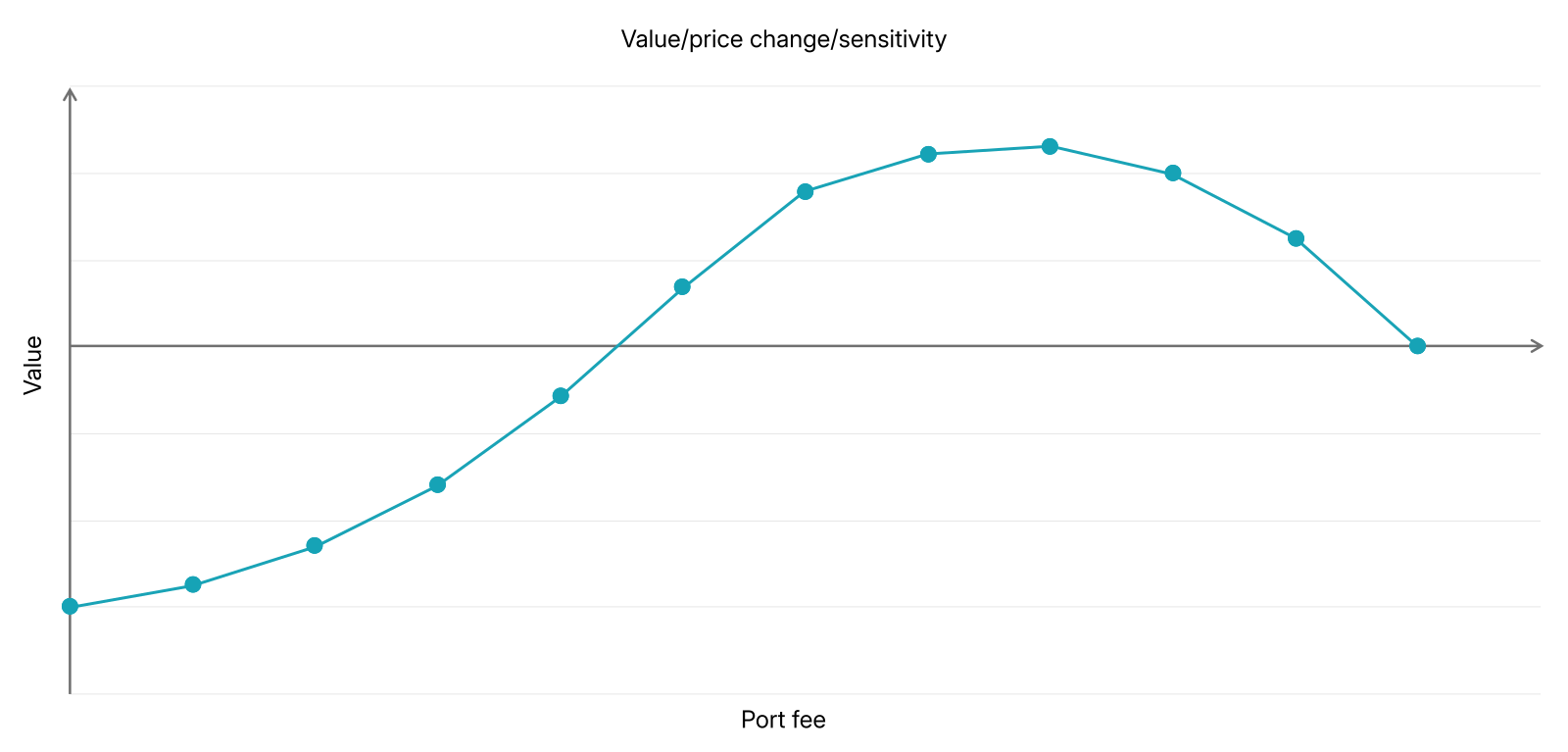
Obviously, the portability-exercise fee, as a percentage of the principal, will be an increasing function of mortgage-rate savings against prevailing mortgage rates. It can also be made a function of loan size, to maximize the number of benefiting borrowers as well as to maximize the positive valuation impact for the RMBS passthrough/investors.
For CMO/REMIC tranches/investors, the portability fees paid to the RMBS passthrough can be distributed proportionally to the tranches’ value as a percentage of the passthrough, to make sure the positive valuation impact is distributed to tranches. If running a complex valuation process is operationally impractical, a PSA type of valuation formula can be specified and agreed upon as standard.
4) Would portability options increase future mortgage rates?
Using the agency to-be-announced (TBA) RMBS market as an example, ported mortgages with the same principal amount but backed by a different property and subject to proper credit underwriting could remain in the same RMBS security, with these and future RMBS securities sharing the same standard embedded portability options and TBA eligibility. Given the resulting positive valuation impact, future mortgage rates should not increase. It is important to make portability compatible with the TBA delivery, to allow borrowers and investors to benefit from the TBA liquidity premium.
5) How does the mortgage-portability option compare with the mortgage-assumability features in Ginnie Mae MBS?
The mortgage-portability and -assumability features have many common economic drivers under current large discount mortgage environment. The assumability option is rarely exercised in Ginnie Mae mortgages/RMBS, with loan assumptions around 0.2% of Federal Housing Administration and Department of Veterans Affairs mortgage-loan transactions. We are not aware of any detailed studies on this issue. Possible reasons can be borrowers’ lack of awareness of this option, the financial sophistication of borrowers and the cumbersome process (it might be complex to coordinate buyers, sellers and lenders). We hope our proposed mortgage-portability options can be more effective, given motivated borrowers expecting large savings in mortgage costs — and investors/lenders expecting positive impacts as well.
6) Would portability be too complicated for mortgage applications and the service process?
Many countries allow mortgage portability. The U.S. can use similar processes for mortgage application and services. For RMBS, coordination needs to be planned between all stakeholders.


Subscribe todayto have insights delivered to your inbox.
How Making Agency Mortgage-Backed Securities Portable May Impact Housing and Mortgage-Backed Securities Investors
Mortgage portability would enable borrowers in the U.S. to move their mortgages from their current homes to new homes. How could it affect portfolios of mortgage-backed securities? Our new paper appeared in the Journal of Fixed Income.
Danish Mortgage Market: Flexibility for Borrowers, Complexity for Investors
The global interest-rate rise since 2022 has suppressed mortgage-prepayment speeds in markets around the world. That has led to complexity in Danish mortgage bonds.
Fixed Income Offerings
Our holistic approach — integrating indexes, analytics and a robust climate/sustainability framework — sets the stage for portfolio differentiation.
The content of this page is for informational purposes only and is intended for institutional professionals with the analytical resources and tools necessary to interpret any performance information. Nothing herein is intended to recommend any product, tool or service. For all references to laws, rules or regulations, please note that the information is provided “as is” and does not constitute legal advice or any binding interpretation. Any approach to comply with regulatory or policy initiatives should be discussed with your own legal counsel and/or the relevant competent authority, as needed.