
Macro Scenarios in Focus: Central-Bank Credibility and Portfolio Risk
- The Federal Reserve’s credibility may emerge as a key macro risk, increasing the likelihood of stagflation, with sticky inflation and slow growth.
- We provide a framework for multi-asset-class investors to assess portfolio impacts under three potential 2026 macroeconomic scenarios: stagflation, recession and stable growth.
- We show how these scenarios translate into various outcomes for a multi-asset-class portfolio, with returns ranging from an 11% loss under stagflation to a 4% gain under a stable-growth outlook.
Market confidence in the Federal Reserve’s independence may prove decisive in 2026. With inflation still above target and emerging signs of a softer labor market, pressure to ease policy risks colliding with the Fed’s mandate.1 Federal Reserve Chair Jerome Powell's grand-jury subpoenas on Jan. 9 — and published video response on Jan. 11 — further added to the already-delicate policy backdrop. When central-bank credibility erodes, inflation can persist even as growth slows — creating stagflation, in which bonds fail to diversify equities.2 In our stagflation scenario, a global diversified portfolio could lose roughly 11%. By contrast, a recession with falling yields could limit losses to around 5% through bond gains, while a productivity-led soft landing could deliver a 4% return.
Why Fed credibility matters
Political pressure in 2025 put Fed independence and credibility under scrutiny.3 When central-bank credibility weakens, inflation becomes harder to control through monetary policy, because shocks are more likely to persist and expectations become less anchored. Central-bank credibility is reflected through inflation persistence within the MSCI Macro-Finance Model, as shown in the chart below. Think of it as stickiness: When credibility is high (parameter near 0), inflation snaps back to its long-term average quickly. When credibility erodes (parameter near 1), today’s inflation bleeds into tomorrow’s.4
Credibility was low in the 1970s, when inflation shocks lingered and expectations drifted higher. It strengthened during the Volcker disinflation, as decisive tightening re-anchored expectations, and remained high through the Great Moderation from the mid-1980s to 2007, when inflation shocks tended to fade quickly.5 After the COVID-19 surge in prices, credibility weakened again as markets questioned whether monetary policy was sufficiently tight to bring inflation back to target. Looking ahead, policy decisions that ease financial conditions while inflation remains above target could similarly affect expectations and prolong the persistence of inflation shocks.
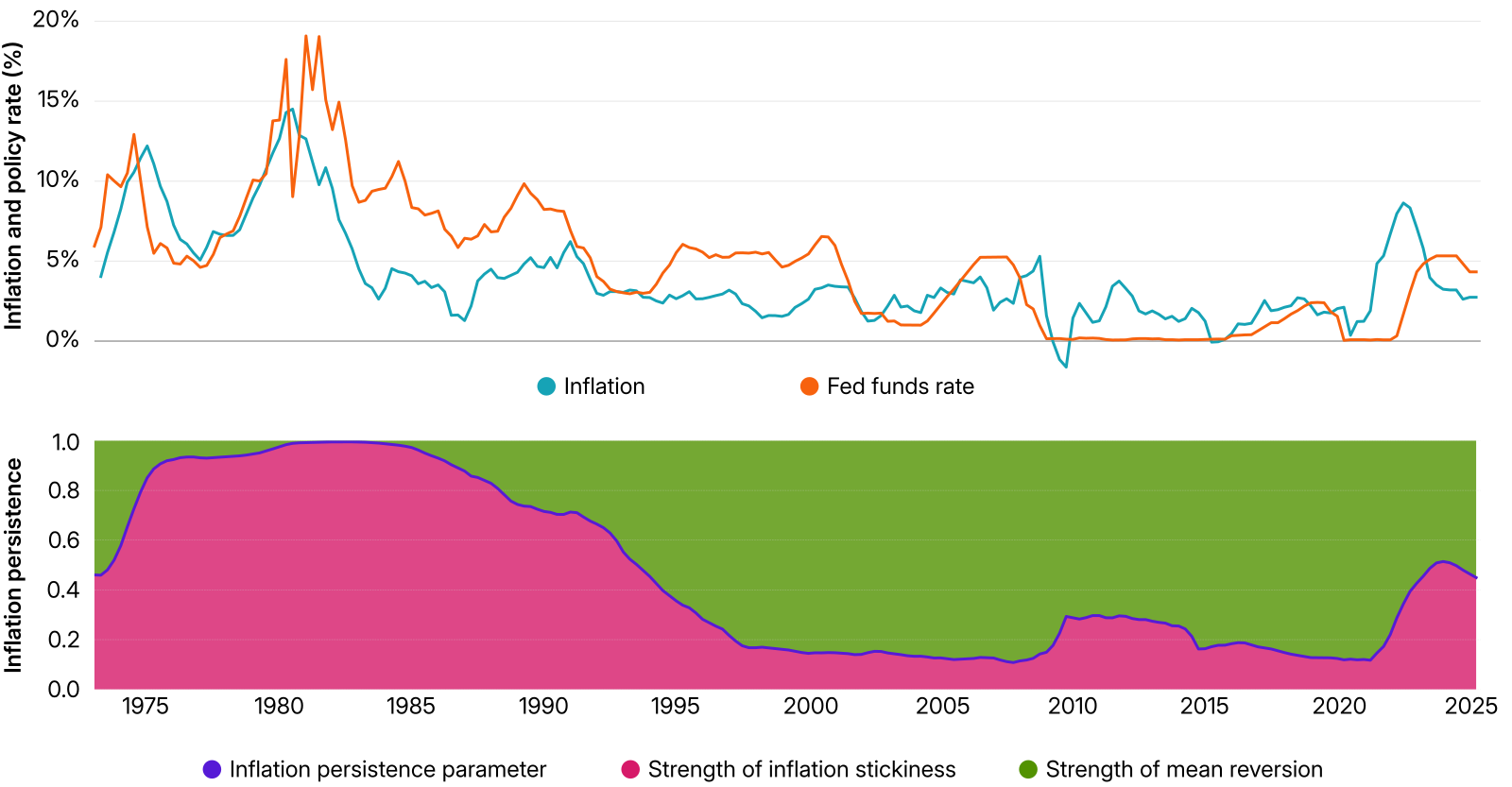
Inflation and the policy rate (top panel) and inflation persistence (bottom panel). Inflation persistence is bounded between 0 and 1: Higher inflation persistence corresponds to weaker credibility and slower mean reversion. Source: Organization for Economic Cooperation and Development, Federal Reserve Bank of St. Louis FRED database, MSCI
Three forward-looking macroeconomic scenarios
Using the MSCI Macro-Finance Analyzer, we refreshed our three scenarios with more recent market data, interpreting the stagflation narrative through the lens of weakened central-bank credibility.6
The stagflation scenario is characterized by an initial inflation shock and a sharp rise in long-term Treasury yields, as inflation expectations de-anchor. Inflation remains persistent and growth is sluggish in the medium term. By contrast, in the recession scenario, a reduction in economic activity weakens labor demand and pulls inflation lower. Treasury yields decline as the Fed shifts toward rate cuts. Stronger productivity growth and resilient consumption support economic activity in the stable-outlook scenario. Growth receives a near-term boost, and inflation converges back toward target.
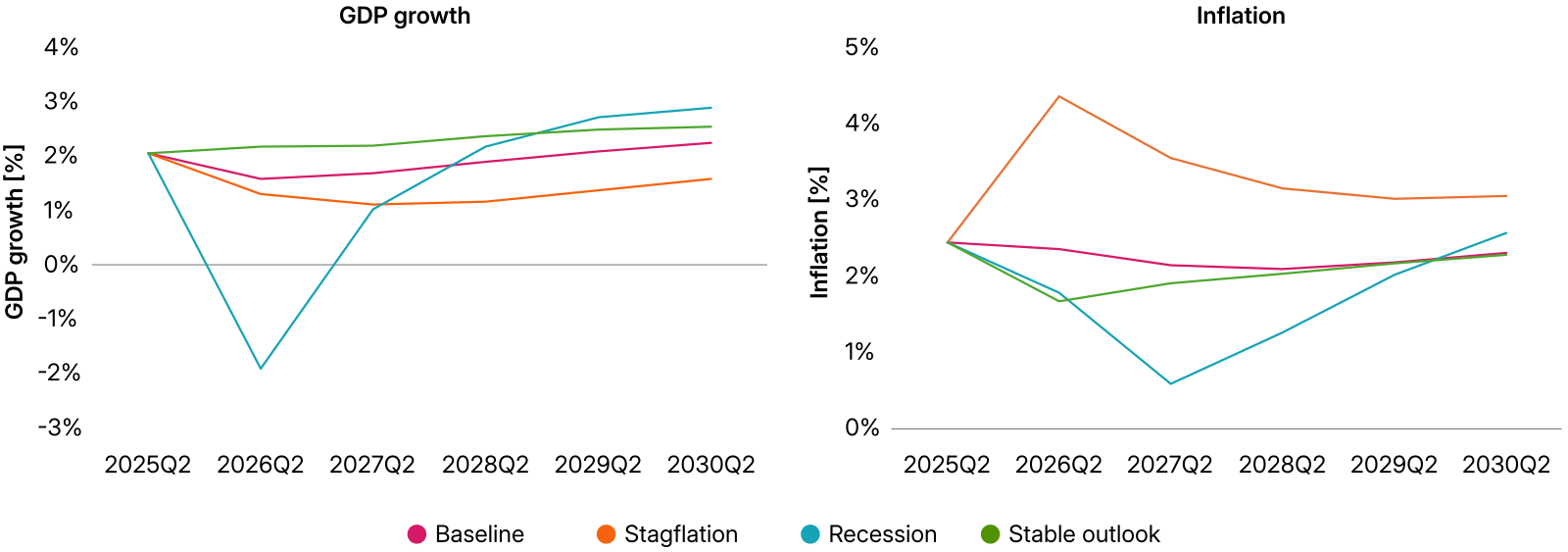
GDP and inflation paths were generated with the MSCI Macro-Finance Analyzer, using the MSCI baseline scenario as of June 30, 2025. These are not forecasts, but hypothetical narratives of different macroeconomic scenarios.
Impact on multi-asset-class portfolios
To assess the scenarios’ impact on multi-asset-class portfolios, we used MSCI’s predictive stress-testing framework and applied the shocks from the table below to a hypothetical global diversified portfolio, consisting of global equities, U.S. bonds and real estate.7
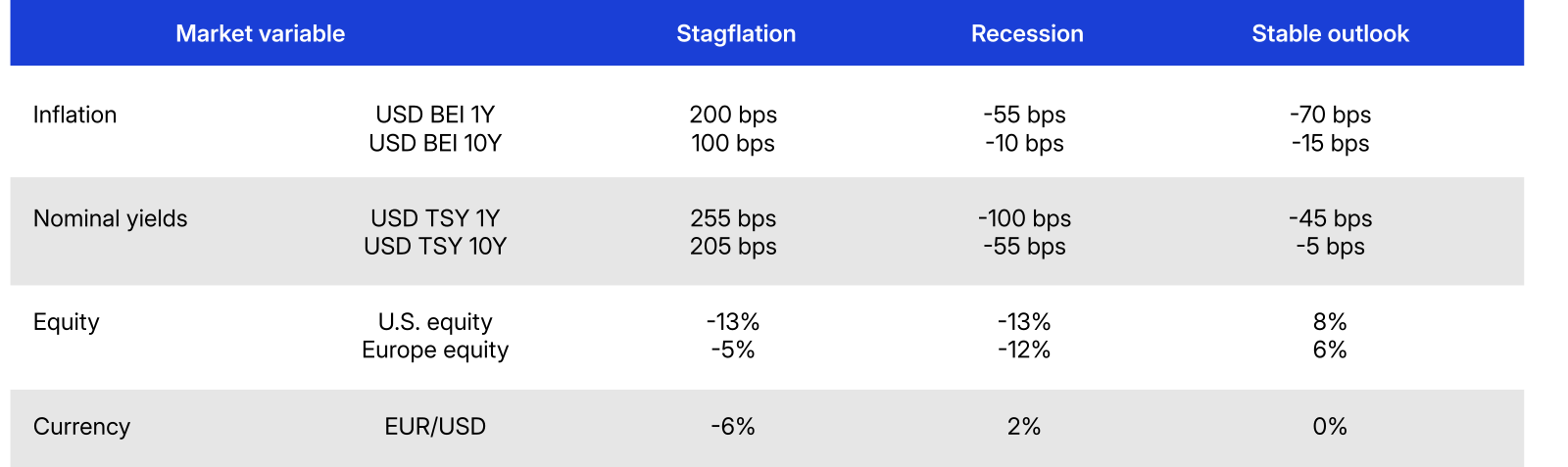
Assumptions about risk-factor shocks are informed by the MSCI Macro-Finance Analyzer and by analysis of historical data and judgment. Breakeven inflation (BEI) is measured in basis points (bps). This is not a forecast, but a hypothetical narrative of how the scenario could affect multi-asset-class portfolios.
Portfolio returns show that diversification depends on the macro regime. When inflation persists and policy credibility is questioned, bonds may no longer hedge equity risk, leading to the most severe losses, under stagflation: Equities and bonds sell off, and the portfolio falls by about 11%. In the recession scenario, the drawdown is materially smaller (5%) as declining yields allow bonds to offset equity losses. Under a stable outlook, the portfolio delivers a gain of 4%.
Portfolio impact of the scenario based on market data as of Dec. 19, 2025. Source: S&P Global Market Intelligence, MSCI
For investors, the key question is not only where inflation and growth will go — but whether the Fed can keep expectations anchored. A shift in credibility could alter cross-asset-class correlations and redefine portfolio risks in the year ahead.
The author thanks John Burke and William Baker for their contributions to this blog post.

Subscribe todayto have insights delivered to your inbox.
Scenario Analysis: How Could Soaring US Debt Impact Markets?
Soaring U.S. government debt could trigger market losses from rising yields or inflation from a politicized Federal Reserve, or gains with fiscal discipline.
Investment Trends in Focus: Key Themes for 2026
Markets are moving faster than ever. Explore the research revealing and analyzing the key forces that will shape markets in 2026 — and what these forces could mean for investors.
1 Claire Jones, Myles McCormick and Kate Duguid, “Federal Reserve Cuts Rates to 3-Year Low After Fractious Meeting,” Financial Times, Dec. 10, 2025.
2 Policy credibility can influence cross-asset correlations: When credibility is strong and inflation shocks are expected to mean-revert quickly, growth slowdowns are typically accompanied by falling yields, allowing bonds to hedge equity risk. When credibility weakens and inflation shocks are expected to persist, yields may rise even as growth slows, increasing the likelihood of positive equity-bond correlations and reducing diversification benefits. For a more detailed discussion, see: Peter Shepard, Chenlu Zhou, Will Baker and John Burke, “The MSCI Macro-Finance Model,” MSCI Model Insight, Oct. 21, 2024 (client access only).
3 Chris Giles, “The Mounting Challenges to Fed Independence,” Financial Times, Nov. 4, 2025.
4 In the MSCI Macro-Finance Model, central-bank credibility is calculated as a normalized linear combination of its components: inflation volatility and average deviation from the target. The bπ parameter, which governs the short-term persistence of inflation, is derived as a sigmoid function of the central bank credibility. Higher bπ values correspond to weaker credibility and slower mean reversion.
5 “Volcker disinflation” refers to aggressive U.S. monetary tightening under Fed Chair Paul Volcker in the late 1970s to early 1980s that broke entrenched inflation, at the cost of a severe recession.
6 GDP and inflation paths were generated with the MSCI Macro-Finance Analyzer using the MSCI baseline scenario as of June 30, 2025. These are not forecasts, but hypothetical narratives of different macroeconomic scenarios. You can find the scenarios here: stagflation, recession and stable outlook.
7 The results are generated by using model correlations to propagate shocks to the portfolios, using MSCI's BarraOne®. MSCI clients can download the correlated BarraOne stress test and RiskMetrics® RiskManager® stress test. Note that the above stress-test results capture the effect of repricing the assets, not the income component. Treasury inflation-protected securities (TIPS) are represented by the iBoxx TIPS Inflation-Linked Index provided by S&P Dow Jones Indices. U.S. Treasurys, equities and corporate bonds are represented by MSCI indexes. Private equity and private credit are represented by model portfolios. U.S. real estate is represented by the MSCI/PREA U.S. AFOE Quarterly Property Fund Index. The composite portfolio is 35% global public equities, 24% U.S. Treasurys, 2% TIPS, 12% U.S. investment-grade bonds, 2% U.S. high-yield bonds, 10% U.S. real estate and 15% global private assets (13% private equity and 2% private credit).
The content of this page is for informational purposes only and is intended for institutional professionals with the analytical resources and tools necessary to interpret any performance information. Nothing herein is intended to recommend any product, tool or service. For all references to laws, rules or regulations, please note that the information is provided “as is” and does not constitute legal advice or any binding interpretation. Any approach to comply with regulatory or policy initiatives should be discussed with your own legal counsel and/or the relevant competent authority, as needed.