
Physical Climate Risk and Corporate Bonds: Evidence from Hurricanes
- The bonds of issuers most exposed to hurricanes traded at wider residual spreads than those of their least-exposed peers, particularly in the USD high-yield market.
- Credit investors using asset-level geospatial data can better identify where physical climate risk is concentrated.
- The most exposed issuers experienced weaker profitability and bond performance following hurricanes, highlighting the potential cost of overlooking concentrated physical risk.
Mentioned in this blog post:
As extreme weather events become more frequent and severe, portfolio managers and risk allocators face a practical question: Do physical risks show up in bond pricing, and if so, how? Prior MSCI research found that firms with assets in hurricane paths experienced measurable stock underperformance. This analysis examines whether a similar pattern was observed in corporate bonds.
To assess the impact on bondholders, we extended our hurricane event study to the credit market, analyzing 29 Category 3 to Category 5 hurricanes from 2022 to 2024.1 Using MSCI GeoSpatial Asset Intelligence data,2 we examined how hurricanes affected corporate bonds across the USD and EUR investment-grade and high-yield markets.
At first glance, bonds issued by hurricane-impacted companies appeared to trade at tighter spreads than those of their unimpacted peers — a counterintuitive result. Two factors help explain this finding. First, larger, more diversified companies were disproportionately represented among impacted issuers during peak storm seasons. Second, a binary “impacted versus unimpacted” classification grouped together firms with vastly different exposures, ranging from 0.004% to 51% of assets located in hurricane-affected areas.
The signal became clearer when exposure concentration was taken into account.3 Ranking impacted issuers into deciles within each hurricane by the share of assets located in hurricane-affected areas showed that the most exposed companies faced higher borrowing costs than the least exposed. After controlling for credit quality, duration, liquidity and sector, bonds issued by companies in the most exposed decile (D10) carried residual credit spreads approximately 76 basis points wider than those in the least exposed decile (D1) in the USD high-yield market. The result remained statistically significant after correcting for multiple tests.4
The spread premium observed over a 35-business-day window around each storm suggests that bond investors may have been pricing the probability of hurricane-related losses into the cost of debt for materially exposed issuers. This cross-sectional premium was observed consistently across the 29 hurricanes in our sample when comparing the most and least exposed issuers. For investors, the implication is that physical risk was visible in spread data for issuers with the greatest asset-level exposure to hurricanes.
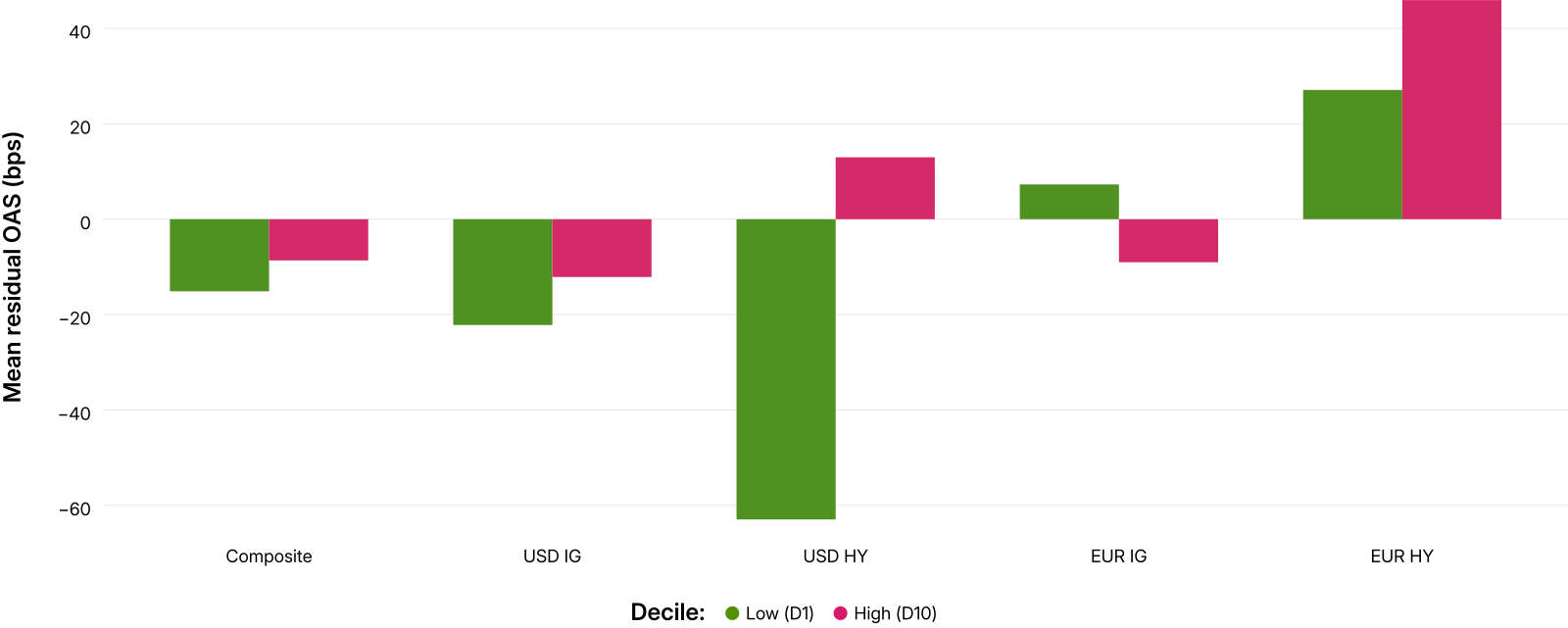
This chart shows the mean residual option-adjusted spread (OAS) — the portion of the spread remaining after controlling for sector, credit quality, duration and liquidity — by exposure deciles. Decile 1 (D1) contains issuers with the least exposure concentration, while Decile 10 (D10) contains those with the highest. In the composite portfolio, D10 issuers had between 0.9% and 51% of asset value exposed to hurricanes, while D1 issuers ranged from 0.0004% to 0.09%. Source: MSCI Sustainability and Climate Research. MSCI Sustainability & Climate products and services are provided by MSCI Solutions LLC in the United States and MSCI Solutions (UK) Limited in the United Kingdom and certain other related entities.
This finding is consistent with results from MSCI’s previous equity event study, which found that higher exposure concentrations were associated with greater financial impacts. In credit markets, the effect appeared as a spread premium concentrated in the USD high-yield market. The result is also consistent with prior evidence from credit markets suggesting that sustainability-related risks may not be fully captured by credit ratings alone. Physical climate risk may be another example.
The spread premium documented above raises a natural question: Why would hurricane exposure be associated with a higher cost of debt? Fundamental data offers a possible explanation. Return on assets (ROA) deteriorated markedly for the most physically exposed issuers after hurricane impacts, relative to the least exposed issuers. ROA remained broadly stable for the least exposed group throughout the observation period, while the most exposed group experienced a decline beginning in the first quarter after hurricane impact. The gap widened over time and remained statistically significant through six quarters after impact.
These results suggest that physical risk was associated with a measurable effect on profitability during the study period, even after sector-neutral controls and correcting for multiple tests.5
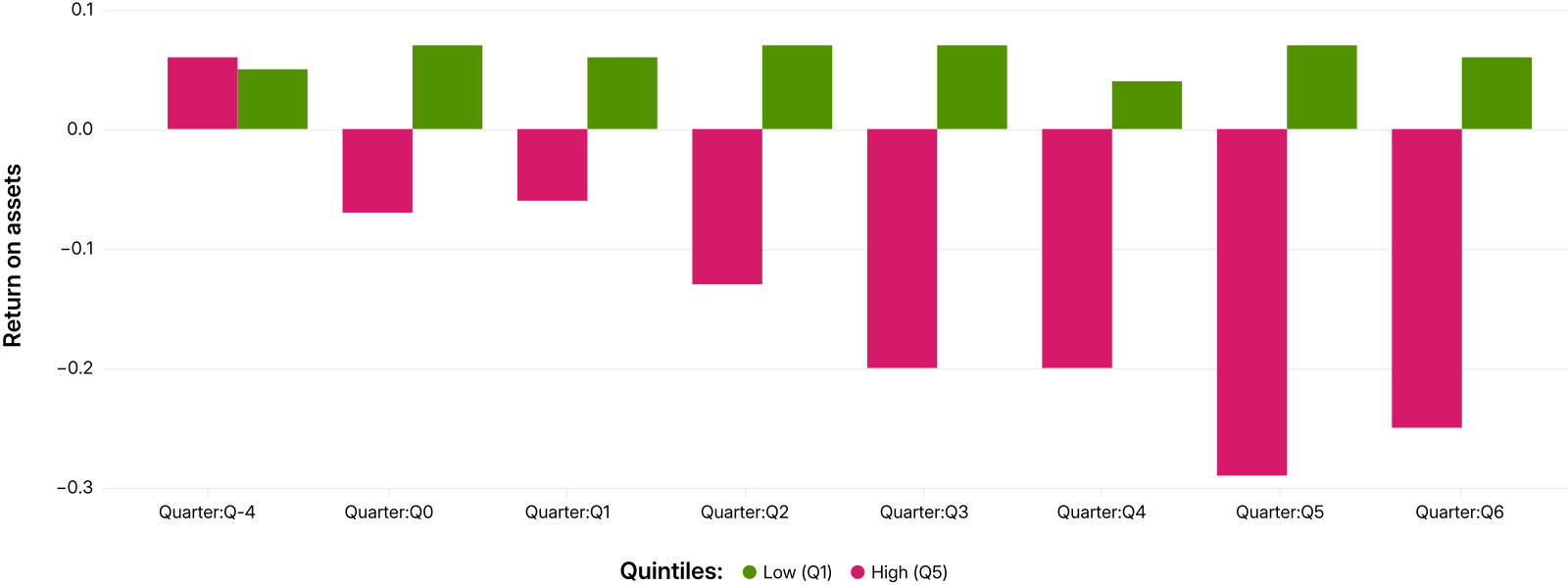
The bar chart shows the mean sector-neutral Z-scored return on assets (ROA) for the least exposed (Q1) and most exposed (Q5) quintiles from Q-4 (four quarters before hurricane) through Q6 (six quarters after hurricane). Beginning in Q0, the ROA gap between the highest- and lowest-exposure quintiles widened and became statistically significant after correction for multiple tests, reaching −0.12 at Q1 (p = 0.09*), −0.27 at Q3 (p = 0.005***) and 0.31 at Q6 (p = 0.024**). ROA for the least exposed issuers remained broadly stable at approximately 0.04 to 0.07 throughout, while ROA for the most exposed issuers declined steadily to −0.25 by Q6. We repeated the same analysis using deciles of damage-weighted hurricane exposure and found broadly consistent results, with statistically significant differences at Q3 and Q5. Quintiles are shown here because they allow for sector-neutral comparisons. Source: MSCI Sustainability & Climate Research
The aggregate pattern observed across 29 storms becomes clearer when examining individual storms with both high intensity and broad exposure footprints. Hurricane Milton, which reached Category 5 intensity and struck just two weeks after Hurricane Helene, provides a useful case study for examining the financial impact of a severe hurricane event.6
When bonds issued by companies impacted by Hurricane Milton were ranked by asset exposure, a clear divergence emerged. The most exposed issuers substantially underperformed the least exposed issuers over the 35-business-day event window.7
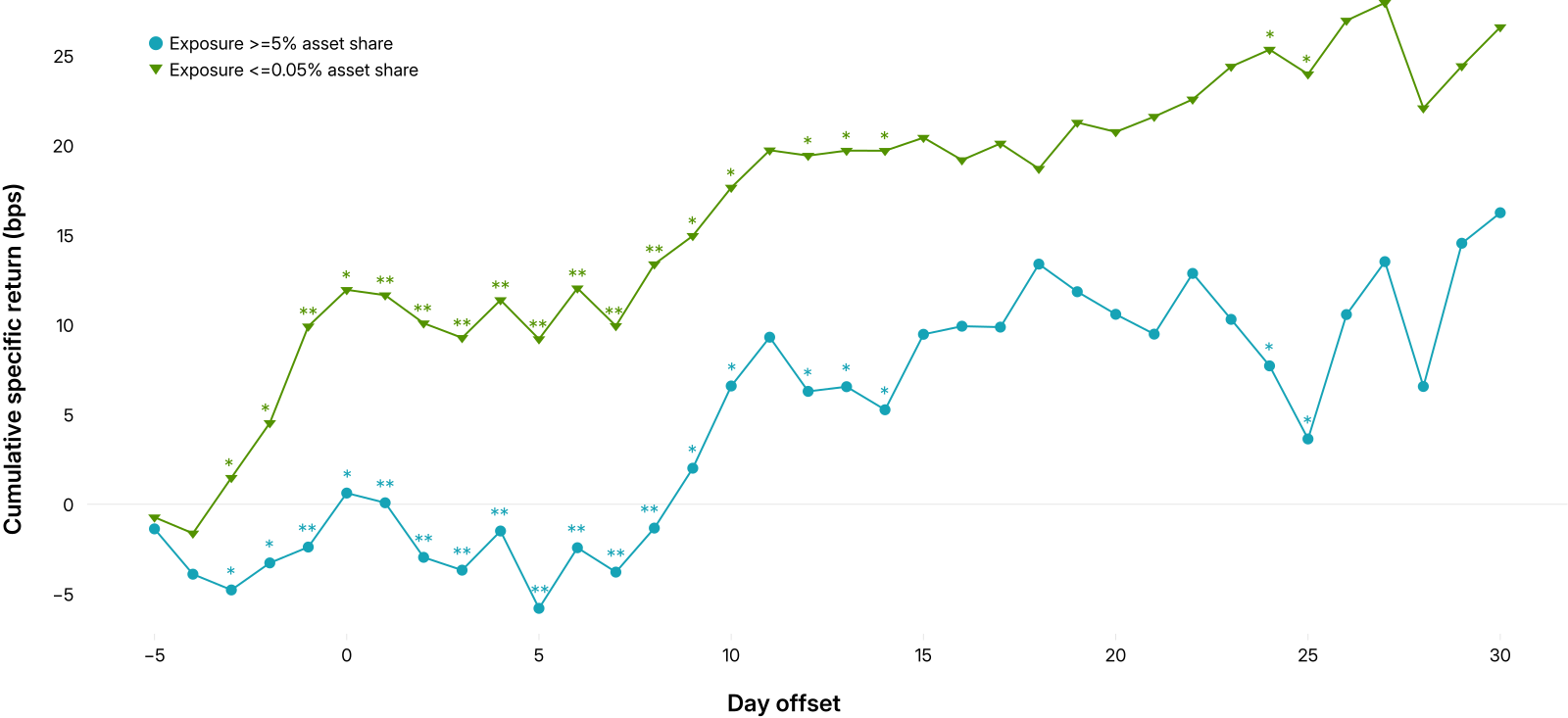
This chart shows the mean cumulative geometric specific return (in basis points) for highly exposed bonds (> 5% asset value exposed) and minimally exposed bonds (<0.05% asset value), measured from five business days before hurricane impact to 30 business days after. Specific returns are residual returns unexplained by the MSCI Multi-Asset Class Factor Model. Bonds of the least exposed issuers generated returns that were statistically higher than those of the most exposed companies. (** statistically significant at the 95% confidence level; * at the 90% confidence level; both indicate that highly exposed bonds differ meaningfully from the least exposed bonds.) Source: MSCI Sustainability & Climate Research
A closer look at individual issuers helps illustrate the relationship between exposure and performance. Duke Energy Florida (DEF) and Florida Power and Light (FPL) both had significant assets in Hurricane Milton’s path, with approximately 40% and 45% of assets exposed, respectively. However, when asset exposure was weighted by National Oceanic and Atmospheric Administration (NOAA) damage potential to reflect the exponential relationship between wind speed and structural damage, DEF’s effective exposure was materially higher than FPL’s. Consequently, DEF bonds showed marked underperformance relative to FPL bonds during the Hurricane Milton event window.
Taken together, these findings from the three-year study period — supported by both issuer fundamentals and bond-market outcomes — suggest that physical climate risk may already be reflected in credit spreads for materially exposed issuers.
For credit portfolio and risk managers, these findings have a direct practical implication: Asset-level geospatial data may help identify where physical climate risk is most concentrated and how it may be reflected in market pricing. Integrating these insights into risk oversight may involve:
- Mapping exposure using geospatial data to identify issuers with the highest concentration of physical assets and to then estimate the material share of revenue or output at risk.
- Monitoring spread signals during hurricane season by tracking spread differences between the most and least materially exposed issuers, which may provide an early indication of market pricing before any potential fundamental deterioration.
- Incorporating adaptation metrics by evaluating resilience indicators such as business-continuity plans, site redundancy and insurance coverage. Issuers with stronger physical-risk management may be less impacted.
- Adjusting allocations by rebalancing or applying hedges based on material exposure concentration, with particular attention to issuers where asset concentration in hurricane-prone regions is highest.
- Engaging at-risk issuers using physical-risk data to engage more strategically with materially exposed issuers on adaptation planning and not just disclosure.
For investors with access to detailed asset-level data, the effects of physical climate risk may already be observable in credit spreads.


Subscribe todayto have insights delivered to your inbox.
Anticipating Hurricane Risk Before It Strikes
What if investors could see hurricane risk before it strikes? Asset-level insights reveal vulnerabilities, enabling smarter engagement, hedging and adaptation to safeguard portfolio performance.
Is Physical Risk Financially Material?
Using MSCI GeoSpatial Asset Intelligence, we linked hurricane exposure to persistent underperformance and rising tail risk, providing direct evidence of climate hazards’ material impact on valuations.
1 A hurricane was included in this analysis if its path intersected assets belonging to at least 10 companies with bonds in the USD and EUR investment-grade and high-yield markets.
2 The MSCI GeoSpatial Asset Intelligence dataset covers more than four million asset locations across over 780,000 companies as of April 2026.
3 Exposure concentration is measured as the percentage of a company’s asset value exposed to hurricanes, weighted by the damage potential of the wind speed at each asset location. Damage potentials are derived from the National Oceanic and Atmospheric Administration (NOAA) and reflect expected structural and economic damage. This rises exponentially with wind speed.
4 Residual option-adjusted spread (OAS) is estimated from a cross-sectional regression of OAS on bond-level credit quality, Macaulay duration, 30-day bid-ask spread (as a liquidity proxy) and sector fixed effects. Statistical significance reported uses the Benjamini-Hochberg false-discovery rate (FDR) correction. The spread difference between the most and least exposed issuers is statistically significant at the 90% confidence level.
5 Statistical significance reported uses Benjamini-Hochberg FDR correction.
6 Hurricane Milton reached Category 5 intensity over the Gulf of Mexico before making landfall near Siesta Key, Florida, on Oct. 9, 2024, as a Category 3 storm with winds up to 120 mph. It was one of the strongest Atlantic hurricanes on record, fueled by record-breaking Gulf of Mexico sea temperatures.
7 Performance is measured using specific returns. Specific return is derived from the MSCI Multi-Asset Class (MAC) Factor Model, which decomposes each bond’s total return into systematic factor components and a residual component. The systematic factors include key-rate-duration exposures across the yield curve, credit-spread duration, sector and industry, country and currency, liquidity and convexity. The specific return, sometimes referred to as the idiosyncratic or residual return, is the portion of daily bond performance that remains after removing all estimated factor contributions. It captures return variation associated with issuer-specific events rather than broad market or sector movements. In this study, we compound daily specific returns geometrically over the event window and expressed the result in basis points. Because the factor model controls for sector- and market-level credit-spread movements, specific return constitutes a stricter test than changes in OAS.
The content of this page is for informational purposes only and is intended for institutional professionals with the analytical resources and tools necessary to interpret any performance information. Nothing herein is intended to recommend any product, tool or service. For all references to laws, rules or regulations, please note that the information is provided “as is” and does not constitute legal advice or any binding interpretation. Any approach to comply with regulatory or policy initiatives should be discussed with your own legal counsel and/or the relevant competent authority, as needed.