
Scenario Analysis: What Could a US Tech Correction Look Like?
- Rapid growth in AI-related capital expenditure and elevated U.S. tech valuations are fueling market-concentration risks — a dynamic reminiscent of the dot-com era.
- Using the MSCI Multi-Asset Class Factor Model, we assess the impact for equity portfolio and risk managers of a scenario where a loss of confidence in meeting high AI growth expectations could trigger a tech-led sell-off.
- Within our stress test, global semiconductors and other cyclical industries lost up to 63%, while defensives gained up to 12%.
The recent surge in AI capital expenditure and elevated U.S. tech valuations often draw comparisons to the dot-com era.1 With the information-technology and communication-services sectors now at record weights within the MSCI USA Index, and their price-to-earnings (PE) ratio well above the historical average, investors face renewed exposure to a narrow set of market drivers.2 Unlike their dot-com-era counterparts, today’s market leaders combine profitability with high margins, but their elevated growth expectations leave them vulnerable to a loss of confidence if investors start doubting the sustainability of the AI-driven growth narrative. Our stress test applies a shock to U.S. semiconductors to capture their sensitivity to a tech-led correction. Under this scenario, global semiconductors underperform the broader equity market by about 45%, while defensive segments such as consumer staples, utilities and health care remain comparatively resilient.
History has shown how market concentration can unwind sharply. Between March 2000 and September 2002, the U.S. IT and communication-services sectors fell nearly 80% when sentiment reversed, compared with 22% for the rest of the market. U.S. financials collapsed by a similar magnitude during the 2008 global financial crisis, while nonfinancials fell 42% between May 2007 and February 2009.
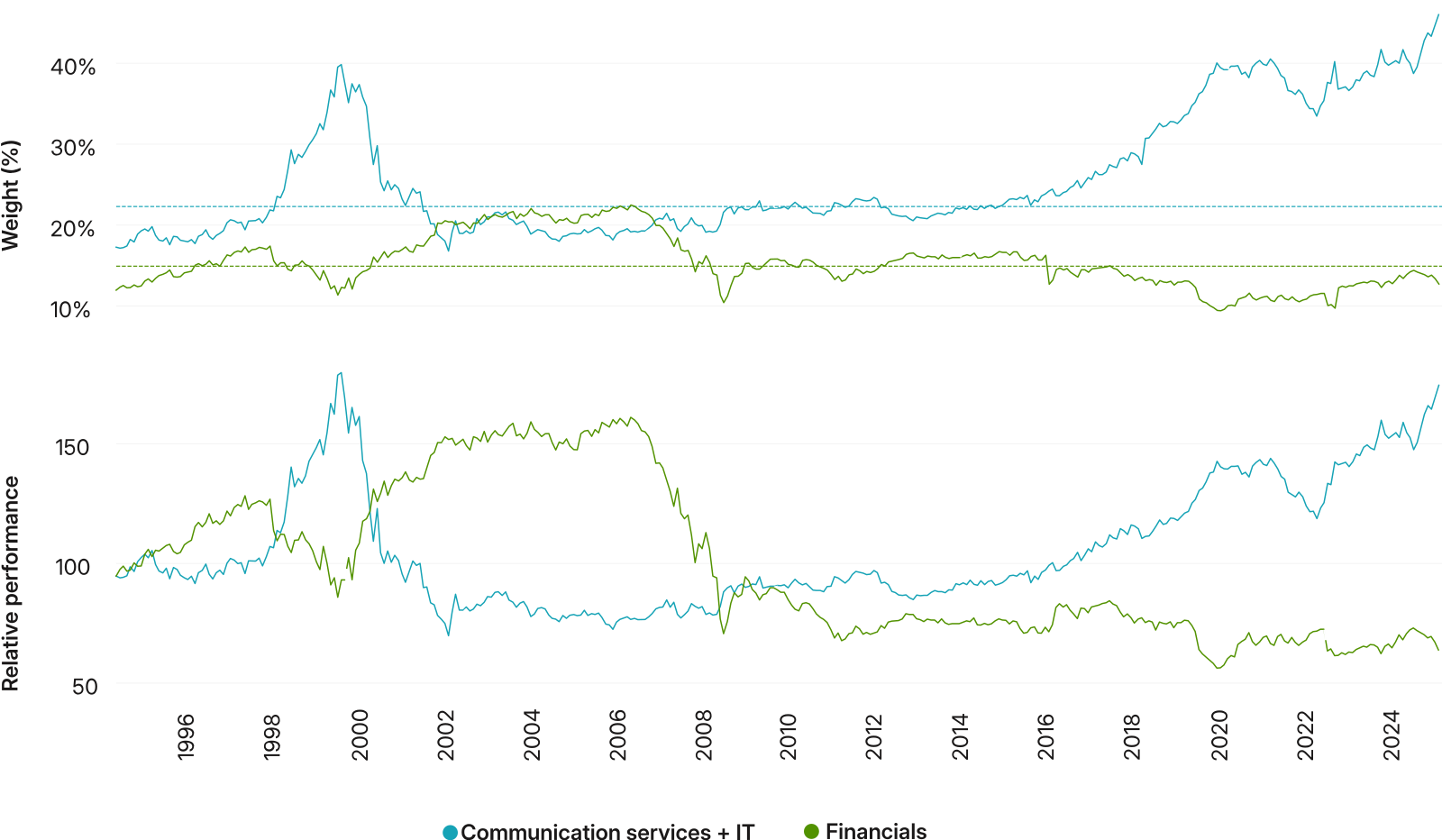
Top panel: Weight in MSCI USA Index of the combined information-technology and communication-services sectors and of financials; median monthly weight over the 30-year horizon marked by the dashed line. Bottom panel: Sectors’ relative performance to the MSCI USA Index. Performance was based at 100 on June 30, 1994.
Unlike their dot-com predecessors, today’s leaders are characterized by sustained profitability and strong margins, giving them potentially more resilience against a correction. Yet they also display higher sensitivity to market swings — as their beta exposure is higher — and elevated growth expectations can still be repriced.3
In the scenario, we wish to apply the sharpest shock to U.S. semiconductors, reflecting their high valuations. Growth stocks are also re-rated downward as expectations normalize, while quality companies with prudent capital management should provide some offset. We translate this narrative into stress-test factor shocks: The U.S. country factor captures the broad market move, and the semiconductor factor adds a steeper, sector-specific sell-off on top. The modeled growth and management-quality factor shocks reflect the intended shift in investor preferences — penalizing high-growth stocks and favoring firms with stronger capital discipline.4 We propagate these shocks using the MSCI Multi-Asset Class (MAC) Factor Model’s correlations.
Assumptions about risk-factor shocks are informed by historical analysis and judgment.
When applying the stress test to a portfolio of global equities represented by the MSCI ACWI Index, we see semiconductors declining the most, underperforming the market by 44%. Automobiles also fall by 36%, driven by a few constituents with sharp sell-offs rather than general underperformance of the industry. In contrast, defensives — telecom, consumer staples and health care — outperformed in the stress test, as intuitively investors would rotate toward stability.5
The transmission of shocks across factors varies by industries. For semiconductors, losses were broad-based, with market, industry and style factors all contributing heavily to the drawdown. In contrast, defensive industries such as household products and beverages benefited from positive beta and style effects, which more than offset the drag from the overall market move.
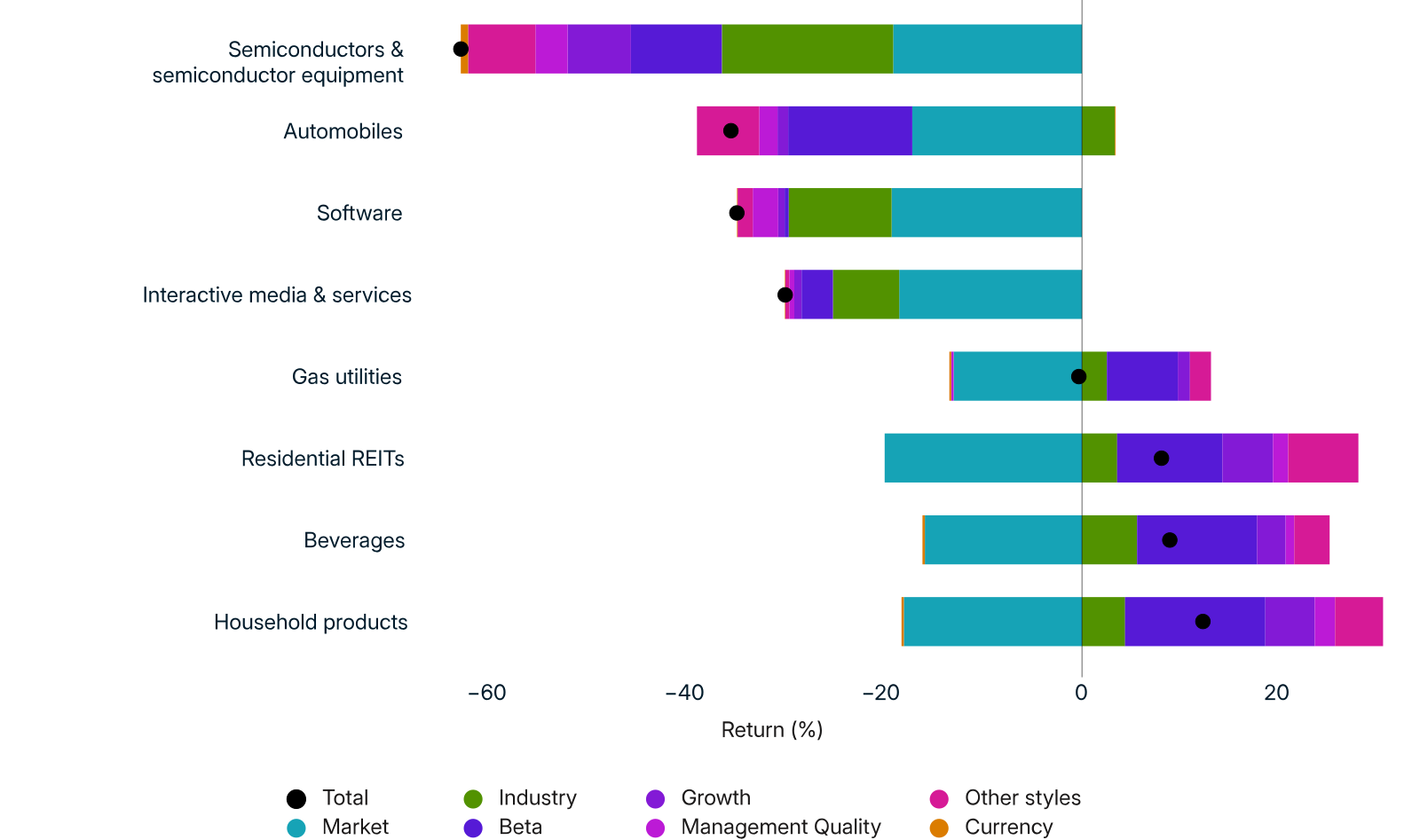
Factor P&L decomposition of select ACWI industries using the MAC.S model. As of Oct. 30, 2025.
We also examined how including a shock on growth and management quality complemented a stress test set up with only broad-market and industry shocks. The additional shocks lifted GICS industries in defensive sectors like consumer staples, compared to the base case, and intensified losses among cyclical industries such as semiconductors and automobiles.
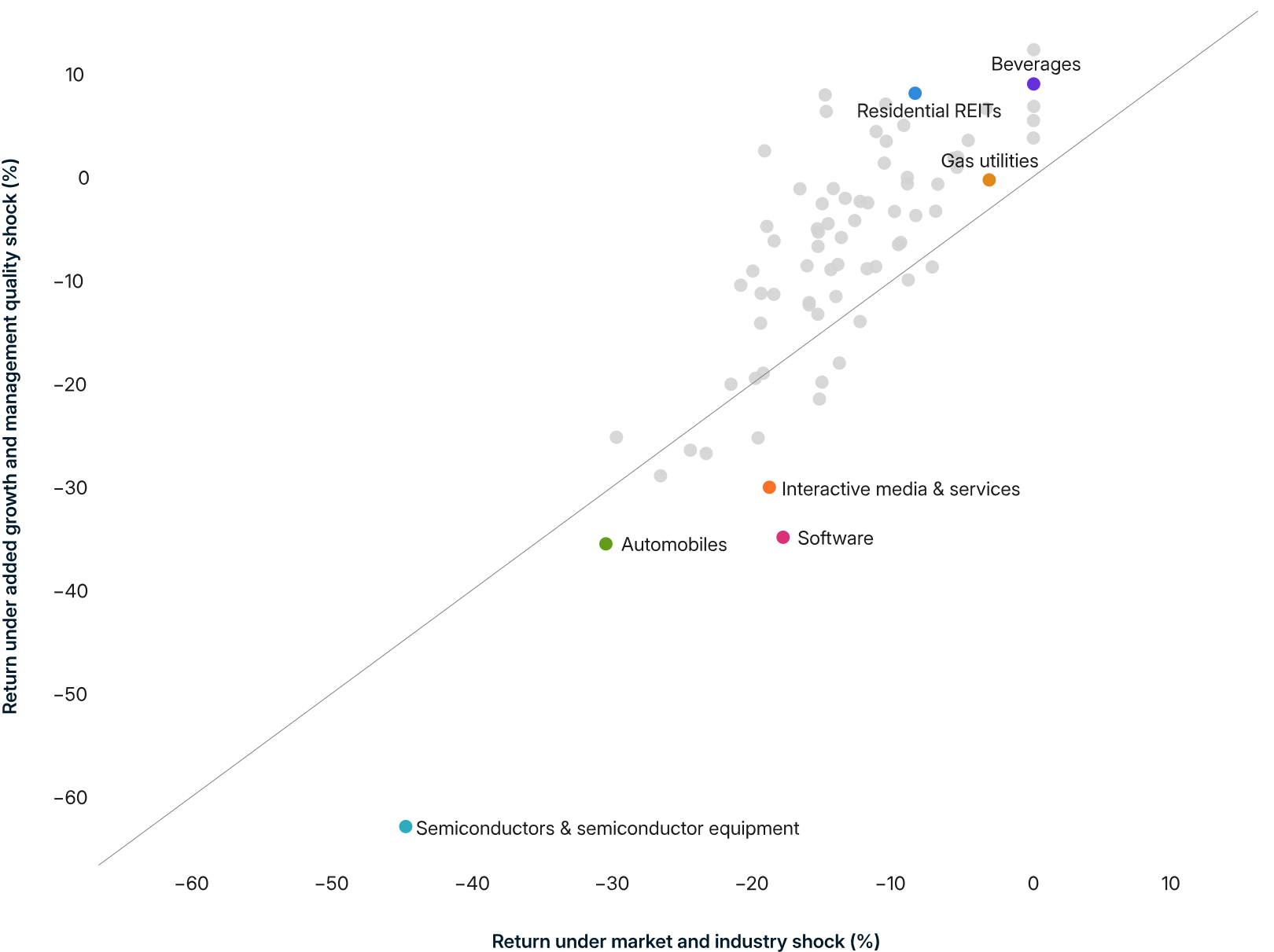
Impact on GICS industries of MSCI ACWI Index in USD as of Oct. 30, 2025, using the MAC.S model.
Despite having stronger fundamentals than during the 1990s dot-com bubble, today’s tech firms remain exposed to valuation-driven corrections. For investors, this highlights the importance of reviewing portfolio concentration and exposure to high-growth sectors. The scenario analysis showed how a tech-driven sell-off could ripple through industry and style factors globally, suggesting which segments could bear the largest losses and which might benefit from such a rotation — emphasizing the potential benefits of diversification.


Subscribe todayto have insights delivered to your inbox.
A Historical Look at Market Downturns to Inform Scenario Analysis
When investors assess risk, they construct narratives around the data. Investment managers and asset allocators can look to the long history of market sell-offs for context, to better anticipate future drawdowns and prepare portfolios for what the future may hold.
Markets in Focus: DeepSeek Shakes up AI and Investment Quality Prevails
U.S. markets declined in the first quarter amid souring consumer sentiment, inflation and tariff headlines and disruption from China’s low-cost DeepSeek model. We explore global markets responses to trade tensions and why investment quality may be a pivotal risk factor in the AI race.
1 Ian Harnett, “The AI capex endgame is approaching,” Financial Times, October 3, 2025.
2 Sectors defined by the Global Industry Classification Standard, or GICS®, which is the industry-classification standard jointly developed by MSCI and S&P Dow Jones Indices. The current price-to-earnings ratio of the combined IT and communication-services index is 43 — well above the 30-year average of 30.
3 Based on the USSLOW factor model’s U.S. profitability and U.S. beta factor exposures of the combined IT and communication-services sectors in the MSCI USA Index during the dot-com bubble and today.
4 The U.S. country shock of -20% is the average for fundamental event types based on our analysis of historical drawdowns in the U.S. We added a similar-magnitude shock to U.S. semiconductors on top of the market shock. The shocks to style factors were calibrated using patterns from the September 2000–April 2001 market drawdown, when the growth factor declined by about 8%, or roughly 3 sigmas. Given today’s lower growth-factor volatility, a comparable 3-sigma move would correspond to a 6% shock. We also applied a +3-sigma (4%) shock to management quality.
5 The results are generated by using model correlations to propagate shocks, using MSCI's BarraOne®. MSCI clients can download the correlated BarraOne stress test.
The content of this page is for informational purposes only and is intended for institutional professionals with the analytical resources and tools necessary to interpret any performance information. Nothing herein is intended to recommend any product, tool or service. For all references to laws, rules or regulations, please note that the information is provided “as is” and does not constitute legal advice or any binding interpretation. Any approach to comply with regulatory or policy initiatives should be discussed with your own legal counsel and/or the relevant competent authority, as needed.