
Time in the Markets Beats Timing the Markets
- Staying invested through market shocks has historically rewarded clients — but overcoming the behavioral impulse to sell remains one of wealth management's persistent challenges.
- The total-portfolio approach helps wealth managers reframe the conversation: By segmenting a client's portfolio into goal-based sleeves, short-term volatility becomes easier to weather.
- Sector-level analysis across 10 geopolitical events shows that a well-diversified portfolio almost always has sleeves that are holding up, giving wealth managers the evidence to keep clients invested.
As events unfold in the Middle East, investors are focused on ensuring their portfolios are positioned appropriately. For some, this presents an opportunity; for others, the challenge is simply staying invested and resisting the urge to withdraw their funds.
The long history of the U.S. equity market, proxied by the MSCI USA Index, illustrates the benefit of staying invested through market turmoil: USD 1,000 invested in December 1969 grew to over USD 65,000 by February 2026 — but only for those who stayed the course. Investors who instead attempt to time the market — trying to buy low and sell high — typically reduce their investment returns instead.1 Most returns come from just a few days of outsized gains; missing the best 10 could halve an investor's return.2 Wealth managers therefore strive to keep clients in the market through any shock.
Returns of the MSCI USA Index from December 1969 to December 2025. The chart uses a log scale to better illustrate the consistency of long-run growth. On this scale, a straight line represents constant growth, underlining how consistently the market has compounded over 50+ years, despite repeated shocks. Hovering over each event shows the maximum drawdown as well as recovery time for each.
The largest shocks were the OPEC oil embargo (1973), bursting of the dot-com bubble (2000) and the 2008 global financial crisis (GFC). The market took more than six years to recover from the OPEC embargo, and about four years to recover from both the dot-com bust and the GFC. The longest recovery (74 months after the 1973-74 stagflation crash) and the shortest (just two months after the COVID-19 crash) both ended the same way: with the market reaching new highs and rewarding those who stayed invested.
Keep your mind off your money and your money off your mind
Wealth managers face a dual behavioral challenge: keeping clients invested during drawdowns and steering them away from meme stocks when markets rally. This asymmetry is at the heart of prospect theory — which holds that investors weigh losses roughly twice as heavily as equivalent gains.3
One of the simplest ways to reduce this impulse is to limit the frequency of portfolio reviews — quarterly check-ins, for example, naturally limit the moments at which a client might act on a loss.
But geopolitical shocks make this difficult. When market drawdowns become front-page news, clients don't wait for their next scheduled review — they call their adviser, or rebalance themselves.
When the market is talking loud and saying nothing
This is where using a total-portfolio approach (TPA) can help: By managing all of a client's assets as a single portfolio aligned to their goals, TPA reframes allocation decisions away from short-term performance by focusing on what a client needs their money to do, and by when.
This goal-first lens helps counter the impulse to sell during drawdowns — anchoring each allocation decision to the client's long-term goals, and steering the conversation toward portfolio resilience and growth rather than individual positions. TPA also draws on the behavioral-finance theory of mental accounting, where investors tend to divide their portfolio into several sleeves, each with their own risk and return profile, such as “retirement,” “vacation” or “emergency fund.”
Using the TPA framework means that short-term, essential sleeves are invested in lower-volatility assets, which may remain relatively stable; longer-term sleeves may fall, but clients know they won't need that money for years. A six-year market recovery feels less alarming when it's happening in a bucket earmarked for 20 years' time — making it easier to stay invested rather than withdraw.
Less money, mo’ problems
TPA also draws on another behavioral-finance concept: framing — the idea that how information is presented can impact how people respond to it. In contrast, the rational-investor theory states that investors are only concerned with their final wealth, not how much might have been gained or lost along the way.
The first chart is an example of temporal framing, showing that a short-term drop is much smaller than the gains achieved over a longer period.
During a drawdown, a well-diversified portfolio is likely to have sleeves that are performing well. Highlighting these is another example of framing. Focusing the client's attention on what is working, rather than what isn't, helps minimize the emotional impact of losses and makes it easier to stay invested throughout the portfolio.
We can apply the TPA framework for sector investors by looking at the performance of MSCI sectors for the more recent events shown in the chart.4 We determine the sector-level drawdowns and compare them to the broad market. In addition, we show the returns of the best-performing sector during that same period. The best- and worst-performing sectors are shown as bars, while the return of the broad index is represented by a red circle.
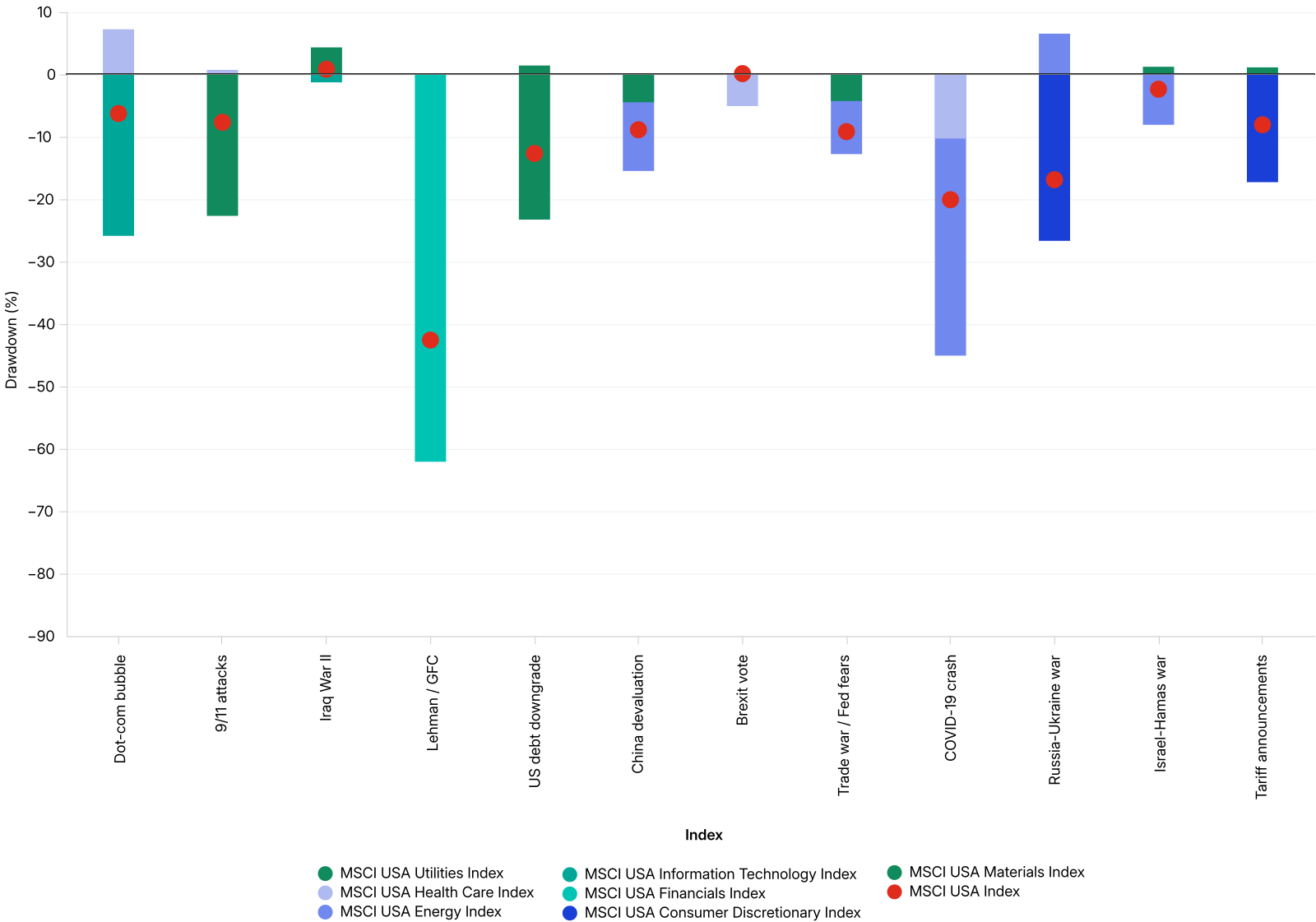
Data from December 1998. Drawdown is calculated using the lowest value reached in the six-month period following each event.
Different sectors were affected differently by each shock, and in some cases, sectors gained as the broad market fell. By looking beyond the top-level return of the portfolio and showing that a portfolio may still contain gains despite a drawdown, wealth managers may be better able to convince their clients who may be better off staying the course to do so.
In our sector-level analysis for example, when the dot-com bubble burst, information-technology stocks lost almost 26%, but health-care stocks gained 7%. Following Russia's invasion of Ukraine in 2022, consumer-discretionary stocks lost 27%, but energy stocks gained 6.5%. During both the downgrade in U.S. debt, as well as the tariffs announced in April 2025, utilities gained as the broad market was falling. The debt downgrade impacted the materials sector the most, while tariff announcements impacted consumer discretionary the most, reflecting the expected impact on consumer spending.
Even in situations where there are no winners, such as after the COVID-19 shock in 2020, showing the impact of those sectors that lost less than the portfolio average can help mitigate the impulse to sell.
Started at the bottom (of the market)
The data tells a clear story: Market shocks hit different sectors at different times. Technology bore the brunt of the dot-com crash; financials took the hardest hit during the GFC. Energy suffered through the U.S.-China trade war and COVID, then surged on the back of the Russia-Ukraine war in 2022.
No single sector has been consistently vulnerable — which is precisely the case for diversification. Showing clients this history makes it tangible: A well-diversified portfolio has historically provided a durable defense against geopolitical events.
TPA gives wealth managers the framework to bring this all together: keeping clients focused on their goals, reducing the impulse to sell when it’s unwarranted and guiding them through the unexpected. Staying invested paid off.

Subscribe todayto have insights delivered to your inbox.
Sector Indexes
MSCI's Sector Indexes are designed to help investors identify companies based on sector traits, while also offering a diversified opportunity set and supporting the expression of allocation views.
Earning a Place in the Portfolio: Using Implied Returns in TPA Decisions
Learn how implied returns enable asset owners to align teams, compare opportunities and make confident, data-driven capital-allocation decisions.
Investment Trends in Focus: Are Investors Uneasy Enough?
Geopolitics, AI disruption and private credit stress converge. Ashley Lester and Axel Kilian explore what investors should be asking right now.
1 Geoffrey C. Friesen and Travis R.A. Sapp, “Mutual Fund Flows and Investor Returns: An Empirical Analysis of Fund Investor Timing Ability,” Journal of Banking & Finance 31, no. 9 (2007). “Quantitative Analysis of Investor Behavior,” DALBAR, April 10, 2026.
2 “Timing the Market is Impossible,” Hartford Funds, 2026.
3 “Prospect Theory Explained: How It Influences Investment Decisions,” Investopedia, April 2026.
4 GICS sector information was first published in 1998, so we are including only the geopolitical events that occurred since then in this analysis. GICS is the industry-classification standard jointly developed by MSCI and S&P Dow Jones Indices.
The content of this page is for informational purposes only and is intended for institutional professionals with the analytical resources and tools necessary to interpret any performance information. Nothing herein is intended to recommend any product, tool or service. For all references to laws, rules or regulations, please note that the information is provided “as is” and does not constitute legal advice or any binding interpretation. Any approach to comply with regulatory or policy initiatives should be discussed with your own legal counsel and/or the relevant competent authority, as needed.