
What a Recent Working Paper Gets Wrong About MSCI ESG Ratings
MSCI’s ESG Ratings are designed for one purpose: to measure a company’s resilience to financially material environmental, social and governance risks.
A recent working paper by four academic researchers contends that MSCI uses an internal committee process to override model-driven ratings changes, hypothesizing that we do so to align with competitors’ ratings and to suppress changes that would trigger rebalancing costs for investors.1
We reject these claims, which rest on an incomplete reconstruction of our methodology and misconstrue both our process and our incentives. Here are the facts.
The authors could not accurately reconstruct our scores.
The paper claims to reverse-engineer our methodology to identify scores modified by internal committee review. The authors, however, were unable to fully replicate our scoring parameters for the study period (2014–2022), in part because those parameters can change during the year and because we published a methodology update in 2020 that the authors do not account for.
We do not align our ratings with competitors’ ratings.
Our analysts do not have access to competitor ESG scores and therefore cannot use them. Our competitive advantage lies in the distinctiveness of our methodology, namely a financial-materiality focus, industry-relative scoring and significant weight on risk exposure. Peer-reviewed research, including by one of the working paper’s co-authors, has found that MSCI exhibits among the lowest correlations with other ESG raters.2
Our score distribution contradicts the paper’s thesis.
The authors point to “bunching” of companies near letter-rating thresholds as evidence. The current distribution of MSCI ESG Ratings across roughly 9,000 issuers is relatively smooth and continuous, with no systematic bunching near rating thresholds — the very test the authors say would indicate the absence of a committee effect. Where historical patterns occurred, we identified them through ongoing monitoring and addressed them through published methodology updates.
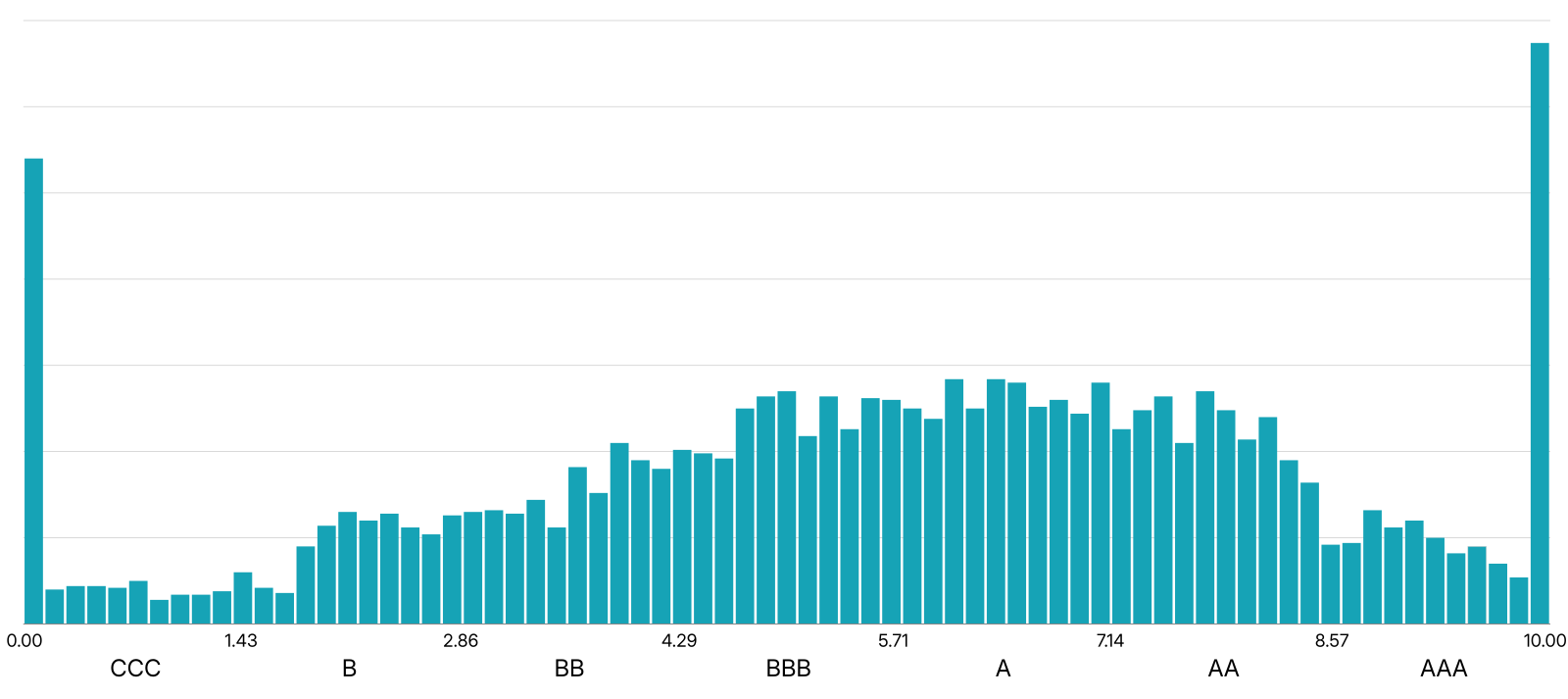
Distribution of Industry-Adjusted ESG Scores, n=9,052 issuers. The spikes at 0.0 and 10.0 are a mechanical feature of the IAS scale — a documented and expected consequence of the benchmarking methodology’s floor and ceiling truncation. Source: MSCI Sustainability & Climate Research, April 2026.
Our process is transparent and rules based.
The committee reviews ratings changes from our model only in limited, defined instances. We disclose any committee adjustments and make pre-adjustment scores available to clients. MSCI ESG Ratings rely solely on publicly available information. At least 25% of our ESG ratings change annually, a pace inconsistent with the allegation of systematic suppression.
MSCI’s ESG Ratings process is designed to support the integrity of our ratings. What the authors observe as a “traffic light effect” reflects well-established procedures that we document, disclose and continuously refine. Our complete process and methodology documents are available here.
Subscribe todayto have insights delivered to your inbox.
MSCI Sustainability and Climate Methodologies
Our methodology documents describe the calculations, data inputs and processes followed by MSCI Research.
Resources for Issuers
A library of helpful resources and quick links, including to our issuer communications portal for information on your company’s ESG Ratings report and data.
ESG Ratings
Measure companies’ exposure to financially relevant, industry-specific environmental, social and governance risks.
1 “The Traffic Light Effect in ESG Ratings,” Florian Berg, Jess Cornagia, Cristian Foroni and Francesco Tripoli, Working Paper 26-072, Harvard Business School, 2026.
2 “Aggregate Confusion: The Divergence of ESG Ratings,” Florian Berg, Julian F Kölbel, and Roberto Rigobon, Review of Finance, Volume 26, Issue 6, November 2022.
The content of this page is for informational purposes only and is intended for institutional professionals with the analytical resources and tools necessary to interpret any performance information. Nothing herein is intended to recommend any product, tool or service. For all references to laws, rules or regulations, please note that the information is provided “as is” and does not constitute legal advice or any binding interpretation. Any approach to comply with regulatory or policy initiatives should be discussed with your own legal counsel and/or the relevant competent authority, as needed.