
Analyzing Freight Traffic’s Impact on Logistics Asset Pricing
Understanding how the flow of goods influences real-estate performance is increasingly relevant to investors in logistics real estate, amid raised uncertainty around global trade and tariffs. Analyzing approximately 5,000 logistics-property transactions across Germany, the Netherlands and U.K., we explored whether freight-handling volume has correlated with transaction pricing.1
Positive relationships between freight volume and pricing are more apparent in particular markets. Higher freight volumes in the Netherlands were linked to stronger transaction prices; this relationship was even more pronounced in the U.K. These country-level relationships can weaken at the metro level, however. Germany illustrates this divergence well: Properties exposed to over 20 million tonnes of freight volumes over three years saw a positive pricing effect, while those below that threshold did not.
Freight volume can help explain the pricing of logistics real estate, but its influence varies. National averages mask market nuance, and investors and stakeholders would be well served to use a local lens.
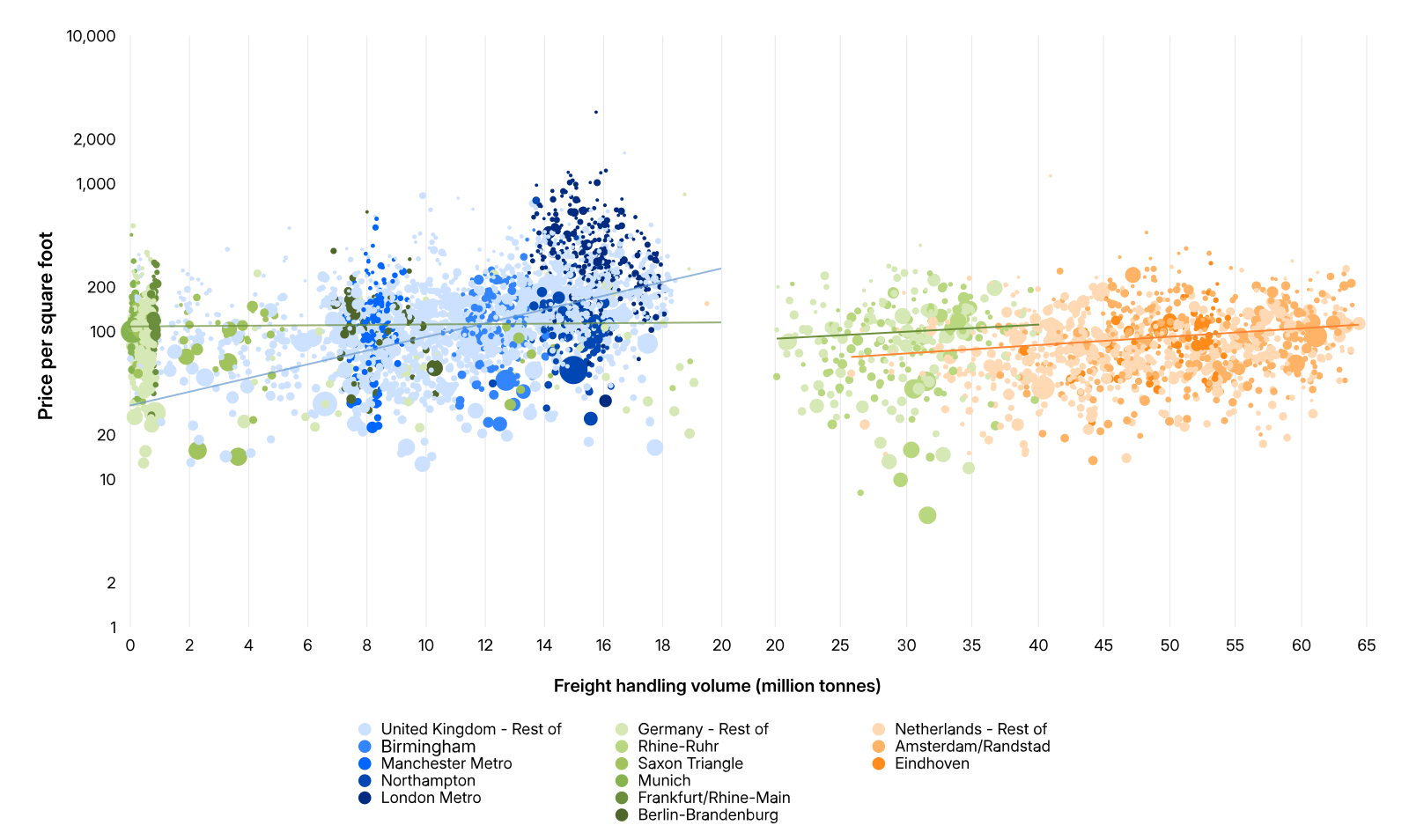
Each line represents a simple linear regression using freight-handling volume to explain pricing for a specific country. Different shades of the same color represent the largest metro areas within that country, with the remainder collected in a “Rest of” category. Freight-handling volume refers to the tonnes passing through freight-handling locations within a four-hour driving window of that asset, over a three-year period prior to the asset’s transaction date, weighted by drive time. Source: Kania Advisors, MSCI
The author thanks Will Robson for his contribution to this quick take.

Subscribe todayto have insights delivered to your inbox.
Greater Divergence of Returns in Infrastructure than Real Estate
Sector-based allocation decisions in infrastructure could have a substantially greater impact on portfolio returns than allocation choices in real estate.
The Office-Market Recovery Is Here, Just Not Everywhere
Office markets are showing early signs of recovery, but the rebound won’t be uniform. Success now hinges on identifying assets that meet post-pandemic tenant and investor demand.
Game-changing data for investing in commercial real estate
Get game-changing data, analytics and research on global commercial real estate and infrastructure to help inform your investment decisions.
1 Most properties in the U.K. are in locations exposed to freight-handling volume of less than 20 million tonnes over three years, because freight moving through U.K. ports is generally traveling only to or from the U.K. In Germany and the Netherlands, by contrast, many assets are in locations exposed to higher volumes, since their ports also serve as gateways for freight to and from other European countries.
The content of this page is for informational purposes only and is intended for institutional professionals with the analytical resources and tools necessary to interpret any performance information. Nothing herein is intended to recommend any product, tool or service. For all references to laws, rules or regulations, please note that the information is provided “as is” and does not constitute legal advice or any binding interpretation. Any approach to comply with regulatory or policy initiatives should be discussed with your own legal counsel and/or the relevant competent authority, as needed.