
Crossing the Buyout Value Bridge as Valuations Wobble
Amid shifting macro conditions over the past decade, the buyout value-creation playbook at exit has cycled through three distinct regimes, requiring close attention from limited and general partners (LPs, GPs).
In 2015-2019 exit years, in pooled terms,1 buyout GPs turned every dollar of invested capital into 2.58x of total-value-to-paid-in (total value) at exit.2 After accounting for the 1x invested capital, two levers contributed almost evenly to the remaining 1.58x of incremental gain: a 1.02x boost from revenue growth and a 0.95x lift from EBITDA-multiple expansion, as shown in the chart.
By 2020-2021, the math skewed sharply, with one lever powering most of the uplift. Roughly two-thirds of the 2.30x incremental gain came from multiple expansion alone, underscoring the elevated exit-market valuations during the period.
As 2022 ushered in higher rates, the drivers of value shifted again. In 2022-2025, amid a higher cost of capital and relatively compressed exit-market multiples, revenue growth emerged as the main source of value creation, accounting for about two thirds of the 2.15x incremental value.
Why should LPs and GPs care?First, liquidity may increasingly hinge on fundamentals. With revenue growth generating most of the gains at exit and multiple expansion adding only marginal lift, investors may need to take a closer look at the balance-sheet health of portfolio companies to assess how saleable an asset truly is. In recent years, growth in fund-level distribution rates has closely tracked growth in portfolio-company margins, underscoring fundamentals’ rising relevance for both exit probability and dividend-recap potential.
Second, zombie-fund risk is rising. Funds that cannot deliver real growth in revenue or margins may drift into zombie status, extending holding periods and fee drag, or may end up rolling assets into continuation vehicles.
Taken together, these trends point to a market in which fundamentals may increasingly shape exit pathways, capital recycling and the long-term health of private-equity portfolios.
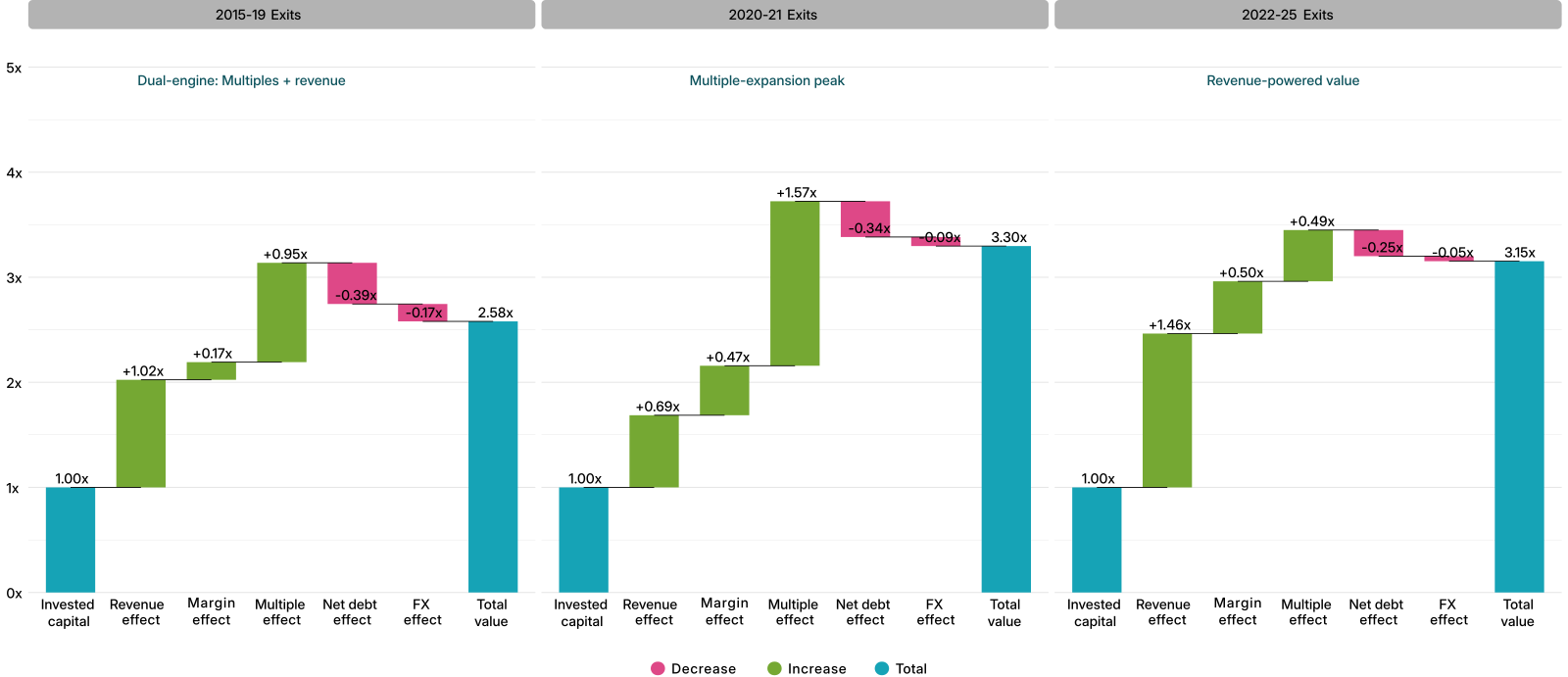
Data as of Q2 2025. Pooled value bridge across a subset of exited buyout holdings, weighted by invested capital. Source: MSCI Private Capital Universe, MSCI Private Asset and Deal Metrics data

Subscribe todayto have insights delivered to your inbox.
Troubling Signals for Private-Equity Exits
Recent trends in the buyout exit market show that assets are being sold at lower median-valuation multiples, despite stronger margin growth and reduced leverage. Hidden pressure points lurk. Limited partners may wish to look beyond net asset values.
Night of the Living Fund: The Rise of Zombie Private Equity
Zombie private-equity funds are carrying unusually high net asset values due to persistently low distribution rates. This trend challenges traditional cash-flow models and raises concerns about liquidity in private-capital portfolios.
Private Asset and Deal Metrics
Evaluate opportunities, benchmark with precision and engage LPs with confidence.
1 Weighted by invested capital, across a subset of exited buyout holdings.
2 Invested capital is normalized to 1.0x. Total value equals cumulative distributions plus remaining NAV, divided by cumulative invested capital, expressed as a multiple, gross of fees.
The content of this page is for informational purposes only and is intended for institutional professionals with the analytical resources and tools necessary to interpret any performance information. Nothing herein is intended to recommend any product, tool or service. For all references to laws, rules or regulations, please note that the information is provided “as is” and does not constitute legal advice or any binding interpretation. Any approach to comply with regulatory or policy initiatives should be discussed with your own legal counsel and/or the relevant competent authority, as needed.