
Co-benefitsWhat impacts does the project have beyond emissions reductions?
A high-quality carbon credit does more than reduce emissions. Co-benefits capture the wider impacts of a project beyond its emissions reductions or removals. Those impacts can be positive or negative, and vary significantly by project type and implementation.

What are co-benefits?
Co-benefits are the environmental and social impacts of a carbon-credit project beyond its direct effect on emissions. They can include contributions to biodiversity, ecosystem health, employment, health outcomes or local livelihoods. Whether they materialize depends on project design, location and how activities are implemented on the ground.
Projects may also pose co-risks, such as negative impacts on communities or ecosystems if safeguards are weak.
Together, these co-benefits indicate how likely a project is to generate net positive outcomes beyond emissions mitigation.
How co-benefits are assessed
Assessments estimate whether a project is likely to generate material positive impacts and whether safeguards exist to limit potential harm. Three factors drive that assessment:
- Relevance of impacts: Is the project type and design inherently linked to environmental or social outcomes?
- Evidence and implementation: Is there credible information that co-benefits are likely to be delivered in practice, not just assumed?
- Safeguards: Does the project include measures to avoid or mitigate potential negative impacts on communities, ecosystems or biodiversity?
The focus is on whether co-benefits are likely to be material, rather than requiring a quantified outcome.
How co-benefits vary across project types
Co-benefits differ widely across project types and within the same category
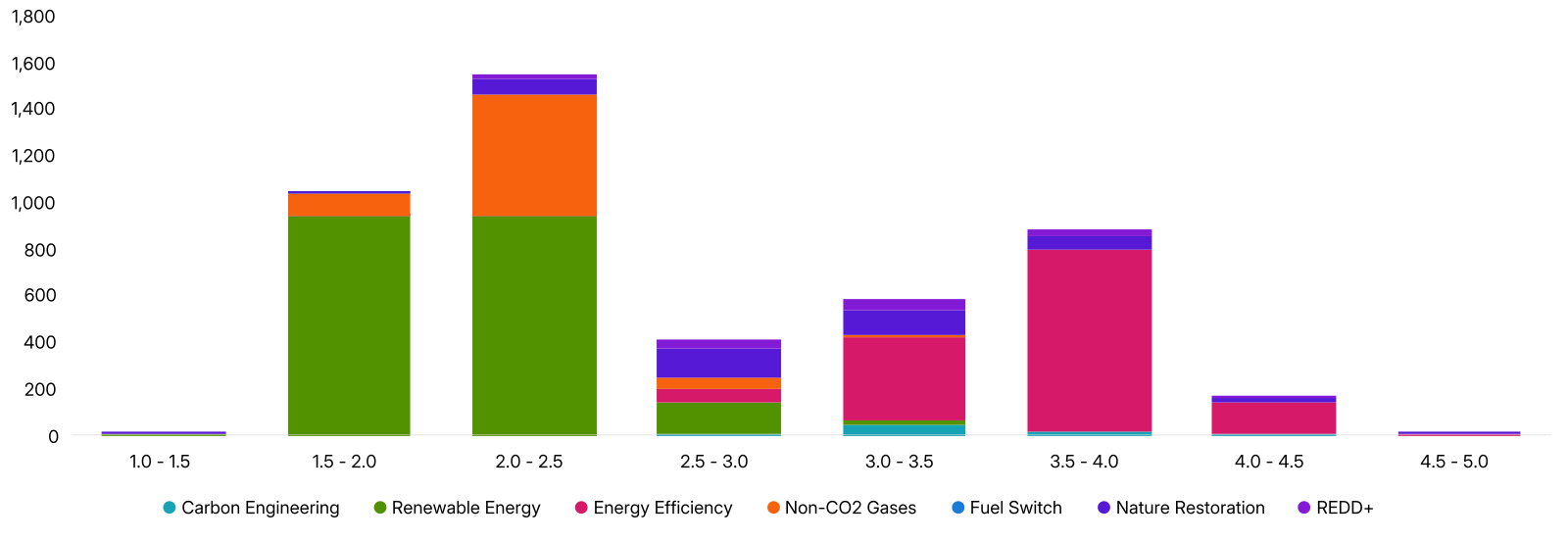
Common patterns observed across the market include:
- Nature-based projects often exhibit stronger potential co-benefits, particularly for biodiversity and ecosystem services. Outcomes vary significantly depending on species selection, land use and local engagement.
- Clean cooking projects frequently deliver social co-benefits, such as improved health outcomes and reduced fuel collection burdens, when effectively implemented.
- Renewable energy and non-CO₂ gas projects tend to show more limited co-benefits, particularly where projects are capital-intensive and geographically isolated.
- Engineered removal projects may deliver innovation-related co-benefits, though broader social or environmental impacts are often more limited.
These patterns highlight that co-benefits are context-specific and cannot be assumed from project type alone.
Case illustration: Co-benefits in nature-restoration projects
Nature-restoration projects illustrate how co-benefits depend on implementation choices. Projects that restore native ecosystems and engage local communities may deliver biodiversity enhancement, improved land resilience and livelihood opportunities. By contrast, projects that rely on monoculture planting or limited stakeholder engagement may deliver weaker or even negative outcomes.
Assessments therefore examine project design, species selection, land tenure arrangements and the presence of safeguards to estimate the likelihood of net positive co-benefits.
Conclusion
Co-benefits reflect the broader environmental and social impacts of carbon projects. While they are not guaranteed, well-designed projects can strengthen overall integrity by delivering net positive outcomes beyond emissions.
Carbon Project Ratings
Investor-grade ratings for over 4,000 carbon projects grounded in granularity and backed by geospatial intelligence.

Projects and Transactions
Access roughly 30,000 projects spanning more than 15 registries and 1 million transactions.1

1 Data and coverage as of December 2024.