
Aligning Benchmarks with Asset-Class Reality: The Case for Private-Capital Indexes
- A private-equity benchmark should assess an investor’s selection skill within private markets, not whether private equity beat public equities. Public-plus-spread benchmarks therefore misjudge performance and manager skill.
- Comparing private equity to public indexes ignores fundamental differences in valuation timing, liquidity and risk exposure. This mismatch distorts both performance evaluation and incentive alignment.
- Public and spread references can frame opportunity costs and return targets vs. public markets, but they’re not true benchmarks given private markets’ structural and temporal differences.
Benchmarking is a central element of the investment process. For asset owners, it defines good performance, guides manager selection, shapes asset allocation and often influences compensation design.
While benchmarking practices are well established in public markets, approaches for private assets remain unsettled. Many institutions still compare private-equity portfolios to public-equity indexes plus a fixed spread — for example, the MSCI World Index plus 300 basis points (bps). The logic is intuitive: If public equities return X, private equity should deliver X plus a premium for illiquidity, complexity and less transparency.
But recent market dynamics have exposed the flaws in this framework, which distorts both performance evaluation and incentive compensation. A growing number of asset owners are therefore turning to private-capital indexes as a more representative basis for benchmarking private-capital funds.
Both public and private equity derive value from corporate performance, yet the mechanism used to measure that value differs significantly. Public equities are priced daily by the market, incorporating sentiment and short-term market volatility. Private assets are valued much less frequently, often using appraisal models and manager discretion. Measuring a private-market portfolio against a public index plus spread overlooks differences in valuation frequency and methodology. A private-equity manager can outperform the MSCI World Index plus 300 bps and still be a poor manager — or underperform it and still have made strong allocation decisions — simply because the benchmark itself is irrelevant to how private-equity value is created. If the goal is to assess skill, performance should be judged relative to a skill-less private-equity portfolio, not against an arbitrary public-equity index plus a spread.
Linking compensation to public-plus-spread benchmarks produces unintended effects. When public markets rise sharply, private equity may appear to underperform despite steady fundamentals; during downturns, the opposite can occur. This volatility in relative performance distorts incentives and weakens alignment. In essence, performance assessment and compensation should be tied to decisions within the manager’s control — such as fund selection and portfolio construction — not to the broader question of whether to invest in private versus public markets.
A key point is that the correlation between public- and private-equity returns is time-varying. During periods of market stress or rapid recovery, public markets reprice almost instantly, while private valuations adjust on a lag. Benchmarking private-asset funds or portfolios to public indexes can therefore misrepresent the short-term relative performance of these funds or portfolios.
We illustrate how public- and private-equity markets can diverge in the charts below. In the first chart, we see that from September 2022 to June 2025, the MSCI World Index outperformed the MSCI Global Buyout Closed-End Fund Index by over 50%.
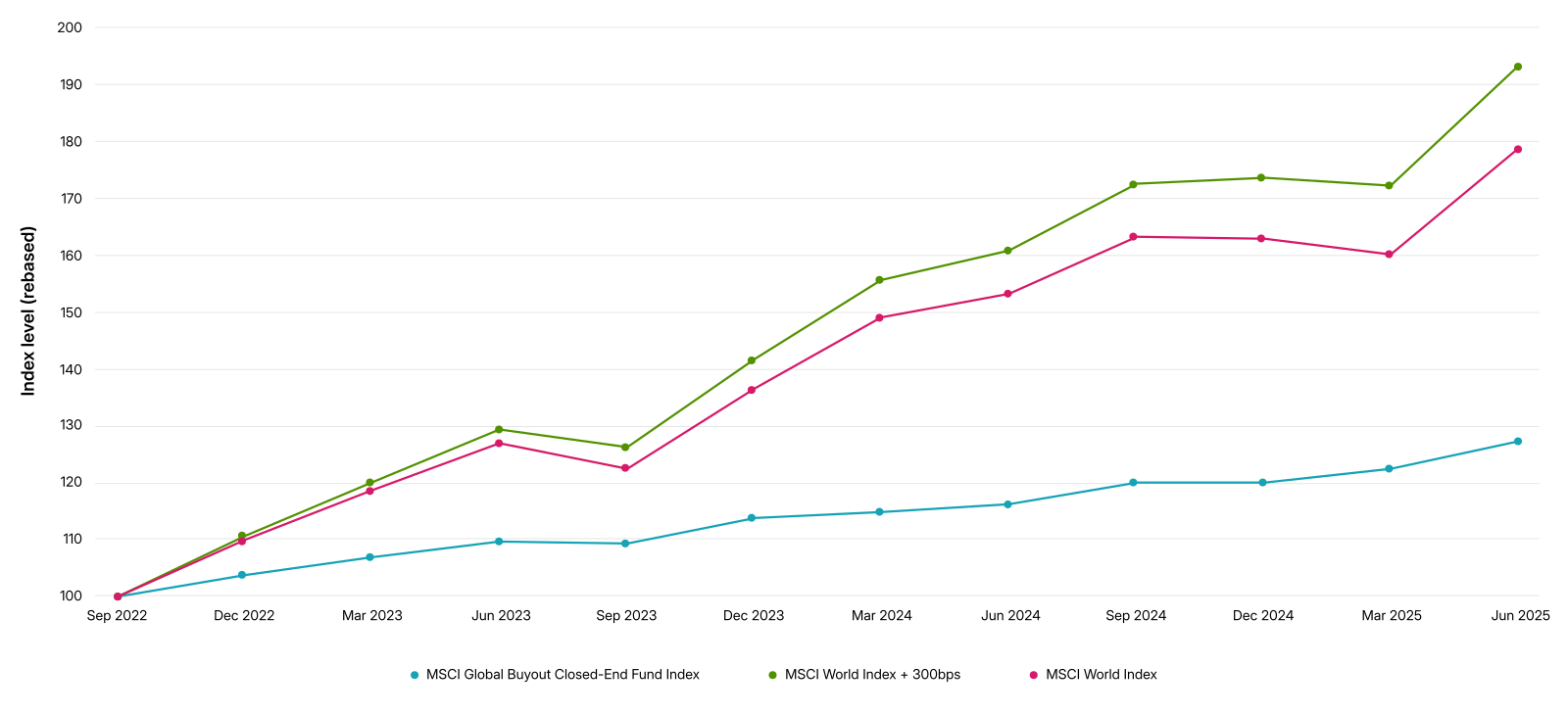
MSCI World Index is gross total return in USD. MSCI Global Buyout Closed-End Fund Index is quarterly pooled net of fee returns in USD.
Even funds with a one-year internal rate of return (IRR) in the 75th percentile of private-equity funds lagged the benchmark of MSCI World plus 300 bps.
The prior years told the opposite story. Between 2021 and mid-2022, the buyout index outperformed the MSCI World by roughly 35%.
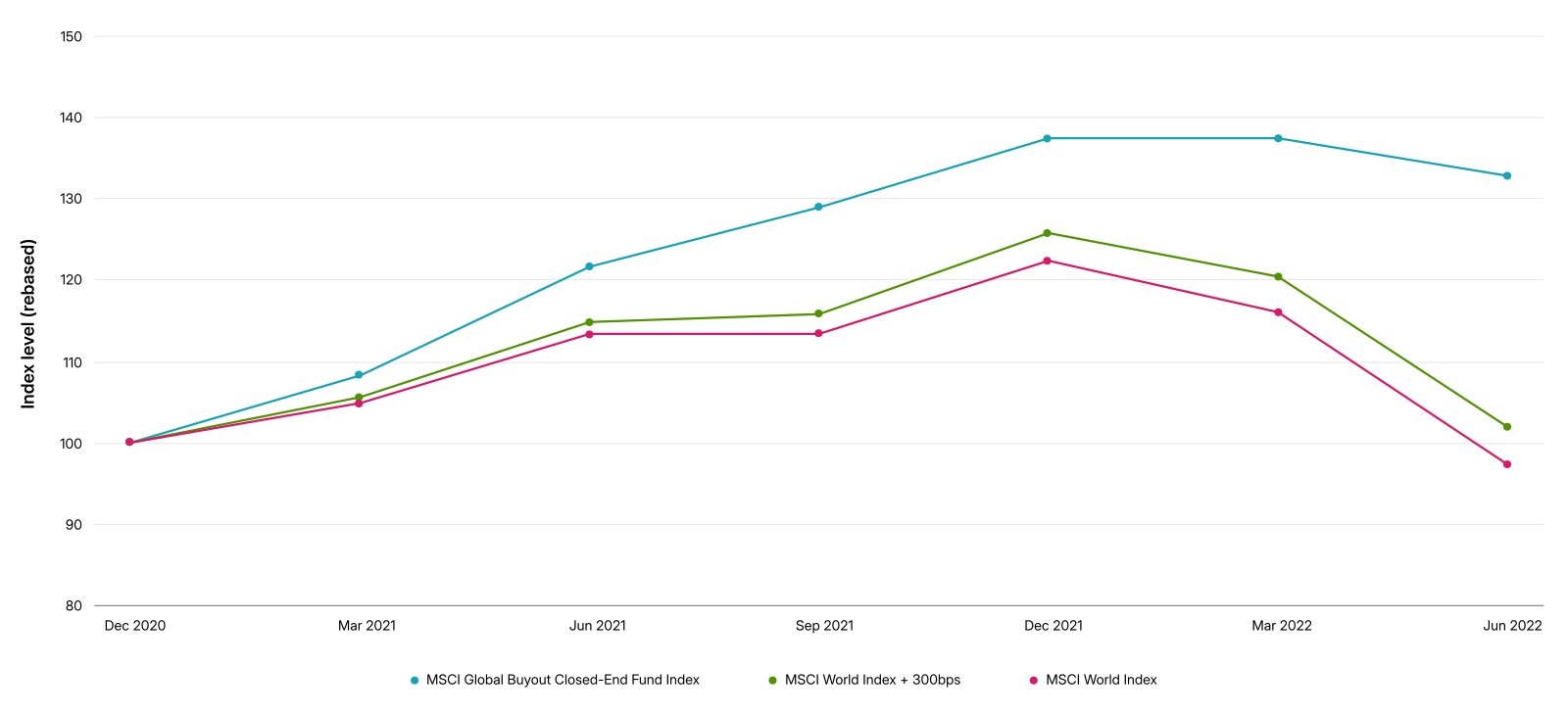
MSCI World Index is gross total return in USD. MSCI Global Buyout Closed-End Fund Index is quarterly pooled net of fee returns in USD.
These reversals highlight the limitations of using public markets as a reference point. While differences may converge over long horizons, short-term divergence reflects distinct structural and behavioral dynamics. Public markets react quickly to macroeconomic signals while private valuations adjust gradually, smoothing through volatility rather than capturing it immediately. The chart below highlights these differences over the longer period.
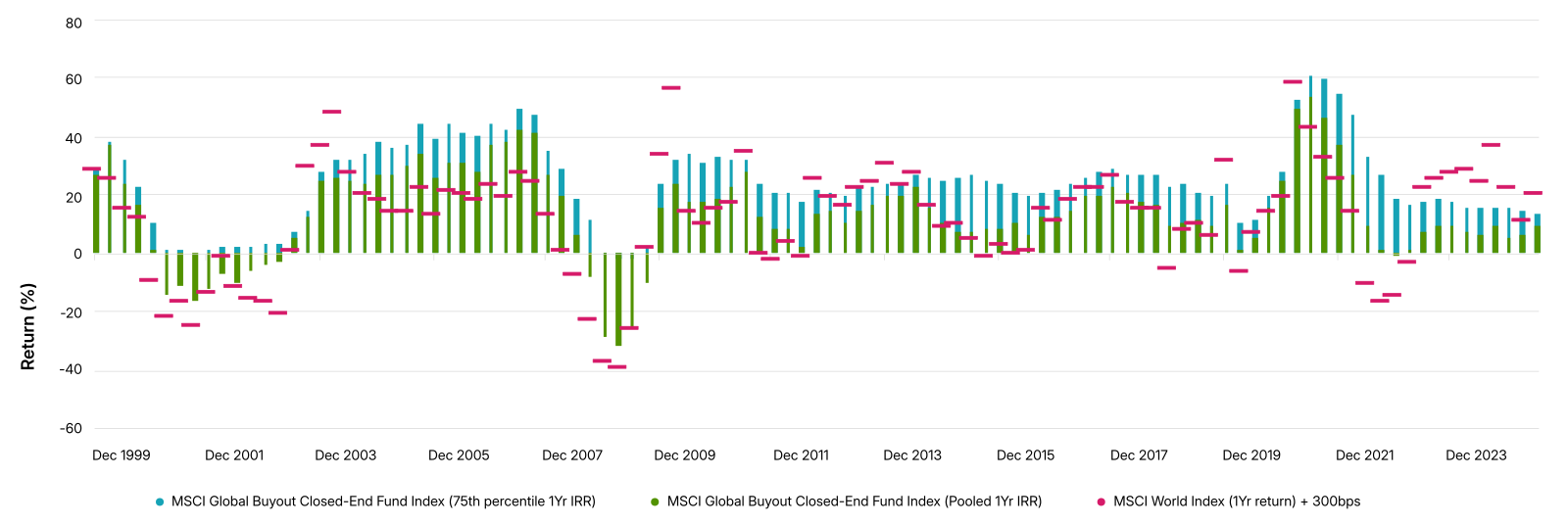
One-year IRR of the Global Buyout Closed-End Fund Index (both pooled IRR and 75th percentile IRR) compared with MSCI World Index one-year return plus 300 bps of spread. One-year returns are used as that is often how private-equity performance is assessed and reported by investors.
Private-capital indexes reflect the actual structure of private portfolios. They incorporate the effects of capital calls and distributions, vintage-year dynamics, valuation lags and manager dispersion — all elements that define how private markets behave. This makes them more consistent with the exposure and risk profile investors experience in practice, in direct contrast with public-equity indexes. A simple public-plus-spread benchmark may be straightforward to explain, but it comes at the expense of accuracy when used as a private-capital benchmark.
Asset owners, furthermore, evaluate success relative to comparable investors, not to public equity. Private-capital indexes represent the aggregate performance of similar funds, providing a more realistic measure of whether a portfolio is outperforming its peer group rather than tracking unrelated public-market cycles. While a common complaint is that private indexes lag the market, so do private-asset portfolios. Here, the immediacy of public-market data introduces inconsistency when compared to assets that are valued on a delay and based on appraisals.
Private-capital benchmarks have also become more transparent and timely. Modern datasets capture thousands of funds globally, apply standardized methodologies and are refreshed quarterly. While not without limitations, these advances produced indexes that are more robust and operationally reliable, addressing long-standing concerns about data coverage.
Benchmark selection in private equity has direct consequences for performance evaluation, governance and compensation. Public indexes plus a spread were once a pragmatic choice in the absence of a better solution, but they are misaligned with how private-equity performance is measured.
Public-plus-spread references can still play a role — mainly when framing opportunity costs or aspirational return targets relative to public markets. They can help articulate what investors expect in exchange for illiquidity and active management risk. But this should not be confused with benchmarking. For performance and policy purposes, such constructs fail to capture the structural and temporal realities of private markets.
Private-capital indexes provide a more precise, asset-specific and peer-relevant foundation for assessing performance. As private markets continue to evolve, aligning benchmarks with the true characteristics of the asset class will be critical to ensuring that measurement remains both rigorous and meaningful.

Subscribe todayto have insights delivered to your inbox.
The Cornerstones of Benchmarking Private Capital
Indexes can provide vital benchmarks for investors navigating private markets, a significant but relatively opaque investment ecosystem. We explain the hallmarks of building a foundational dataset and creating indexes that are reliable and robust.
How to Benchmark Private Capital
We discuss the importance of constructing a benchmark for private-capital portfolios that is both accurate and informative. We address the characteristics that such a benchmark should have and recommend a pooling methodology to avoid the danger of misleading performance data.
Private Asset Indexes
We enable you to assess unlisted assets with quality benchmarks for private equity, debt, real estate, infrastructure and natural resource investments.
The content of this page is for informational purposes only and is intended for institutional professionals with the analytical resources and tools necessary to interpret any performance information. Nothing herein is intended to recommend any product, tool or service. For all references to laws, rules or regulations, please note that the information is provided “as is” and does not constitute legal advice or any binding interpretation. Any approach to comply with regulatory or policy initiatives should be discussed with your own legal counsel and/or the relevant competent authority, as needed.