
Balancing Risk and Return: Gold and Digital Assets in a 60/40 Portfolio
- Equity-bond correlations turned positive earlier this decade and remain above pre-2020 levels, diminishing the diversification benefits of the classic 60/40 portfolio that once balanced growth and stability.
- As traditional equity-bond relationships change, investors must look beyond the 60/40 to rebuild resilience and capture opportunity across changing market regimes.
- Gold has historically provided protection during market stress, while digital assets have driven recoveries; modest allocations to both can enhance risk-adjusted returns through stability and growth potential.
For decades, the 60/40 asset-allocation portfolio of equities and bonds has provided a simple reference designed to strike a balance between growth and stability. In recent crises, however, this has not played out the way investors expected: The 2022 Fed pivot saw the 60/40 portfolio suffer its worst returns in 50 years, while both equity and fixed-income markets experienced losses during the April 2025 tariff turmoil.1
On top of poor returns, the negative correlations between equities and bonds that prevailed for much of the century have started to reverse in recent years, limiting their diversification benefits. Equity and bond returns began moving more closely together, and bonds have not provided a strong counterbalance to declining equities. This reversal has prompted a reassessment of the traditional 60/40 asset allocation and its benefits. As a result, some investors have turned to traditional diversifiers such as gold, with its defensive profile, as well as newer investments such as digital assets, because of their growth-oriented characteristics.2
In this blog post, we analyze how gold and digital assets have behaved during recent crisis periods and assess their impact when incorporated into a traditional 60/40 portfolio.
Equity-bond correlations turned positive, reversing a two-decade pattern
Equities and bonds were historically negatively correlated since the start of the century, allowing bond gains to offset equity losses. However, this relationship has shifted in this decade. Although equity-bond correlations have recently turned negative again, their average this decade remains positive. At the same time, bond returns have become less sensitive to spikes in equity volatility, offering less consistent protection during stress periods.
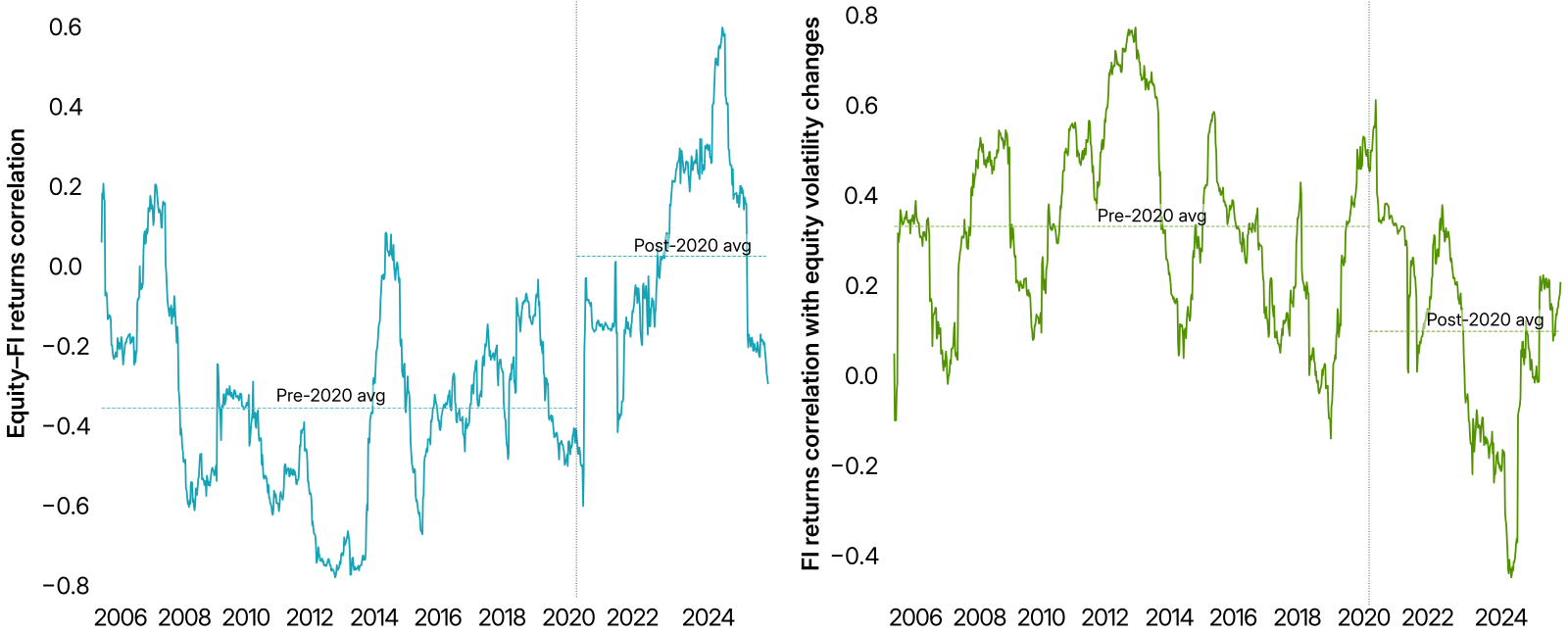
The plots show the 52-week rolling correlation between weekly returns of the MSCI USA Index and the MSCI U.S. Government Bond Index, and between weekly returns of the MSCI U.S. Government Bond Index and U.S. equity volatility (represented by the CBOE VIX Index). Time period: Feb. 28, 2005, to Nov. 28, 2025.
Looking beyond equities and fixed income: Gold and digital-asset indexes
As the traditional relationship between equities and bonds has weakened, investors have turned their attention to other exposures that may offer diversification benefits by behaving differently across market cycles. Gold has long been considered a safe-haven asset, maintaining low correlations with both equities and bonds and offering defensive characteristics during periods of market stress and rising inflation. Digital assets, by contrast, have exhibited higher return potential and greater variability, reflecting their sensitivity to liquidity and market sentiment. During periods of market stress, gold has typically helped cushion drawdowns, while digital assets typically fell more sharply than equities.
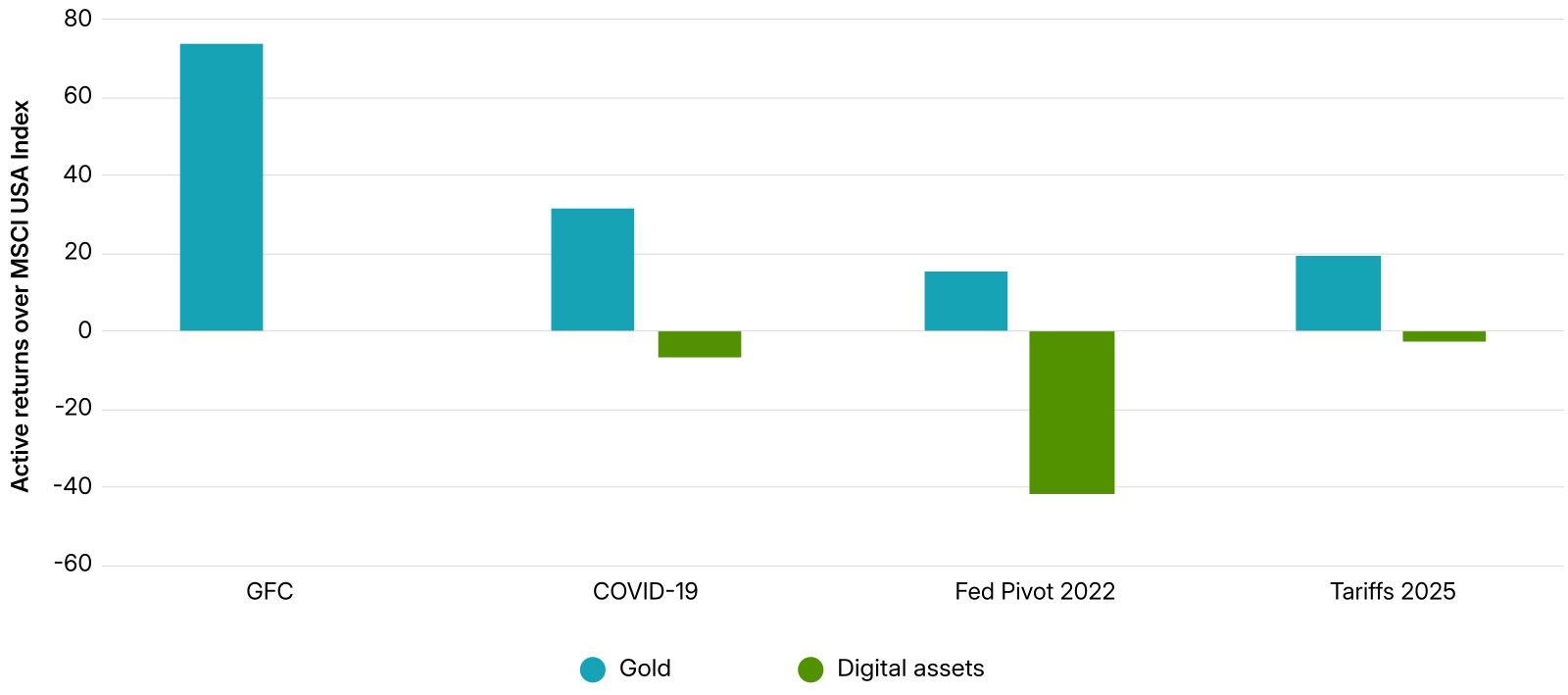
The plot shows cumulative active returns of the MSCI Gold Futures Index and the MSCI Global Digital Assets Index relative to the MSCI USA Index for crisis periods. Crises are defined from U.S. equity-market peak to trough: Global Financial Crisis (Oct. 9, 2007, to Mar. 9, 2009), COVID-19 (Feb. 19, 2020, to Mar. 23, 2020), Fed Pivot (Dec. 27, 2021, to Oct. 12, 2022) and Tariffs 2025 (Feb. 19, 2025, to Apr. 8, 2025).
Performance across market regimes: Equity and volatility deciles
We analyzed the active weekly performance of gold, fixed income and digital assets relative to the MSCI USA Index, grouping returns into deciles based on equity performance and volatility levels.
Gold delivered strong relative performance in the weakest equity deciles and during periods of high volatility, with average active returns exceeding one percentage point at peak volatility, consistent with gold’s historical behavior as a defensive asset and a tail-risk hedge during market stress.
Fixed income displayed a similar defensive pattern, with positive active returns concentrated in the weakest equity return deciles and during high-volatility weeks, consistent with its role as a stabilizer in risk-off environments.
Digital assets, by contrast, achieved their strongest results in middle deciles, when volatility moderated and market sentiment improved. Average active returns exceeded two percentage points in those recovery phases but turned negative during episodes of heightened stress.
The plot shows the average weekly returns of the MSCI Gold Futures Index or the MSCI Global Digital Assets Index relative to the MSCI USA Index, conditioned on deciles created by weekly equity returns or volatility (CBOE VIX). Time period: Feb. 28, 2005, to Nov. 28, 2025, for the MSCI Gold Futures Index and the MSCI U.S. Government Bond Index and Nov. 29, 2019, to Nov. 28, 2025, for the MSCI Global Digital Assets Index.
Integrating alternatives into a traditional 60/40 equity-bond portfolio
We evaluated the historical impact of adding allocations to either gold or digital assets within a traditional 60/40 equity-bond portfolio.
We began by adding a 5% allocation of gold, taken from the equity allocation. Analyzing those returns over the last 20 years, the introduction of gold reduced volatility from 10.7% to 9.9% and drawdowns from 33% to 30%, while improving the risk-return ratio.
When we replaced 5% of the fixed-income allocation with gold, the portfolio delivered higher returns than the benchmark 60/40 portfolio, reflecting gold’s stronger relative performance versus bonds. During the past year, a 10% gold allocation, taken from fixed income, would have lifted annualized returns by nearly 400 basis points with little change in volatility, in line with gold’s recent strength.
Similarly, over their full history, digital assets produced a steeper efficient frontier when the allocation was drawn from equities, raising annualized returns from 9.2% to 11.9% with a 5% allocation and to 14.4% with 10%, while risk rose modestly from 12.1% to 12.2% and 13.2%, respectively. Monthly rebalancing and low short-term correlations helped temper the impact of digital assets’ higher volatility. While gold allocations tended to lower portfolio risk, digital assets primarily lifted returns.
The interactive chart compares efficient-frontier outcomes for portfolios combining equities, fixed income and alternative assets (gold or digital assets) under different allocations (5% and 10%), funding sources and time horizons. Portfolios are rebalanced monthly and evaluated using historical index returns in USD. Time period: Feb. 28, 2005, to Nov. 28, 2025, for the MSCI Gold Futures Index and the MSCI U.S. Government Bond Index, and Nov. 29, 2019, to Nov. 28, 2025, for the MSCI Global Digital Assets Index.
Rethinking diversification for a new market era
The recent evolution of equity and fixed-income correlations has reminded investors of the importance of managing their asset-class opportunity set more dynamically. Over the last 20 years, gold has demonstrated its defensive qualities during periods of market stress, while more recently digital assets have been a “risk on” investment associated with growth and equity outperformance during market recoveries. We have shown that modest allocations to either of these exposures improved risk-adjusted portfolio outcomes compared to the classic 60/40 equity-bond asset allocation. For investors making strategic asset-allocation decisions, a thoughtful incorporation of both defensive and growth-oriented diversifiers — such as gold and digital assets —may enhance portfolio resilience and return potential across market cycles.

Subscribe todayto have insights delivered to your inbox.
Bitcoin: Good as Gold?
During inflationary periods, equity investors, historically, have turned to gold as a hedge and diversifier. As the issue of inflation becomes more pressing, we ask whether cryptocurrencies, such as Bitcoin, could have played a similar role.
Beyond Bitcoin: Decrypting Digital-Asset Investment in Private Markets
Cryptocurrencies were at the forefront of digital-asset investment by private-market investors, but where has the recent momentum been? We chart holdings and valuations to illustrate the trends.
Earning a Place in the Portfolio: Using Implied Returns in TPA Decisions
Learn how implied returns enable asset owners to align teams, compare opportunities and make confident, data-driven capital-allocation decisions.
1 Equity markets, represented here by the MSCI USA Index, declined by 7.2%, while fixed-income markets, represented by the MSCI U.S. Government Bond Index, declined by 1.3%.
2 We use the MSCI Gold Futures Index as a proxy for gold exposure and the MSCI Global Digital Assets Index for digital assets. These indexes have inception dates of Jan. 4, 2000 and Nov. 29, 2019, respectively.
The content of this page is for informational purposes only and is intended for institutional professionals with the analytical resources and tools necessary to interpret any performance information. Nothing herein is intended to recommend any product, tool or service. For all references to laws, rules or regulations, please note that the information is provided “as is” and does not constitute legal advice or any binding interpretation. Any approach to comply with regulatory or policy initiatives should be discussed with your own legal counsel and/or the relevant competent authority, as needed.