
Balancing the Scales: How Credit Registries Distribute IFM Reduction and Removal Credits
- Accurately measuring removal credits is key for carbon credit buyers, asset managers and corporate net-zero teams seeking high-integrity removal credits in nature-based portfolios.
- The share of removal-dominant Improved Forest Management (IFM) projects varies widely across registries due to different inputs and whether credits are classified as removals or reductions.
- Without project-level analysis, buyers risk overstating removal alignment and mispricing credit quality. Registry tags are improving but remain inconsistent, requiring deeper due diligence from investors.
A growing share of carbon credit buyers have turned their focus toward carbon removal credits as they are perceived to have higher integrity than reduction credits, and are increasingly recognized under net-zero frameworks of carbon accounting standards like the Science-Based Targets Initiative (SBTi).1 This has allowed sellers of removal-only credits to command a price premium in the market. But many credit registries have been unable to effectively label their credits for certain project types, complicating the purchasing process for buyers and preventing the sellers from securing a higher price for their credits. Registries may also contain project-level categories, further complicating the process for sellers and buyers.
Detailed labeling is particularly pertinent for Improved Forest Management (IFM) — a carbon project type that enhances the management of existing forests through sustainable practices — which accounted for nearly 30% of all nature-based carbon credits in 2025.2 Without clear tagging of removal credits, removal-focused buyers may struggle to source credits from IFM projects. Likewise, IFM developers may not be able to achieve a price premium for their sought-after credits. Unlike afforestation or restoration projects that focus primarily on carbon removal, and REDD+ (Reduced Emissions from Deforestation and Degradation) that focus on carbon reduction, IFM projects generate mixed credits. They can claim avoided emissions through the protection of existing carbon stocks (reductions) and additional sequestration through forest growth or long-lived harvested wood products (removals). Yet, historically, carbon project registries did not distinguish between reductions and removals within IFM project issuances.
Major registries making moves
The landscape is changing: The American Carbon Registry (ACR) now tags IFM issuances as removals or reductions, and Verra has released a tool enabling project-level separation for IFM issuances, though it is not yet widely adopted. Meanwhile, Climate Action Reserve (CAR) has a protocol for Mexican IFM projects that only includes removal credits by project design.
MSCI Carbon Markets analysis of 104 IFM projects currently registered on the ACR registry shows that vintage credits issued from 2019 onward have increasingly been tagged as removals. Over the last four years, 25% to 30% of total annual IFM issuances have been classified as removals. This data provides valuable insight for buyers planning their procurement cycles around the availability of such credits. While issuance-level tagging helps meet near-term sourcing needs, buyers and early investors also want to know how the removal share evolves over a project’s lifetime. Using ex-ante project-level figures, we have modeled what this long-term split could look like.
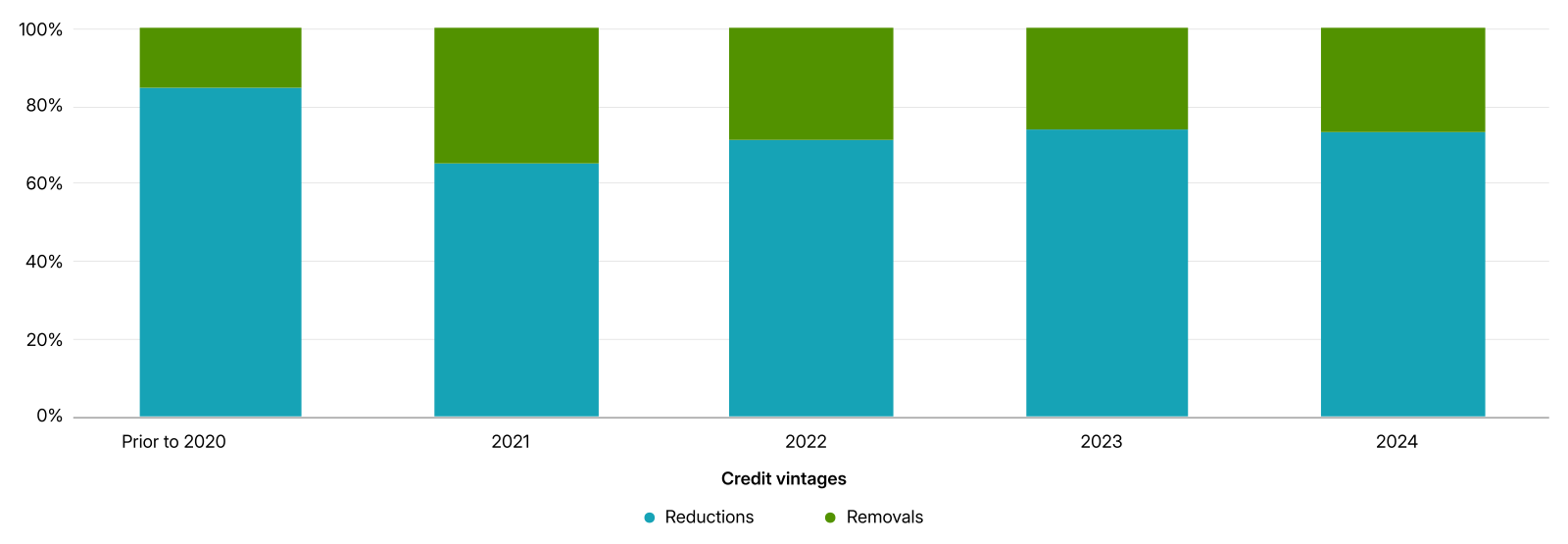
Data as of Oct. 21, 2025. Source: MSCI Carbon Markets
Our data indicates that the ratio of reductions to removals varies significantly across registries and even among projects within the same registry. Measures of how many IFM projects derive more than 60% of lifetime credits from removals varies among providers: MSCI models this as 40% for ACR, Verra at 70%, and under CAR Mexico it is 100%. These differences largely stem from individual project assumptions such as baseline harvest assumptions, crediting period length and developer conservatism.
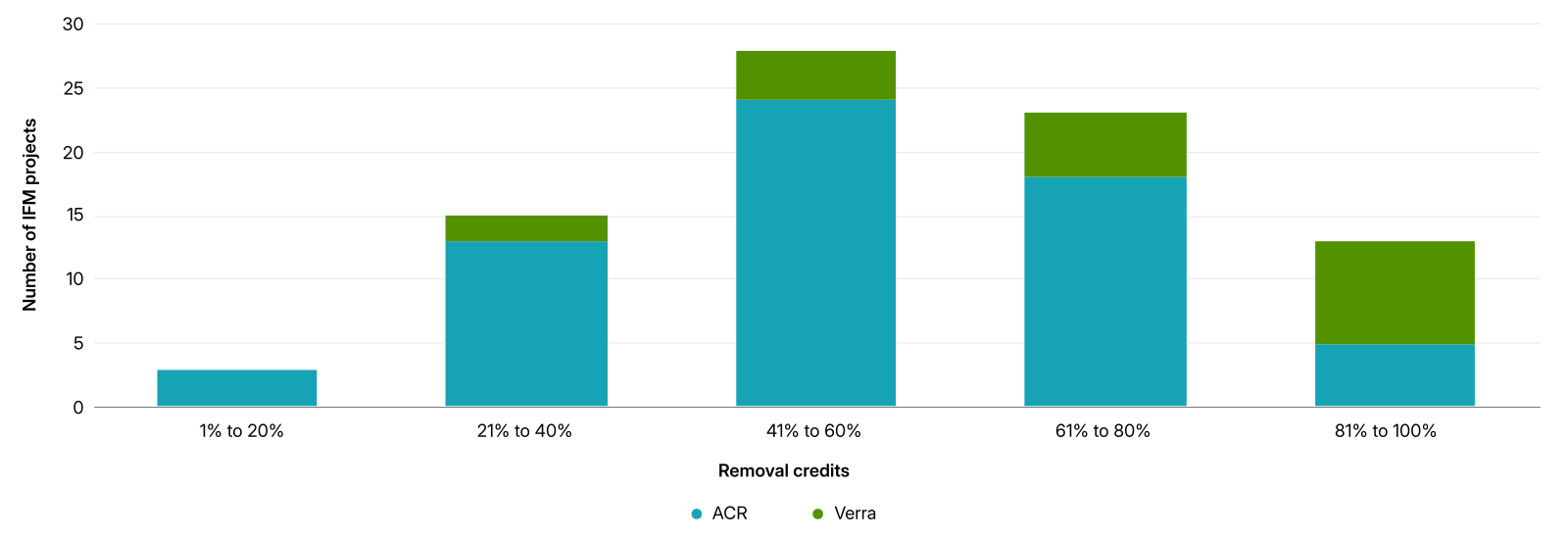
Data as of Oct. 21, 2025. Source: MSCI Carbon Markets
Consistent tagging will help buyers and investors make better decisions
For buyers and investors, the integrity of removal-aligned claims cannot be assumed at the methodology or registry level. Instead, assessing the mix of reductions and removals must happen at the individual project level. Clearer and more consistent tagging of these components across registries will be essential to ensure alignment with buyer expectations.


Subscribe todayto have insights delivered to your inbox.
Nature-Based Carbon-Credit Prices Grow Apart
Why are carbon-credit prices moving in different directions? Our analysis reveals how regional dynamics, supply shifts and quality perceptions are reshaping the market — and investor strategies.
2025 State of Integrity in the Global Carbon-Credit Market
Our 2025 report on the global carbon-credit market shows rising demand for high-integrity credits with stronger ratings, higher prices and new risk frameworks are shaping a more credible market.
MSCI Carbon Project Ratings
Assess the integrity of more than 4,000 carbon projects with our independent, in-depth assessments used by investors, carbon credit buyers and developers market-wide. As of Sept. 18, 2024.
1 Carbon credits have varying quality characteristics. These stem from fundamental differences in project types, but also from which methodologies have been used to define each project and create the credits and how rigorously they have been applied. Higher integrity carbon credits have a high likelihood to deliver and support both a 1 tonne CO2e emissions impact, and a range of positive social and/or environmental outcomes while upholding legal and ethical standards.
2 Credits generated from projects that reduce or remove carbon emissions by protecting, restoring, or sustainably managing ecosystems such as forests, wetlands, or grasslands.
The content of this page is for informational purposes only and is intended for institutional professionals with the analytical resources and tools necessary to interpret any performance information. Nothing herein is intended to recommend any product, tool or service. For all references to laws, rules or regulations, please note that the information is provided “as is” and does not constitute legal advice or any binding interpretation. Any approach to comply with regulatory or policy initiatives should be discussed with your own legal counsel and/or the relevant competent authority, as needed.