
Bridging Public and Private for a Total Equity View
- Institutional investors increasingly view equity as a unified asset class spanning both public and private markets, and they need integrated benchmarks to reflect this view.
- The new MSCI All Country Public + Private Equity Index combines the MSCI ACWI IMI with the new MSCI All Country Private Equity Index to provide a coherent and transparent measure of total equity-market returns.
- The MSCI All Country Private Equity Index is a model-based index that removes the reporting lag inherent in traditional private-market benchmarks, enabling private equity to be measured on a daily frequency.
Institutional equity portfolios have changed fundamentally over the past two decades. Alongside traditional listed holdings, allocations to private equity have become a structural component of long-term investment strategies. While allocation to private equity varies among different types of investors, commitments are generally still rising as investors seek differentiated sources of return and long-term value creation.1
Despite this shift in allocations, public and private assets continue to be analyzed and benchmarked separately. Public equities are represented by transparent, daily calculated indexes such as the MSCI ACWI IMI, while private equity is measured through quarterly, appraisal-based benchmarks. The result is an analytical gap. A unified benchmark that combines both components would offer a more accurate reflection of how institutional portfolios are constructed and managed. A unified benchmark also aligns with the principles of the total portfolio approach, which require evaluating all equity exposures — both public and private — on a consistent footing to support integrated, whole-portfolio decision-making.
Traditionally, private equity has been viewed as a separate, “alternative” asset class — one that sits alongside, rather than within, the broader equity allocation. However, both public and private equity ultimately represent ownership of corporate value creation across the global economy. The main differences lie not in the underlying economic exposure, but in the structure, liquidity and valuation of the investments.
Recognizing private equity as part of the equity continuum (rather than as an alternative), institutional investors are seeking tools for analysis and measurement that can span both components consistently and transparently.
To measure total equity returns holistically, returns in private-equity markets first need to be expressed on terms comparable to public markets. The MSCI All Country Private Equity Index, a model-based daily private-equity index, is designed to address this requirement. This index estimates private-market returns using observable public information, calibrated to the historical relationship between private valuations and public-equity index levels while incorporating private-equity data as it becomes available. The aim is not to replace appraisal-based reporting by general partners (GPs), but to complement it with a higher-frequency, market-consistent proxy.
The MSCI Global Private Equity Closed-End Fund Index is MSCI’s broadest measure of private-equity performance, capturing the net-of-fees experience of asset owners investing across thousands of closed-end funds in the MSCI private-capital universe. This index is published quarterly with a reporting lag of about a quarter, thus we employ a nowcasting model to generate a lag-free, daily performance proxy of this index.2
The nowcasting approach is an econometric model that combines three key inputs:
- Lagged returns of the MSCI Global Private Equity Closed-End Fund Index (henceforth in this article, the Quarterly PE Index),
- A reweighted public-equity proxy, based on the MSCI ACWI Index, constructed to mirror the Quarterly PE Index’s country and sector exposures, which is rebalanced quarterly, and,
- The most recent GP-reported net asset values (NAVs), incorporated as soon as they are available.
We estimate the model parameters using the historical relationship between appraisal-based private-equity index returns and public-market returns, as well as the correlation between quarterly private-equity returns across time. These parameters translate daily public-market movements into implied private-market valuation levels. As new NAVs are reported, the model incorporates this information to update estimates and refine the nowcast.3
This approach ensures that the daily index series aligns with the long-term return behavior of the Quarterly PE Index, while reflecting the timing of market shocks more contemporaneously. The use of a reweighted ACWI-based public-market proxy improves short-horizon accuracy, and quarterly reconciliation maintains consistency with reported fund composition.
The chart below shows the historical behavior of the MSCI All Country Private Equity Index (the daily index, in green) relative to the Quarterly PE Index levels based on GP reports (orange dots), alongside the reweighted MSCI ACWI proxy (blue line). The MSCI All Country Private Equity Index anticipates the quarterly NAV changes by roughly one quarter before they are officially reported — and remains aligned with the long-term path of the Quarterly PE Index.
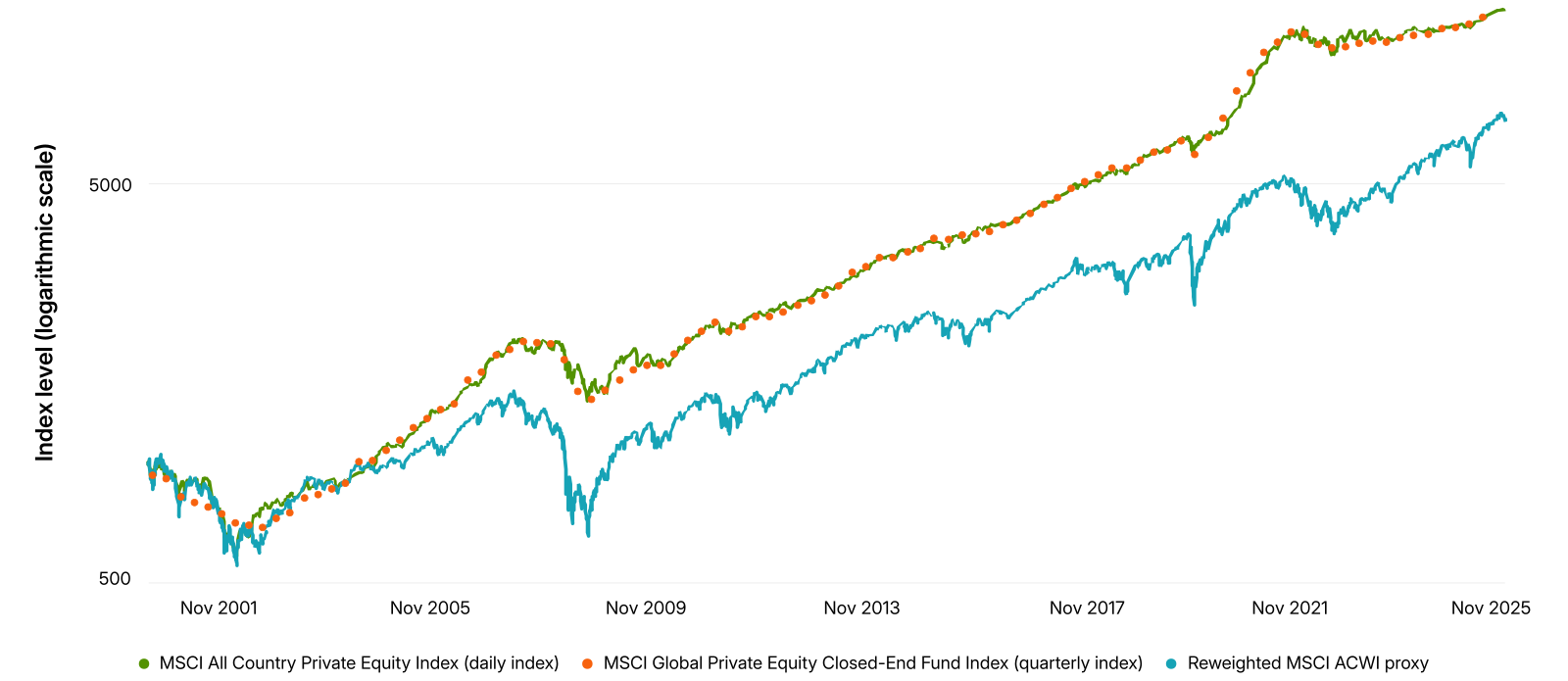
The MSCI All Country Private Equity Index has been backtested to March 1, 2001. Daily returns are generated using point-in-time inputs to mitigate look-ahead bias. For ease of comparison, the Quarterly PE Index levels (shown as orange markers) are displayed without their reporting lag of roughly one quarter. The y-axis is shown on a logarithmic scale to better illustrate relative performance and model alignment over the full sample period.
The MSCI All Country Public + Private Equity Index is designed to be a consistent daily benchmark for a total equity investor constructed by blending a public-equity component with a private-equity component. We plot the resultant index alongside the two index inputs: the MSCI ACWI IMI and the MSCI All Country Private Equity Index. The Public + Private Index uses target weights of 85% public equity and 15% private equity as an approximation of institutional allocations.4 These are reset quarterly.
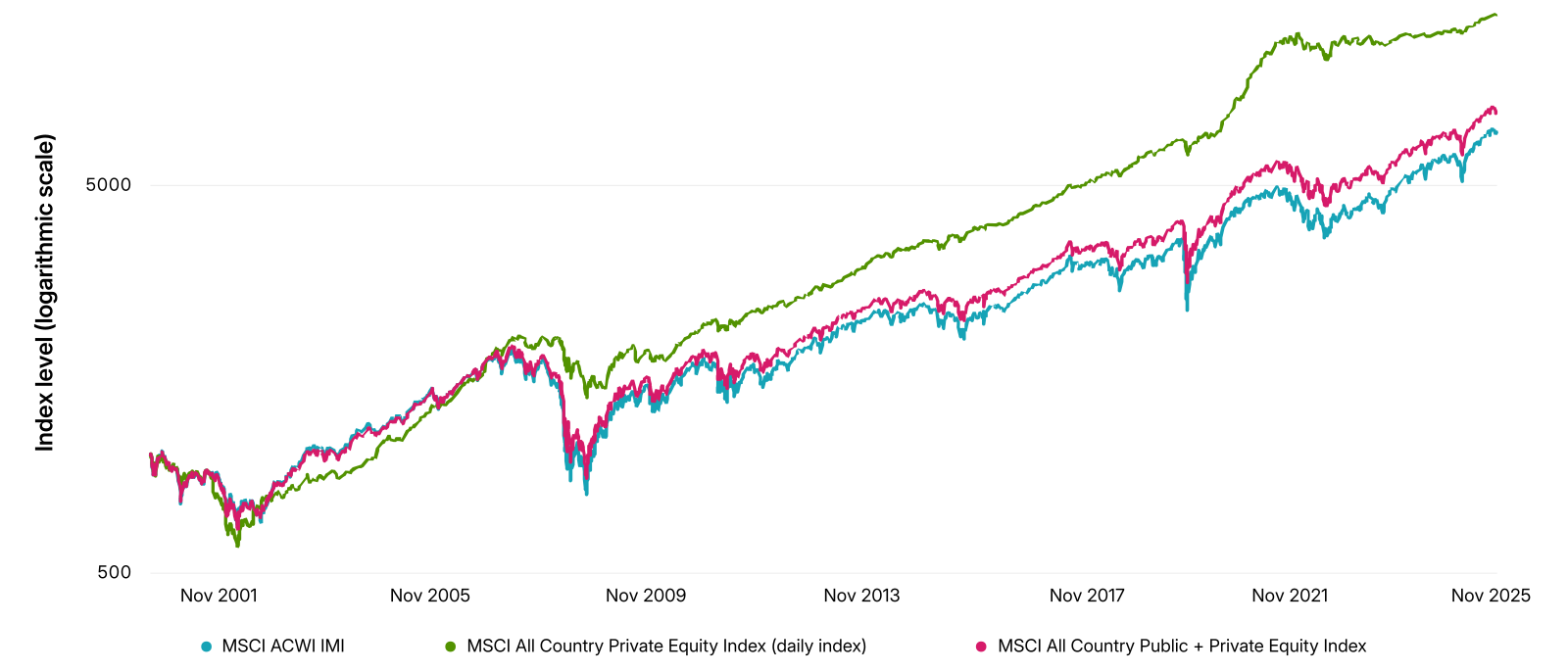
Period of analysis: March 1, 2001 to Nov. 17, 2025. All indexes are shown in USD. The MSCI All Country Private Equity Index and the private-equity component of the MSCI All Country Public + Private Equity Index are net of fees. All indexes reflect total returns, gross of tax. The y-axis is shown on a logarithmic scale to better illustrate relative performance and model alignment over the full sample period.
The rise of private equity as a structural component of institutional portfolios and the shift to a total equity perspective has driven investor needs for measurement tools that reflect that more holistic equity view.
An index of public and private equity that combines a daily, market-traded public-markets component with a daily model-based private-equity component offers a more coherent approach for both investment research and portfolio analysis. It aligns frequency, enhances comparability and supports more accurate assessments of performance and risk.



Subscribe todayto have insights delivered to your inbox.
Aligning Benchmarks with Asset-Class Reality: The Case for Private-Capital Indexes
Benchmarking private equity to public equity ignores fundamental differences between the two, leading investors to seek private-capital indexes as true benchmarks of the asset class.
MSCI Private Capital Benchmarks Summary Q2 2025
Net cash flows in private markets turned just positive in Q2, though distribution rates held at record lows. We provide insights on capital movement as well as performance, valuations and dry powder.
MSCI All Country Public + Private Equity Index
A new daily view of both public and private market performance.
1 Endowments and long-horizon investors tend to be more heavily allocated to private assets, while pension funds and insurers may have more conservative allocations.
2 The term “lag” in relation to private-equity NAVs can refer to the delay between the quarter-end and the release of GP NAVs and hence the publication of quarterly private-equity indexes, as well as to the valuation lag arising from GPs incorporating market and operating conditions into NAVs slowly. The nowcasting approach described here addresses the first, by seeking to provide daily aggregate NAV projections.
3 See MSCI All Country Private Equity Index Methodology and MSCI All Country Public + Private Equity Index Methodology.
4 The allocation to private equity varies among investors depending on their objectives, targets, views and liabilities.
The content of this page is for informational purposes only and is intended for institutional professionals with the analytical resources and tools necessary to interpret any performance information. Nothing herein is intended to recommend any product, tool or service. For all references to laws, rules or regulations, please note that the information is provided “as is” and does not constitute legal advice or any binding interpretation. Any approach to comply with regulatory or policy initiatives should be discussed with your own legal counsel and/or the relevant competent authority, as needed.