
Closed-End Funds vs. Open-End Funds: A Practical Guide for Investors
- Closed-end (or drawdown) and open-end (or evergreen) funds are the two dominant private market structures. The core differences come down to fund life, liquidity accessibility and reinvestment responsibility. Neither structure is inherently better, and the right choice comes down to factors like liquidity needs, time horizon and familiarity with private markets.
- Closed-end funds have a fixed life (typically 10 years for private equity, though duration varies by asset class), call capital in installments and return proceeds as investments are realized. The investor is responsible for redeploying that capital. They have traditionally attracted institutional investors with larger investment programs.
- Open-end funds have no end date and reinvest proceeds internally. They offer periodic liquidity windows, but those are subject to redemption gates and manager-set valuations rather than market prices. Open-end funds have made private markets increasingly accessible to wealth managers and their clients.
Private-market investing has two dominant fund structures: closed-end (drawdown) funds and open-end (evergreen) funds. When choosing how to invest in private markets, understanding the difference between these vehicle types matters. It affects how long your capital is tied up, when you can access liquidity and how much operational complexity you're taking on.
This guide explains both structures in plain terms and helps you think through how the different vehicle types might suit your risk-return profile and investment objectives.
What are private-market funds?Private-market funds pool capital from investors to invest in assets not traded on public exchanges, such as private companies, private loans (private credit) or real assets like infrastructure, natural resources and real estate. Investors in these funds are called limited partners (LPs). The firm managing the fund is the general partner (GP). The GP makes all investment decisions and bears unlimited liability; as an LP, you provide the capital and your liability is limited to your capital commitment.
Both closed-end and open-end funds follow this GP/LP dynamic. One of the key differences is how capital flows in and out over time.
Closed-end funds: The traditional structureA closed-end fund has a fixed lifespan, typically 10 to 12 years. Here's how it works in sequence:
Fundraising. The GP raises capital commitments from investors over a defined window, often six to 18 months. Once that window closes, no new investors can join.
Investment period. Over roughly the first five years, the GP identifies opportunities and draws down capital from LPs in installments called capital calls. Fund documents typically specify how long you have to provide the funds as well as the consequences of defaulting or failing to respond to the call on time.
Harvesting. As portfolio companies are sold or loans are repaid, the GP distributes proceeds back to LPs. By the end of the fund's life, all capital is returned and the fund winds down.
This structure creates a predictable pattern of cash flows: Early in the fund's life, you're sending money out but not receiving much back, so your net cash flow is negative. Over time, as investments mature and are sold, distributions increase and the cumulative return curve moves into positive territory.
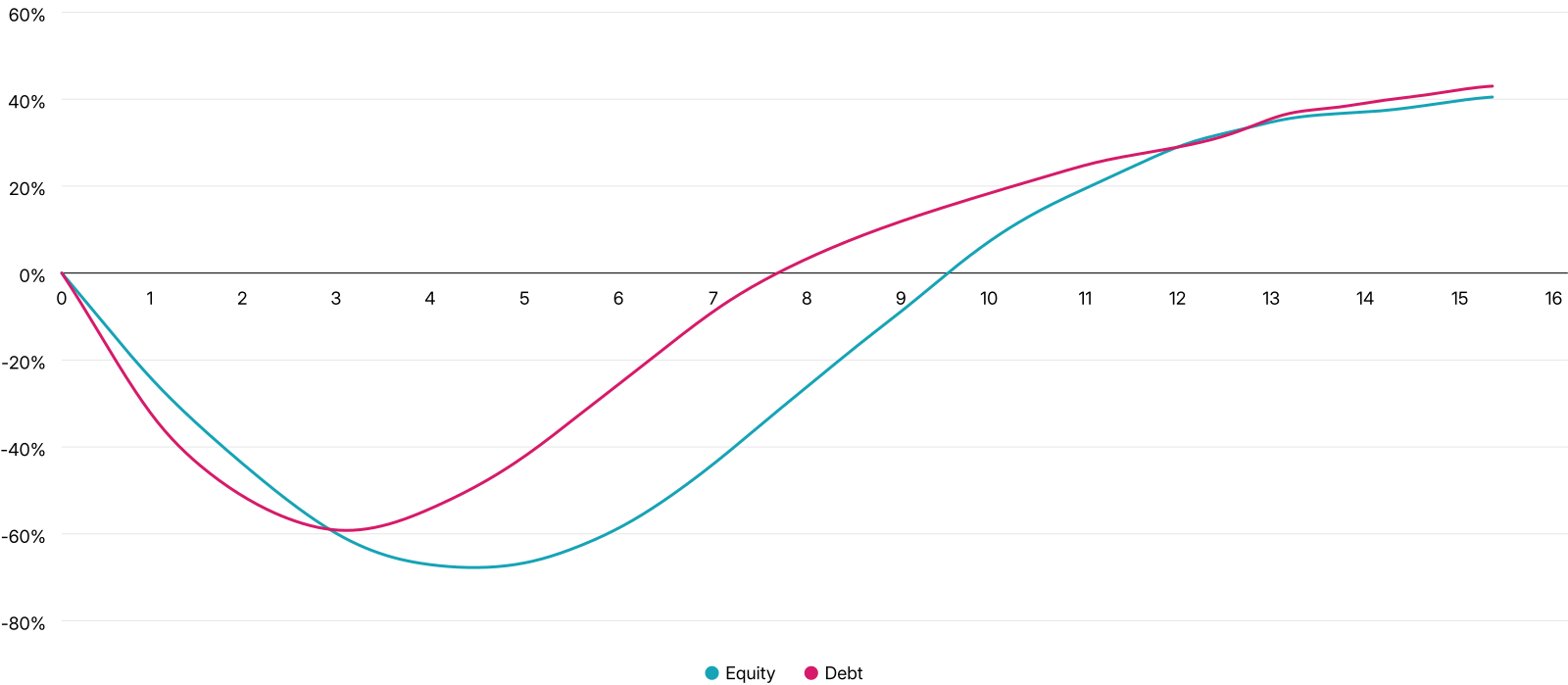
The reinvestment question. When a closed-end fund returns capital, it's your responsibility to figure out what to do with it. If you don't have another fund lined up, that capital may sit idle. Managing a pipeline of successive fund commitments is one of the core disciplines of private-market investing.
Evergreen funds: The newer alternativeEvergreen funds, sometimes referred to as semi-liquid funds, have no fixed end dates. When investments are sold, the proceeds are reinvested within the fund rather than returned to investors. This creates continuous exposure to private markets without requiring you to manage a succession of fund commitments.
Entry and exit work through periodic liquidity windows — generally monthly or quarterly — during which you can invest new capital or request withdrawals. However, these windows come with limits. Fund managers impose redemption gates, which cap how much of the fund's assets can be redeemed in any given period. If too many investors want out at the same time, say, during periods of market stress, your request may be deferred or only partially fulfilled.
Because evergreen funds hold private assets that aren't priced daily, the net asset value (NAV) used for subscriptions and redemptions is based on periodic internal valuations. Those valuations may not fully reflect current market conditions in real time, which creates some pricing uncertainty. In stressed markets, NAV can lag what the portfolio is actually worth. This matters because you're effectively buying or selling at a manager-determined price, not a market price.
Evergreen funds are also increasingly accessible to wealth management clients and high-net-worth individuals. Unlike closed-end funds, which typically require minimum commitments in the millions of dollars, evergreen funds often set minimums as low as USD 25,000–100,000 — and feeder fund structures can lower that threshold further by pooling capital across multiple investors.
Structural differences at a glance
Institutional investors, such as pension funds, endowments and sovereign wealth funds, have historically been the primary investors in closed-end funds. They tend to have longer investment horizons, larger teams to manage capital calls and commitment pacing, and the in-house resources to navigate the complexity. These investors also benefit from the extensive performance benchmarking data available for closed-end funds.
Wealth managers and high-net-worth individuals are increasingly being served by open-end structures. As access to these structures is widening via vehicles designed for broader distribution, private-wealth investors are taking note of the ways in which, operationally, evergreen funds mitigate key friction points of private-market investing: illiquidity, irregular capital flows and complex commitment pacing. As with any private-markets investment, wealth managers should ensure clients understand the liquidity terms — periodic windows are not the same as daily liquidity, and redemption gates are a feature of the structure rather than a sign of distress.
Family offices may be suited to either structure depending on their scale, governance capability and investment program maturity. Larger, more sophisticated family offices with dedicated investment teams may prefer the performance characteristics and benchmarking depth of closed-end funds. Smaller family offices entering private markets for the first time may find evergreen structures more operationally manageable.
The main risks to understand Closed-end funds:Illiquidity. Your capital is committed for the fund's full life. Secondary markets help to offset this risk, though cost and speed of sale can vary across asset types.
Vintage year concentration. All capital in a given fund is exposed to the same economic environment. A fund that started investing in 2007 faced very different conditions than one that started in 2010. However, this is mitigated with the standard approach of investing across a series of closed-end commitments.
Reinvestment responsibility. You'll need to actively manage the cycle of distributions and new commitments.
Open-end funds:Open-end funds reduce several of the frictions associated with closed-end investing — no capital call management, no commitment pacing, no reinvestment responsibility and lower investment minimums. The tradeoffs to understand are:
Redemption gates. Liquidity is conditional, not guaranteed. In stressed markets, gates may limit your ability to exit.
Valuation uncertainty. NAVs are set by the manager rather than the market, which may open investors up to the risk of subscribing or redeeming at a price that lags current conditions.
Limited track record. Most evergreen structures were launched in the last decade. There is little historical performance data spanning a full economic cycle.
Frequently asked questionsWhat is an evergreen fund in private markets? An evergreen fund is an open-end private-market structure with no fixed end date. Instead of returning capital to investors when assets are sold, it reinvests those proceeds into new opportunities. Investors can subscribe or redeem capital during periodic liquidity windows, often quarterly or annually, subject to limits set by the fund manager. The tradeoff for reduced reinvestment complexity is reliance on manager-reported valuations and conditional liquidity.
What is the difference between a closed-end fund and an open-end fund? The core differences are fund life, liquidity and reinvestment responsibility. Closed-end funds have a fixed lifespan, call capital in drawdowns and return capital through distributions. Open-end funds have no fixed end date, allow periodic subscriptions and redemptions, and recycle capital internally. Closed-end funds put reinvestment responsibility on the LP; evergreen funds transfer it to the GP. Closed-end funds have deeper performance histories spanning multiple economic cycles; open-end structures are newer but have grown rapidly, with many now managing tens of billions in assets.
Are evergreen funds better than drawdown funds? Neither is inherently better. Drawdown funds offer a well-established structure with more extensive benchmarking data and alignment between GPs and LPs over a defined period. Evergreen funds can offer greater accessibility via lower investment minimums and reduced operational complexity. Ultimately, the right structure depends on your liquidity needs, time horizon and familiarity with private markets.
Subscribe todayto have insights delivered to your inbox.
Private Markets for Wealth: Insights from 11,000+ Funds
Explore our new guide — featuring proprietary data from over 11,000 funds — designed to support wealth managers seeking to increase their allocation to private assets.
The Ascendance and Implications of Evergreen Funds in Private Markets
The rise of semi-liquid vehicles comes bundled with challenges for GPs, asset owners, wealth investors and regulators. MSCI US Evergreen Fund Monthly Indexes show the performance so far.
The 2026 GP Survey: The Scaling Imperative
MSCI’s Luke Flemmer examines what the 2026 General Partner Survey reveals about LP expectations, technology capabilities and the challenges GPs face as they scale.
The content of this page is for informational purposes only and is intended for institutional professionals with the analytical resources and tools necessary to interpret any performance information. Nothing herein is intended to recommend any product, tool or service. For all references to laws, rules or regulations, please note that the information is provided “as is” and does not constitute legal advice or any binding interpretation. Any approach to comply with regulatory or policy initiatives should be discussed with your own legal counsel and/or the relevant competent authority, as needed.