
The Ascendance and Implications of Evergreen Funds in Private Markets
- Evergreen funds are growing rapidly and have generally delivered returns consistent with broader private-market asset classes over time, the new MSCI US Evergreen Fund Monthly Indexes demonstrate, even outperforming in the most recent returns.
- Meaningful performance dispersion exists within evergreen structures, reinforcing the importance of manager selection in a fund structure where wealth investors now represent one-fifth of AUM.
- Evergreen funds offer continuity and broader access to private markets but introduce new challenges: liquidity mismatches, realigned manager incentives and growing regulatory scrutiny.
Semi-liquid private-market funds have moved from niche to mainstream. These evergreen structures are rapidly approaching USD 500 billion in AUM, with assets growing more than 30% over the 12 months through September 2025 alone. Private markets, once primarily the domain of institutional investors, are now accessible through vehicles designed for broader distribution — including for wealth investors, who represent one-fifth of AUM.
This development marks one of the most significant structural shifts in private markets in decades. Since the 1970s, the industry has been defined by closed-end funds, complex underwriting and long-dated, irregular cash flows. Evergreen structures challenge that model, introducing continuous capital, periodic liquidity and a different set of incentives for managers and investors alike.1
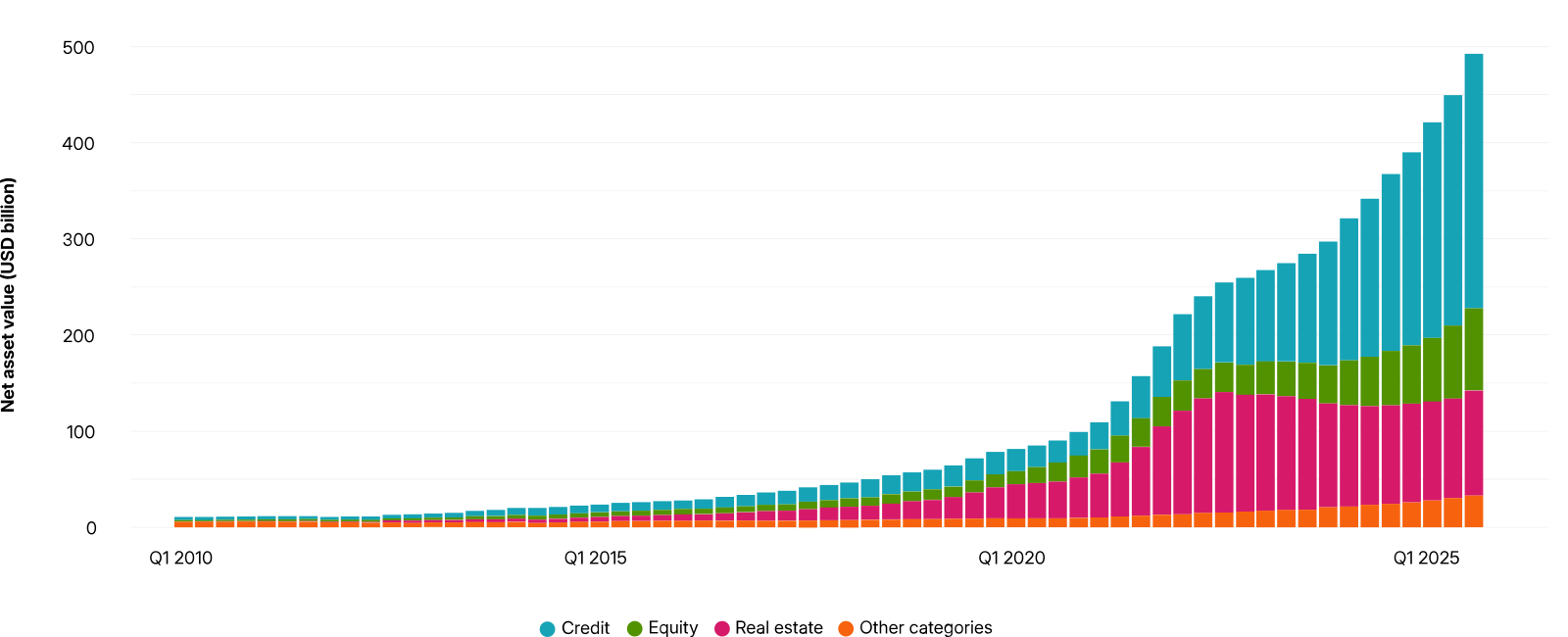
Figures reflect the full identified universe; index constituents are subject to defined strategy, structural, size and reporting criteria. Data through Sept. 30, 2025.
Historically, private equity has outperformed public assets over varying timelines with an alpha that can only be partially captured through listed investments. Evergreen structures aim to capture the same alpha while mitigating three longstanding constraints of private markets: illiquidity, irregular capital flows and complex commitment pacing. On the illiquidity issue, one argument attributes the drivers of private-market outperformance to structural advantages such as control, governance and operational improvement, with illiquidity a mere bug of legacy fund structures that newer semi-liquid vehicles have since fixed.
So what have evergreen funds delivered? Returns measured by the recently launched MSCI US Evergreen Fund Monthly Indexes have been notable. In private credit, evergreen funds outperformed their closed-end counterparts by around 160 basis points for the 12 months ending Sept. 30, 2025, though they lagged for much of 2022 to 2023 with returns that fell to near 0%.
In private equity, the picture is more mixed: The strong outperformance over the year through September contrasts with significant underperformance during the 2021-2022 bull market. Evergreen funds for private real estate have also outperformed their drawdown counterparts in the recent period, and it’s notable that their returns turned positive in 2025, while drawdown funds still posted negative returns.
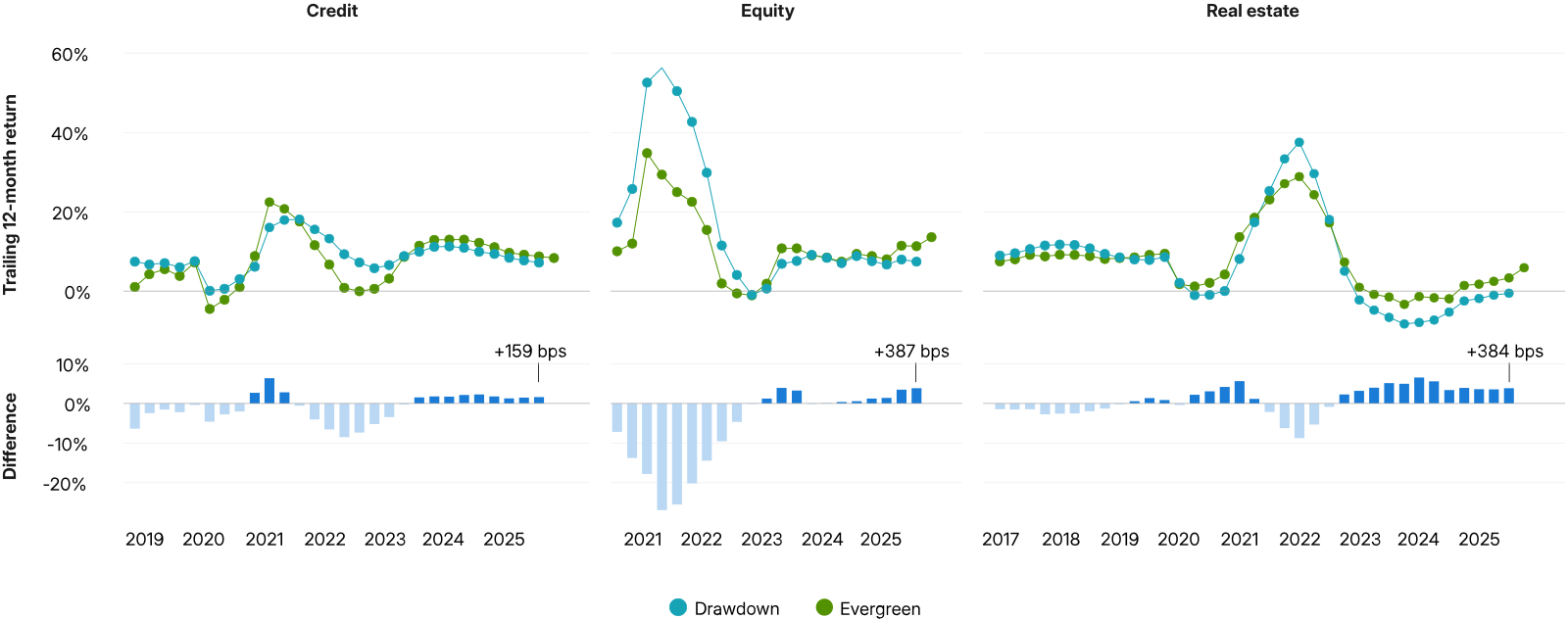
Trailing 12-month returns for evergreen-fund indexes and their drawdown counterparts. Latest performance available for drawdown funds is through Sept. 30, 2025, evergreen-fund indexes through Dec. 31, 2025. Time series correspond to index inception dates. For private credit the drawdown-index comparison is the MSCI US Direct Lending Closed-End Fund Index; for private equity, the MSCI US Private Equity ex-Venture Capital Closed-End Fund Index; for private real estate, the MSCI US Private Real Estate Closed-End Fund Index.
Headline returns tell only part of the story. In private markets, the dispersion (the spread between top- and bottom-performing funds) can be far more consequential than any pooled or median performance because of an investor’s inability to invest across the entire market. Wide dispersion reinforces the importance of manager selection, underwriting discipline and portfolio construction.
In evergreen structures, this dispersion may matter even more. Unlike traditional drawdown funds, where capital is locked for the long life of a fund, semi-liquid vehicles introduce a new possibility: the active reallocation of capital between different funds. Periodic liquidity (although limited in both time and amount) creates a new dynamic where investors are not just choosing a manager once per cycle but can continuously evaluate performance relative to peers — which heightens the importance of relative benchmarking.
Looking at the 12-month performance through September across funds in our evergreen-fund indexes, we observe meaningful performance dispersion. Even setting aside the widest top-to-bottom performance as potentially being one-off outlier events, we observe an 8.1%, 18.1% and 13.3% spread in private credit, private equity and private real estate between the 95th and 5th percentile fund returns, respectively.
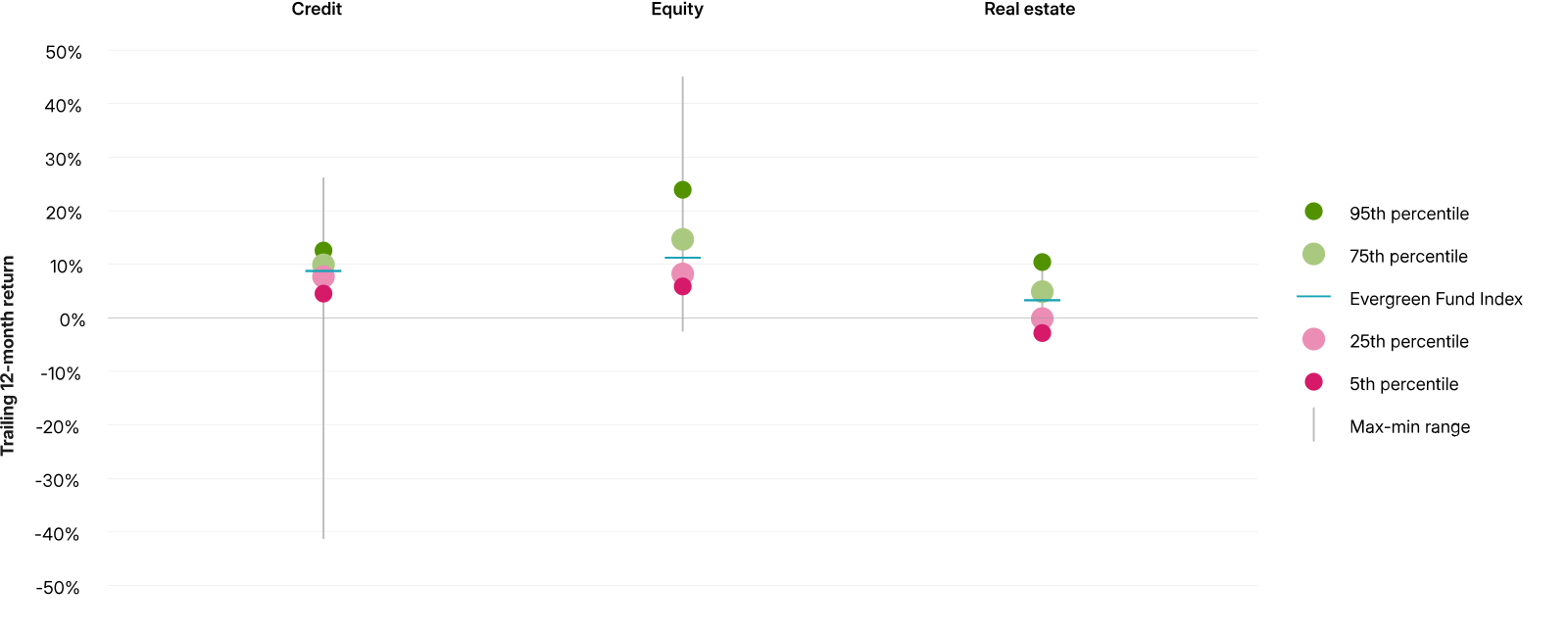
Trailing 12-month returns for evergreen-fund indexes and the dispersion of fund returns within each. Performance through Sept. 30, 2025.
Evergreen funds are likely to become a permanent feature of how private markets raise and deploy capital, with different implications and challenges for the key constituents.
For asset managers, evergreen vehicles introduce something private markets historically lacked: continuity. Rather than episodic fundraising followed by years of deployment and harvest, these structures maintain a continuously invested base, which enables longer-duration and more permanent investment strategies. But continuity comes with new constraints. Liquidity management becomes central, balancing ongoing deployment against redemption pressure — a challenge most familiar in real estate. Net-asset-value (NAV) transparency grows more frequent and consequential, serving as both subscription price and redemption price. What was once merely a reporting metric now functions as a market-clearing price.
For institutional investors, the trade-off is clearer. Evergreen structures can support allocation targets without the vintage straitjacket and pacing constraints of drawdown funds, but they also challenge long-standing assumptions. NAV-based fee models will bring new scrutiny into the quality of reported NAVs. And broader wealth participation could affect the conditions that have historically supported private-market alpha. Institutions will need frameworks that assess evergreen funds, drawdown vehicles and public markets on comparable terms — across risk, liquidity and capital efficiency.
The expansion to the wealth channel may be the most consequential shift. Access through familiar channels broadens participation, but wealth investors are generally less equipped to fully understand the risks they’re taking on. Valuation smoothing can mute visible volatility without removing underlying risk, creating timing mismatches when reported NAVs lag reality. And expectations shaped by the daily liquidity of listed investments will inevitably collide with redemption gates.
Regulators will be watching. As these funds scale, liquidity mismatch moves from a theoretical to systemic concern, and standards around redemption policies, valuation practices and disclosure are likely to evolve. The inclusion of private assets in retirement accounts only raises the stakes.
Evergreen funds are reshaping incentives across the private-market ecosystem and blurring long-standing distinctions between public and private universes. Continuous capital and broad wealth distribution are reconfiguring an asset class once defined by illiquidity and exclusivity. How that reshaping plays out will depend on how managers, investors and regulators adapt — to a private market that is no longer quite so illiquid, nor quite so private.

Subscribe todayto have insights delivered to your inbox.
Private Capital in Focus: Trends to Watch for 2026
Satisfying investors’ unquenched thirst for liquidity, the rise — and risks — of private credit, and the hard work of buyout value creation shape private markets at the start of the year.
Venture-Debt Loan Marks in Deteriorating Health
In private credit, the increase in fair-value write-downs in venture debt has far exceeded that for opportunistic and direct lending strategies, with loans to one industry the chief cause.
1 Evergreen funds comprise interval funds, non-listed business-development companies, non-listed REITs and tender-offer funds. The U.S. Securities and Exchange Commission classifies evergreen funds as closed-end funds, while MSCI and the industry at large typically use the term closed-end for traditional drawdown funds. A drawdown fund allows investors into the fund only at (or near) the start of the fund, and then calls and returns capital during the life of the fund, and eventually liquidates.
The content of this page is for informational purposes only and is intended for institutional professionals with the analytical resources and tools necessary to interpret any performance information. Nothing herein is intended to recommend any product, tool or service. For all references to laws, rules or regulations, please note that the information is provided “as is” and does not constitute legal advice or any binding interpretation. Any approach to comply with regulatory or policy initiatives should be discussed with your own legal counsel and/or the relevant competent authority, as needed.