
From Concentration to Diversification: Balancing Taxes, Risk and Performance
- Transitioning a concentrated stock portfolio to that of a diversified index is a common challenge for wealth managers. The specific mechanisms for doing so can vary widely with market and individual stock performance.
- High embedded gains can lead to significant taxes, reducing an investor’s net returns. We found that how much gain can be realized and how quickly the transition occurs can reduce the tax drag.
- Our historical simulation demonstrates how wealth managers can balance tax efficiency, risk and relative performance to help their clients achieve smooth transitions.
Wealth managers often work with high-net-worth (HNW) individuals who hold a considerable amount of one company’s stock (company executives, for example). This results in a very concentrated portfolio, which can come with high investment risk. Selling these stocks can mitigate the investment risk but may also trigger a considerable tax liability for large realized gains. By reinvesting the embedded gains into a diversified basket of assets, however, the client may be able to reverse the tax drag. Our simulation-based study found that, under the same market conditions, faster transitions reduced the net tax impact by more than 80 basis points (bps) annually with similar total portfolio returns.1
To illustrate how scenario analysis can help with making decisions on balancing trade-offs of risk, tax and after-tax performance,2 we look at a hypothetical case of a U.S.-based HNW individual, the executive of a company, with significant company stock holdings:3
- We assume the stock price has risen after vesting, resulting in USD 1.5 million of unrealized gains in a USD 2.5 million portfolio, at the start of the simulated transition.
- The legacy stock portfolio has a tracking error of 20.3% relative to the MSCI USA Index. Our target is a diversified equity portfolio with tracking error below 2%, which we consider the threshold for a successful transition.
- We examined annual gain budgets from USD 100,000 to USD 1.2 million with quarterly portfolio rebalances over a five-year transition period.4
- The scenario-analysis framework used historical performance deciles of the MSCI USA Index to reflect a wide range of potential stock outcomes and avoid selection bias.
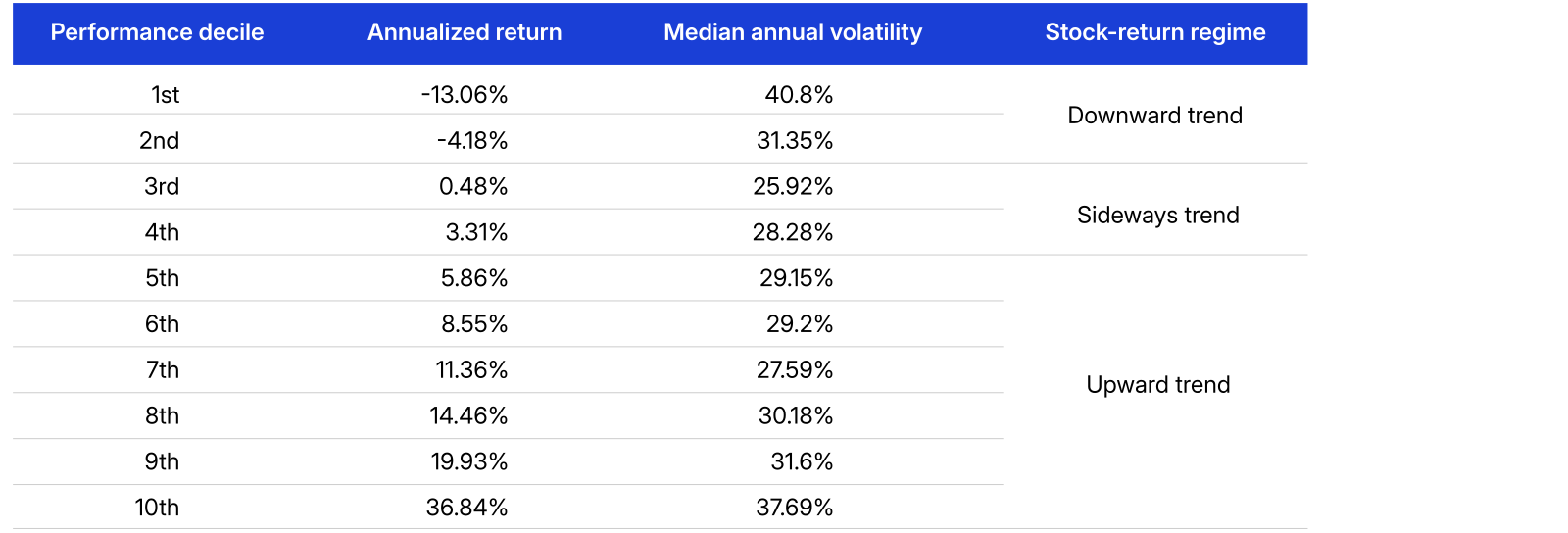
The deciles were constructed by ranking constituents of the MSCI USA Index based on their performance between Dec. 31, 2019, and Jan. 1, 2025. The table reports the average return and median volatility for the assets within each decile. Over the same period, the MSCI USA Index delivered an annualized return of 14% with volatility of 21.7%.
To begin our scenario analysis, we examined the market conditions and potential expectations from the legacy stock. The study is based on data from a recent five-year period, where the market trended upward, but many stocks experienced marked drawdowns.
The charts show the performance, risk and tax dimensions of simulated transition strategies between Dec. 31, 2019, and Jan. 1, 2025. An initial rebalance is followed by quarterly rebalances. The net tax impact models both the taxes and benefits of realized losses, relative to the starting portfolio value of USD 2.5 million.
The selection of a gain budget proved to be critical, but no single choice can simultaneously optimize risk reduction, portfolio performance and tax efficiency. Nevertheless, the transition’s primary goal in this trilemma was to reduce tracking error until we obtained a well-diversified target portfolio. The expected time taken to hit the 2% tracking-error target was a key outcome for the strategy.
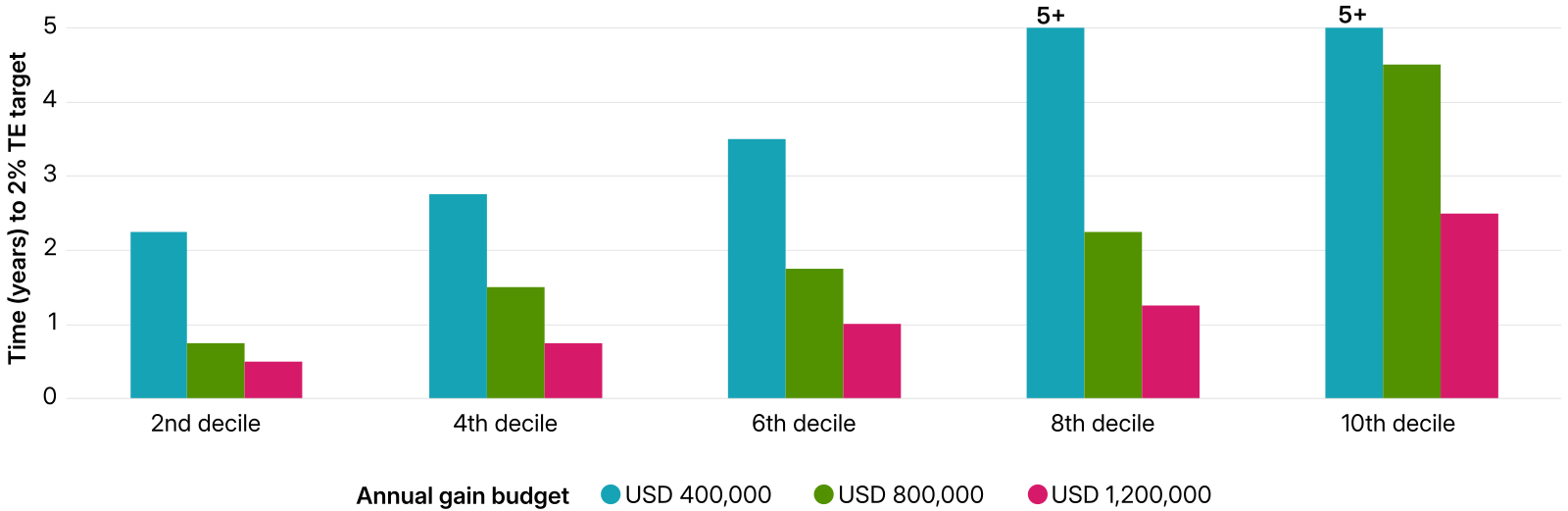
The chart shows the end state of different transition strategies after a five-year transition period. Columns are annotated to indicate cases in which the portfolio did not reach the 2% tracking-error target within the five-year transition window.
Shifting market conditions can create an asymmetrical challenge for wealth managers: In favorable conditions, clients may prefer a slower transition (that is, using a lower gain budget) while their portfolio outperforms, even at the cost of higher risk. In contrast, higher tax efficiency may be insufficient to outweigh the underperformance of the target benchmark and/or major portfolio losses for a client. A low gain budget may be inadequate to complete the transition in five years, given changing conditions, even if gains stayed constant, which is rarely the case.
Each dot represents the end state of each five-year transition strategy that achieved the 2% tracking-error target. In the simulation, higher gain budgets (green-colored) resulted in the best combination between tax efficiency and benchmark-relative performance.
In the downward and sideways-trending deciles of the simulated scenarios, the net tax impact was similar regardless of the gain budget. In these deciles, higher gain budgets and faster transitions toward the benchmark are especially beneficial. By reallocating from a lagging stock into a diversified benchmark portfolio, the likelihood of switching to stronger-performing components increased, which elevated performance.
In the upward-trending deciles, the difference between higher and lower gain-budget outcomes was clearer. Strategies using higher gain budgets achieved an average annual tax reduction of 80 bps when compared with lower-gain-budget strategies that delivered similar performance. With higher gain budgets, the legacy positions were closed earlier in the simulated strategies so that embedded gains were replaced with new positions. In the simulations, we found that during the 2022-2023 market correction, strategies that realized more losses at that time achieved better terminal outcomes. These opportunities translated into an improved net tax impact by realizing losses on weaker performers and enhancing portfolio value with stronger ones. The replacements proved to be new gains by 2025 while keeping performance steady.
Using historical scenario-based simulations, we have shown that realized-gain-budget selection is critical when designing a transition strategy from a concentrated stock portfolio to diversified, broad-market exposure. Additionally, we analyzed how portfolio outcomes may be shaped by the stock’s benchmark-relative performance during the transition. While there is no one-size-fits-all solution, the guidelines we’ve provided are an example of guardrails that can help wealth managers construct a transition strategy that balances after-tax performance, concentration risk and portfolio volatility.

Subscribe todayto have insights delivered to your inbox.
Total Portfolio Allocation for Modern Wealth
Traditional asset allocation theories often overlook private assets. We provide a practical blueprint for total portfolio allocation management, focused on a deeper understanding of market correlations to better manage concentration risk and uncertainty in expected returns.
Drawdowns Can Have a Silver Lining for Your Taxes
An event-driven tax-loss harvesting strategy improved a U.S. equity portfolio’s after-tax return by 2.6 percentage points over six years when compared to a periodic-only approach.
Quantitative Investment Solutions
Portfolio managers can construct customized and tax-optimized portfolios at scale to reflect their clients’ tax and investment objectives.
1 Net tax impact is defined as the combined effect of payable taxes after realized gains and the offsetting benefits of realized losses over the transition period. The 80-basis-point annual reduction reflects the average annual difference observed across simulated transition strategies with higher versus lower gain budgets over the study period. Results may vary by case and market conditions.
2 After-tax performance is calculated by adjusting pre-tax performance with net tax impact. In line with the United States Investment Performance Committee (USIPC) After-Tax Performance Standards promulgated by CFA Institute, taxes have a negative effect on performance, while realized losses can have a positive effect.
3 After-tax performance is calculated by adjusting pre-tax performance with net tax impact. In line with the United States Investment Performance Committee (USIPC) After-Tax Performance Standards promulgated by CFA Institute, taxes have a negative effect on performance, while realized losses can have a positive effect.
4 The gain budget is a predefined limit on realized net capital gains allowed at each transition year. Asset sales are permitted within this constraint, provided they do not violate the wash-sale rule, which restricts the recognition of tax losses when substantially identical securities are repurchased within a 30-day window.
The content of this page is for informational purposes only and is intended for institutional professionals with the analytical resources and tools necessary to interpret any performance information. Nothing herein is intended to recommend any product, tool or service. For all references to laws, rules or regulations, please note that the information is provided “as is” and does not constitute legal advice or any binding interpretation. Any approach to comply with regulatory or policy initiatives should be discussed with your own legal counsel and/or the relevant competent authority, as needed.