
Human-Rights Risks in Portfolios: From Oversight to Due Diligence
- Market shift toward prevention: Financial institutions are moving beyond reacting to human-rights violations and are increasingly embedding proactive due diligence to identify and mitigate risks before they materialize.
- Hidden exposures can run deep: Just 3% of companies in the MSCI ACWI Index report on modern slavery risks, yet nearly 40% may be exposed to forced or child labor somewhere in their value chains.
- Human rights can impact financial resilience: Companies with stronger supply-chain labor standards have historically delivered better financial returns than peers over the past 10 years.
Financial institutions face growing pressure to identify and manage hidden human-rights risks across their portfolios, yet limited corporate disclosure and the lack of forward-looking analytical tools make it difficult to act before financial and reputational impacts materialize.
The share of Principles for Responsible Investment (PRI) signatories with human-rights investment policies rose to 64% in 2024, up from 56% the previous year.1 Most of the 20 largest banks and insurers now integrate human rights into lending and underwriting due diligence.2 This shift reflects heightened policy and stakeholder scrutiny, alongside evidence that weak corporate human-rights practices can carry financial consequences.3
Evolving practices, hidden risks
Market practices are also evolving. Historically, investors and lenders have responded only after human-rights violations surfaced. Today, leading financial institutions are proactively assessing where adverse human-rights impacts may arise in their downstream activities and whether their investees or clients are equipped to prevent or mitigate them. This evolution aligns with the UN Guiding Principles on Business and Human Rights (UNGPs) and the OECD Guidelines for Multinational Enterprises (OECD MNE Guidelines) — frameworks increasingly referenced by regulators and financial institutions globally.4
Our research, however, suggests that exposure to negative human-rights impacts is far greater than corporate reporting or isolated controversies indicate. For example, fewer than 3% of MSCI ACWI Index constituents disclosed exposure to forced or child labor risk, yet we found that 8% faced related allegations.5 In addition, nearly 40% had potential exposure based on MSCI’s Impact Materiality Assessment, which evaluates risk at the product and business-activity level across value chains, as per the chart below. Similar blind spots are evident for other human-rights issues covered in the assessment, including indigenous peoples’ rights and information-related rights.
Identifying the most salient human-rights risks in business activities
MSCI Human Rights Metrics include an impact materiality assessment that evaluates companies’ exposure to material negative impacts on four stakeholder groups across more than 15 human-rights issues, including forced and child labor. These tools can help financial institutions identify priority human-rights risks within a portfolio, loan book or company to better target due diligence efforts. We identify the share of index constituents with a potential material negative impact on people (based on GICS sub-industry) within the MSCI ACWI Index and MSCI SRI Index, respectively.
-01.svg)
Data as of Oct. 10, 2025. Turquoise bars show the percentage of MSCI SRI Index constituents identified as having a potential material negative impact on stakeholders. Blue bars show the percentage of MSCI ACWI Index constituents identified as having a potential material negative impact on stakeholders. Source: MSCI Sustainability & Climate, MSCI Impact Materiality Assessment. MSCI Sustainability & Climate products and services are provided by MSCI Solutions LLC in the United States and MSCI Solutions (UK) Limited in the United Kingdom and certain other related entities.
Among companies identified as being at risk of forced or child labor, many still lack foundational human-rights practices aligned with the UNGPs and OECD MNE Guidelines (see our second chart). Supply chains — the main source of exposure to forced and child labor — are also where safeguards are most often absent. Fewer than one-third of these firms have adopted living-wage commitments or comprehensive grievance and remediation mechanisms for supply-chain workers, despite these measures being critical to addressing root causes such as wage vulnerability, limited worker voice and the lack of effective corrective pathways.
Cracks in the chain: High-risk companies fall short on mitigation practices
MSCI Human Rights Metrics include more than 100 sector-agnostic and sector-specific indicators that assess how companies prevent, reduce and remediate negative impacts on people. Below, we evaluated the practices of companies identified as being at risk of modern slavery, focusing on both foundational human-rights practices as well as supply-chain-specific practices, where the risk is most prevalent (share of companies with such practices).
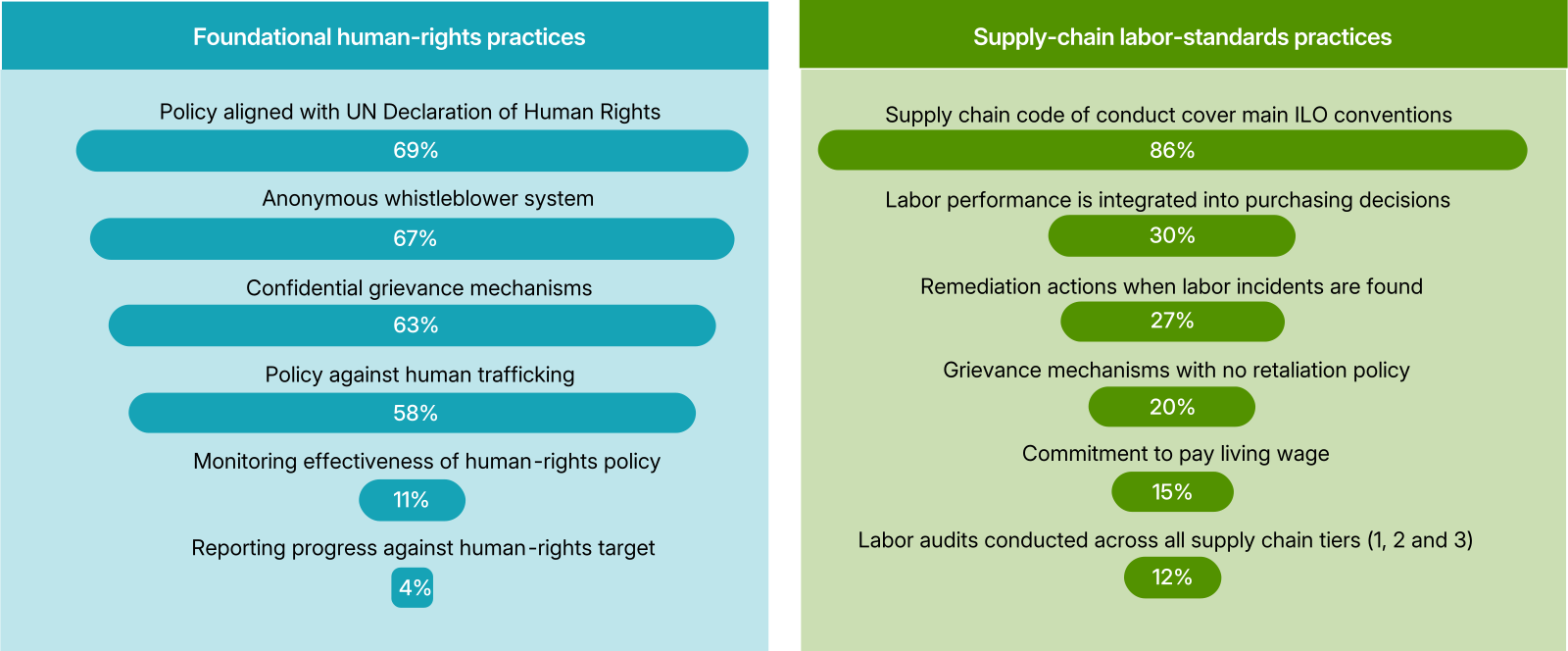
Data as of Oct. 10, 2025. Left chart universe: MSCI ACWI Index constituents identified as having a potential material negative impact related to child and forced labor in the MSCI Impact Materiality Assessment (n=912). Right chart universe: MSCI ACWI Index constituents assessed on the Supply Chain Labor Standards Key Issue in MSCI ESG Ratings (n=143; except for living wage and grievance mechanisms: n=127). Source: MSCI Sustainability & Climate
The cost of inaction could be substantial. MSCI estimates that up to USD 652 billion in revenues among at-risk companies may be linked to forced or child labor.6 Such exposure can translate into regulatory penalties, operational disruptions and reputational damage that may meaningfully affect performance. As of 2025, our research indicates that more than 70% of MSCI ACWI Index constituents were subject to at least one modern-slavery or human-rights-related regulation.7
Beyond legal risk, alleged weak labor standards have already led to higher sourcing costs, production delays and value-chain restructuring as firms divest or rotate away from high-risk suppliers.8 Reputational impacts can also erode consumer trust, with allegations of unethical sourcing contributing to local boycotts, revenue declines and longer-term brand impairment.9
Looking back over the past decade, we found that companies with stronger supply-chain labor practices tended to outperform peers with weaker practices, generating higher cumulative returns, as illustrated in the chart below. This suggests that stronger human-rights practices not only align with global norms and expectations but may also signal greater financial resilience over the long term.
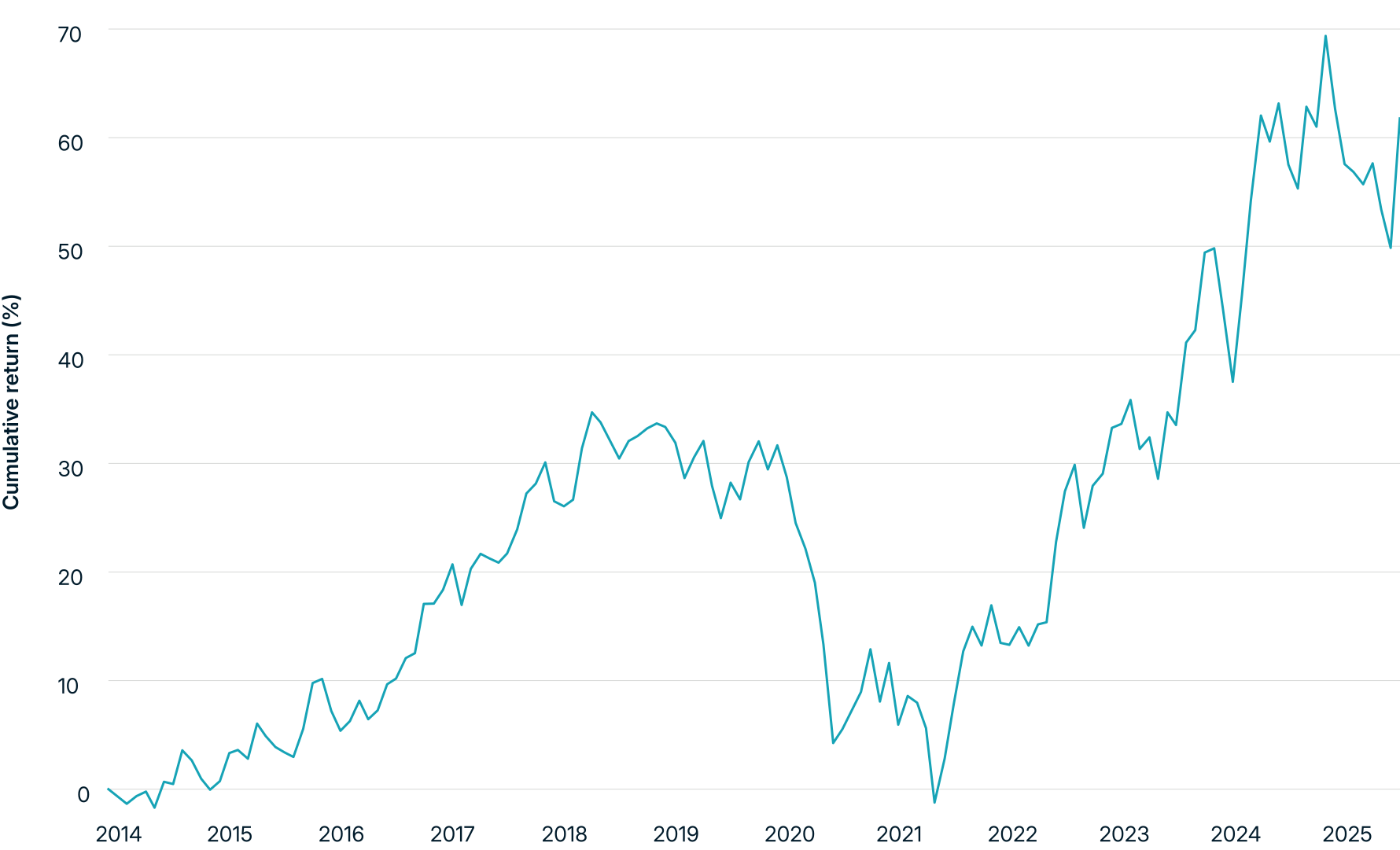
Data for the period Sept. 30, 2013, to April 30, 2025. Analysis covers MSCI ACWI Index constituents assessed on the Supply Chain Labor Standards Key Issue. Over this 10-year period, these companies represented an average of 7.25% of MSCI ACWI Index constituents. Quintiles are rebalanced monthly based on adjusted scores. Scores are first z-scored by GICS sector and region (North America, Europe, Pacific and EM subindexes of the MSCI ACWI Index) and then size-adjusted. The next month’s performance (in USD return) is calculated for each quintile. The chart shows the cumulative performance difference between the top and bottom quintiles. The associations reported are correlations and do not imply causation. Source: MSCI Sustainability & Climate
Financial institutions face growing pressure to embed human-rights due diligence across their investment and financing decisions. Leveraging systematic, data-driven tools — such as MSCI’s Human Rights Metrics and Impact Materiality Assessment — may help investors and lenders respond to emerging regulatory demands, uncover hidden risks and direct capital toward companies better equipped to manage them. This can accelerate the shift from reactive oversight of human-rights risks to proactive stewardship, supporting portfolios that are both more responsible and more resilient.


Subscribe todayto have insights delivered to your inbox.
Sustainability and Climate in Focus: Trends to Watch for 2026
As governments pivot toward security and technology, markets are increasingly defining the sustainability agenda. We explore how capital, data and risk are driving the next phase of the transition.
What is impact materiality?
What is impact materiality, you ask? And how is it different from financial materiality? A fine and important question, listener! In this episode we take you through all the details you need to parse through the most important sustainability-jargon out there. Including, an explanation of the EU's Corporate Sustainability Reporting Directive, or the CSRD, which has its first required reporting cycle due next year.
Social Risks and Opportunities for Corporates: Long-Term Performance in Global Equity Markets
What goes into an analysis of financially material social risks and opportunities? And what does it mean for a company’s market performance? Our analysis found that scoring on social-risk themes was a key indicator of performance.
1 “Global Responsible Investment Trends,” PRI, March 2025. By comparison, 69% of PRI signatories had specific climate-change guidelines in 2024, up from 65% the year prior.
2 10 largest banks and 10 largest insurers by market capitalization, as of Oct. 10, 2025. Source: MSCI Sustainability & Climate.
3 “How are financial institutions in Europe addressing human rights in their core business activities?” Geneva Center for Business and Human Rights, 2025.
4 950 investment managers and 235 asset owners reported using these frameworks, representing USD 24 trillion and USD 40 trillion in AUM, respectively. “Annual Report 2024,” PRI, 2024.
5 Based on active child- and forced-labor-related controversies within MSCI Controversies. Universe: MSCI ACWI Index constituents, as of Dec. 9, 2025.
6 We estimated the share of company revenues potentially linked to forced or child labor by mapping each business segment’s reliance on goods commonly produced under such conditions, as identified by the U.S. Department of Labor, and applying economic input–output data from the U.S. Bureau of Economic Analysis. The analysis focused on MSCI ACWI Index constituents for which forced and child labor in the supply chain was identified as a salient risk according to the MSCI Impact Materiality Assessment (n=905, as of Oct. 7, 2025).
7 By market capitalization, as of Oct. 7, 2025. Source: MSCI Sustainability & Climate.
8 As an example: “Volkswagen sells scandal-hit Chinese factory in Uighur province,” The Times, Nov. 27, 2024.
9 As an example: “Shein Chose Paris for Its First Boutique. Paris Isn’t Pleased,” The New York Times, Oct. 10, 2025.
The content of this page is for informational purposes only and is intended for institutional professionals with the analytical resources and tools necessary to interpret any performance information. Nothing herein is intended to recommend any product, tool or service. For all references to laws, rules or regulations, please note that the information is provided “as is” and does not constitute legal advice or any binding interpretation. Any approach to comply with regulatory or policy initiatives should be discussed with your own legal counsel and/or the relevant competent authority, as needed.