
MSCI’s 2024 Capital for Climate Action APAC Conference: Key Takeaways
- MSCI’s Capital for Climate Action APAC Conference convened the region’s investors, companies and financial institutions to address the challenges and opportunities that mark this decisive moment in the transition toward a low-carbon economy.
- The Asia-Pacific (APAC) region will play an outsize role in the global shift to a clean-energy economy.
- Discussion focused on financing decarbonization, the usefulness of looking beyond emissions, development of biodiversity metrics and the importance of action.
The APAC region is more important than any other for reaching net-zero by 2050, observed Baer Pettit, MSCI's president and chief operating officer. "On the one hand, APAC accounts for about 40% of global emissions, and more than three-quarters of coal-fired power generation. On the other hand, it also accounts for a massive share of low-carbon and green innovation."
- Though the region comprises diverse economies, three characteristics "make it very advantageous for taking climate action," Linda-Eling Lee, head of the MSCI Institute, noted. "Investors in this region are more pragmatic, they are more willing to embrace experimentation and try new financing structures, and there is public and private sector alignment that means less friction between policy and practice."

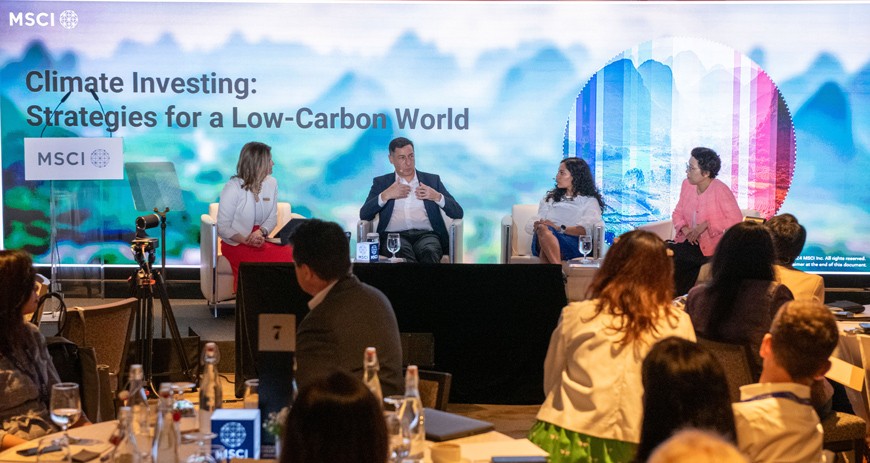
Linda-Eling Lee, head of the MSCI Institute, and Xiaoshu Wang, who leads MSCI's climate research in APAC, discuss climate progress in the region.
- The transition "looks very different across different clients in the region," reported Sunita Subramoniam, APAC head of sustainable product strategy, iShares and Index at BlackRock, who added that decisions about capital allocation start with "the part of the capital stack you're looking at." "So let's say you're looking at public equities, fixed income and real estate," she suggested. "Do you want to simply exclude or do you want to take things a little bit further along in the spectrum of sustainable and transition investing?"
- In the past year "a lot of financial institutions have really started to understand the importance of transition planning," observed Yuki Yasui, managing director, Asia-Pacific Network, Glasgow Financial Alliance for Net Zero (GFANZ), citing financing strategies mapped out by GFANZ that demand "an institution-wide approach."
- There are "obviously going to be leaders and laggards within each sector, and then you move on to companies that are benefiting from or contributing to the transition," Subramoniam noted, adding that "it's not binary; companies can be in all of these categories or some of these categories."
- "I don't think people really understand the concept of stranded assets," suggested Konyn, who noted that AIA last year began to exclude companies involved in providing coal-fired power or mining from its portfolio. "We redeployed those resources, on a proactive basis, in companies that can make the transition."
- At the same time, engagement matters, he added, citing AIA's dialogue with a power company it had removed from its portfolio but later financed after the company "restructured its resources and came back to us with an opportunity where certain assets had been ring-fenced and where we could, with real conviction, put money to work around the transition that we felt had credibility."
- Carbon credits are poised to play an integral role in financing a managed phaseout of coal, suggested Yasui, citing work by the Monetary Authority of Singapore to use transition credits as a complementary financing instrument.[1] "Whether we can get high-integrity credits might be what seals the deal," she observed. "It's super-important to get this right."
- "It's not letting perfect be the enemy of good," agreed Jaclyn Dove, head of strategic initiatives, sustainable finance, Standard Chartered Bank, which set its targets on activities in hard-to-abate sectors that it will and will not finance. "It's client by client and product by product," she noted.
- "We want to make our climate targets come to life from a balance-sheet perspective," explained Priya Bellino, head of the sustainability solutions group, Asia Pacific, Sumitomo Mitsui Banking Corporation, adding that while she and her colleagues examine national energy roadmaps, scenarios, and the alignment of customers with science-based net-zero pathways, "if we wait until that perfect scenario for Thailand, Malaysia or Indonesia, we're not going to have done anything."
- Nietsch noted the value of looking at indicators of transition risk in lieu of emissions. "If you're working with an extractive company, what are the barrels of oil equivalents? What are the tons of coal? You can begin to use all of these other metrics as proxies for Scope 3," he observed.
- Reporting by small- and medium-sized enterprises matters to the region, noted Anjali Viswamohanan, director of policy, Asia Investor Group on Climate Change (AIGCC), citing the disclosure gap between SMEs and their large-cap counterparts. Simplified sustainability reporting guidelines like those issued by regulators in Malaysia can help, she suggested, as can "creating more forums for SMEs to actually engage with each other and understand what sort of data can be put out there."[2]
- The "very long tail of small and medium companies" is an area that MSCI hopes to bring some solutions for in the near future, Pettit said.
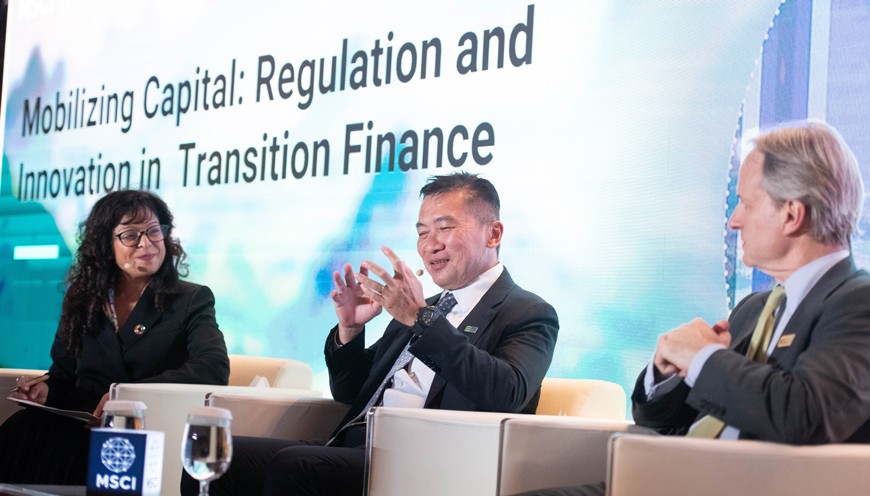
- The critical focus for MSCI, Pettit noted, "is providing the greatest insight into the risk and returns of exposures that have a climate tilt."
- "How do we translate the path to net-zero as a means of unlocking shareholder value," said Loh. At the same time, he added, "many asset owners are new on the path of de-risking, not just a portfolio but in finding new investment opportunities to enhance their portfolio."
- "Conversations on nature and biodiversity depend on the sector, the country and the size of the company itself," observed Melissa Moi, head of sustainable business, group corporate sustainability officer at United Overseas Bank Limited (UOB). "Most of us are quite early in our journey of trying to understand the risks and opportunities and how we start integrating nature and biodiversity into the conversations that we have with clients."
- The risks from biodiversity may not always be what they appear, Moi added, citing UOB's clients in commercial real estate. "Singapore is the world's largest importer of sand from Malaysia, Indonesia and Cambodia. So when we start thinking about nature in terms of the second-order effects in your value chain, that's when the conversation becomes a little bit different."
- "Rebuilding nature is five times more expensive than preserving it," noted Mikkel Larsen, chief executive officer of Climate Impact X. "When clients get that observation, they realize there is some logic for why we should try to preserve before we actually rebuild."
- Clients get a better outcome with the Taskforce on Nature-related Financial Disclosures (TNFD) when they "see it as a risk exercise, not as a reporting exercise" and avoid overcomplicating it, Larsen added. "Do a rough and dirty analysis and you'll get the 80/20 rule right and start to see your exposures," he suggested.
- The availability of TNFD-related data can present a challenge, underscored Vanston, who suggested that for a share of such metrics, "investors will need to get comfortable with proxies for some time."
- Pragmatism matters for driving real decarbonization or preservation of nature, noted Moi, who stressed the importance of viewing the conversation from a regional perspective, citing APAC's outsize exposure to biodiversity risk. "The narrative around target-setting needs to focus on closing the gap instead of getting scolded for breaching that line."
- "I come back to my statement from before that we can make this extremely complex and we'll get nowhere or we can try to be practical," Larsen agreed.


Subscribe todayto have insights delivered to your inbox.
The content of this page is for informational purposes only and is intended for institutional professionals with the analytical resources and tools necessary to interpret any performance information. Nothing herein is intended to recommend any product, tool or service. For all references to laws, rules or regulations, please note that the information is provided “as is” and does not constitute legal advice or any binding interpretation. Any approach to comply with regulatory or policy initiatives should be discussed with your own legal counsel and/or the relevant competent authority, as needed.