
Run Risk or Rational Repricing? Private Credit’s Software Stress Test
- The selloff in listed business development companies (BDCs) in the first week of February reflected a targeted 6% repricing of software-specific borrower risk rather than broad-based stress in private credit.
- Software borrowers from private-credit funds are more highly leveraged and more dependent on future growth expectations than borrowers in other industries, making them more sensitive to adverse shocks.
- For wealth investors seeking private-credit exposure through BDCs, transparency into BDC portfolios is critical for risk management, just as transparency into bank funding was key to averting bank runs during past financial crises.
When Anthropic announced a suite of open-source plug-ins for Claude Cowork on Jan. 30, 2026, investors across asset classes faced a common question: Which companies are most exposed to disruption through accelerating automation? In private-credit markets, the answer came quickly. The MSCI US Listed BDC Index fell 11% through March 11, but the selloff was uneven — in a predictable way. On average, funds with higher allocations to software borrowers underperformed their peers, while those with limited software exposure saw smaller declines.
That dispersion matters. Unlike the stress following the Tricolor Holdings and First Brands Group bankruptcies, which raised broad concerns about private-credit underwriting, this episode appears more targeted. In listed BDCs, at least, investors were not simply reducing exposure to the asset class but differentiating based on underlying portfolio exposures.
Whether the same discipline holds in non-traded, semi-liquid private-credit vehicles is less clear, and may well determine the future of wealth participation in the asset class. More generally, investors are left wondering whether the repricing of publicly listed BDCs and the corresponding redemption queues in non-traded, semi-liquid BDCs accurately reflect fundamentals, or whether they are an overshoot driven by uncertainty and limited information.
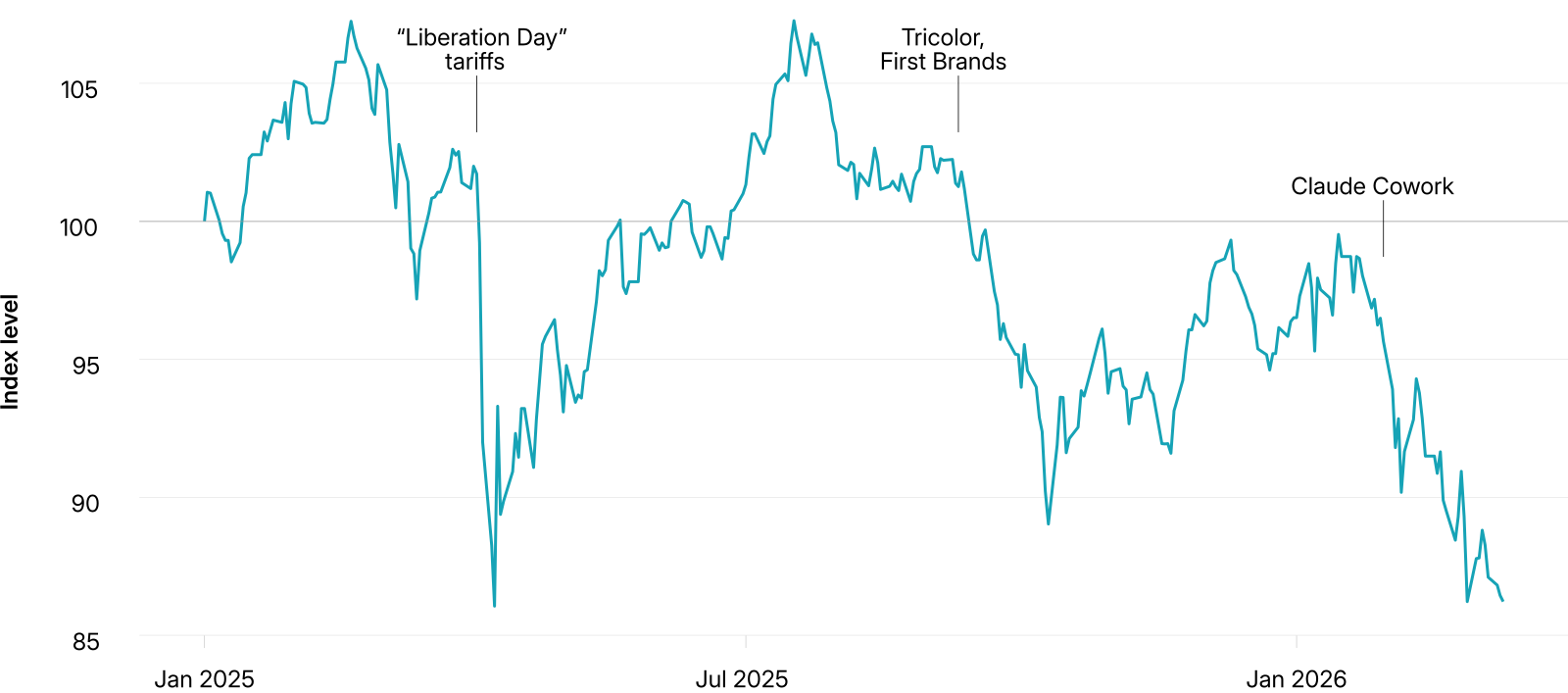
Jan. 1, 2025 through March 11, 2026. The MSCI US Listed BDC Index is a total-return index of listed private-credit BDCs.
Software borrowers represent a meaningful share of many BDC portfolios, exceeding 30% of assets in some funds. These borrowers carry a distinct risk profile. MSCI data on private-credit borrowers indicates that companies in the IT sector have median net-debt-to-EBITDA ratios roughly 0.4x and 1.1x higher than borrowers in other major private-credit sectors such as health care and industrials, respectively, and 0.4x higher than the overall private-credit universe. They also tend to be more dependent on growth expectations. Higher leverage combined with growth dependence makes these borrowers more sensitive to adverse shocks.
To isolate the software-driven component of the BDC selloff, we compared the performance of listed BDCs in the week following the Anthropic announcement to each fund's software exposure, based on portfolio data as of year-end 2025.
The relationship is clear: BDCs with greater allocations to software borrowers experienced larger declines. Our regression indicates that a hypothetical BDC with 100% software exposure would have underperformed a fund with zero software exposure by approximately 13 percentage points over the period.
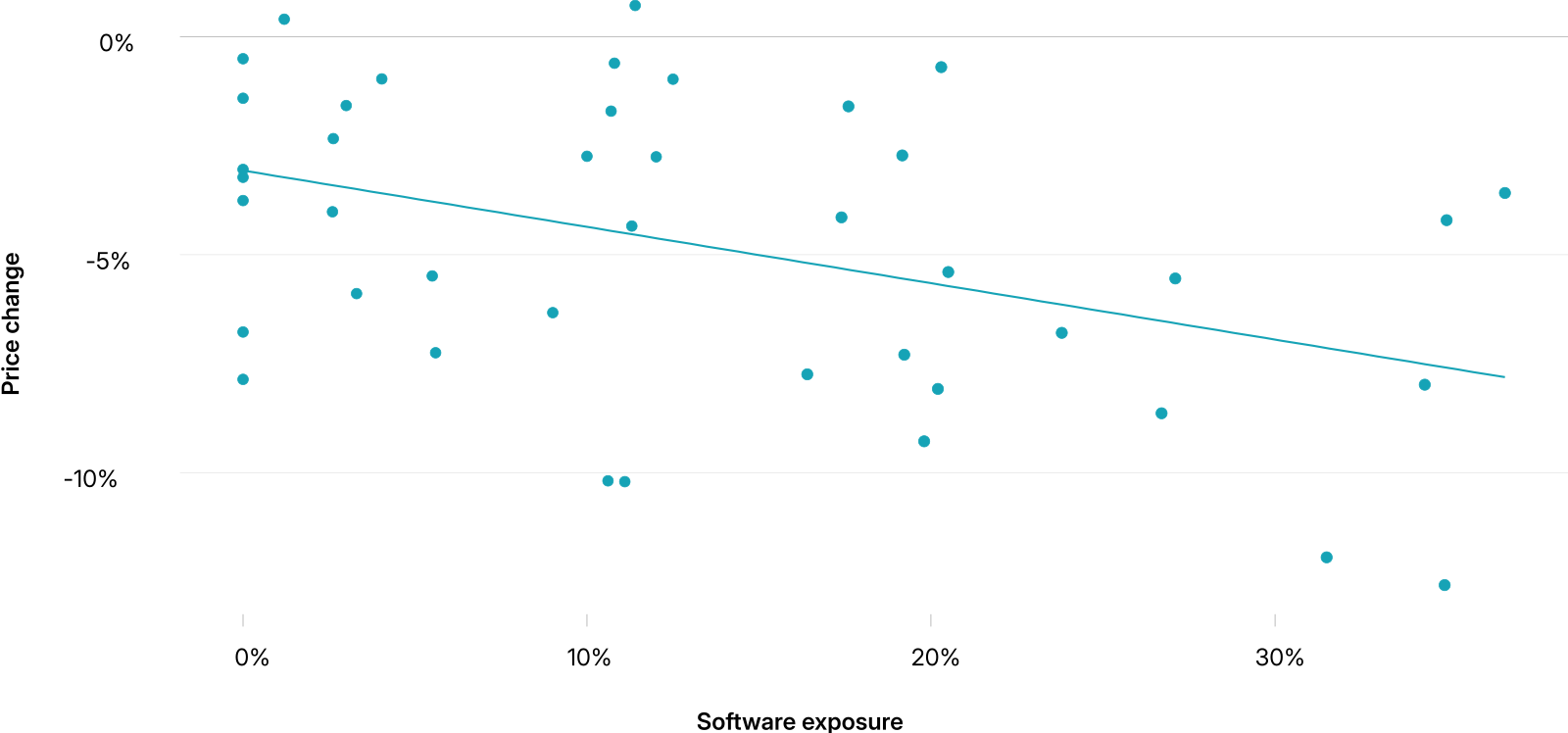
Source: U.S. Securities and Exchange Commission, MSCI Private Capital Solutions
The information gap compounds the problem. Listed BDCs trade continuously, but their underlying assets are private and not marked with the same frequency as public securities. Quarterly filings provide only a lagged view of portfolio composition. When stress materializes, investors update expectations based on incomplete information and price movements can be abrupt, uneven and potentially exaggerated.
The dynamic becomes even more complex in semi-liquid investment vehicles, such as unlisted BDCs. Here, shares are not traded on a daily basis, but investors can redeem on a quarterly basis at a net asset value (NAV) that is usually determined well after they request the redemption. As redemption requests rise, funds that gate or queue withdrawals (e.g., at the typical threshold of 5% of NAV per quarter) may see investor confidence erode further, independent of underlying credit performance. The structure itself becomes a source of stress.
A key question is how much of the downward move reflects underlying asset values, rather than equity-level amplification. BDC equity represents a levered claim on the underlying portfolio. Price moves in BDC shares can magnify shifts in perceived asset values. To account for this, we repeated the analysis using unlevered returns, scaling each fund's price change by its leverage ratio.
The negative relationship between software exposure and performance persists, but the magnitude falls. The implied decline in the value of software-exposed credit is approximately 6% — roughly half the levered estimate of 13% derived above. Listed BDCs tend to be more highly levered than their unlisted counterparts — nearly 1.2x debt to equity for listed vehicles vs. less than 0.9x for unlisted ones — suggesting that similar shifts in perceived asset values should translate into more muted movements in unlisted BDCs.
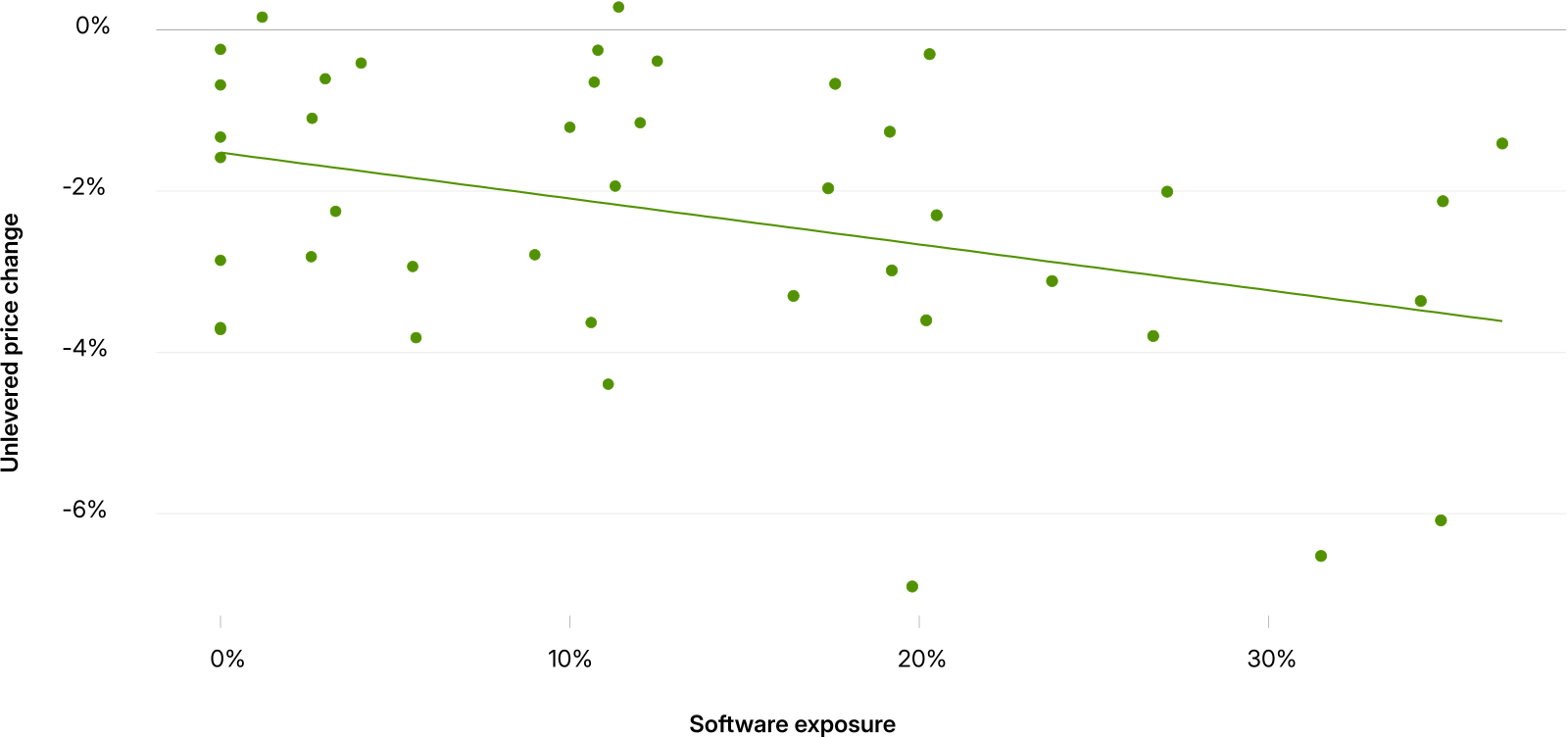
Source: U.S. Securities and Exchange Commission, MSCI Private Capital Solutions
Even with the risk of write-downs, the income profile of these assets remains relevant. MSCI data indicates that private-credit loans in the IT sector yielded approximately 9.6% annually as of the end of 2025. Even if software-exposed portfolios face write-downs in the range of 6–8% — as implied by the listed BDC selloff and some market estimates — the income cushion remains substantial. For investors with a medium-term horizon, such losses would certainly dent returns but would not erase them.
Historical patterns offer additional perspective. High-yield bonds and private-credit loans often finance sub-investment-grade borrowers, and both asset classes respond to overlapping economic and sector-specific risks. This makes sector-specific stress events in high-yield markets a potentially useful historical benchmark for the recent repricing of private-credit software exposures. We examined past episodes in which a sector came under pressure in public markets and measured subsequent performance of private-credit loans to that sector.1
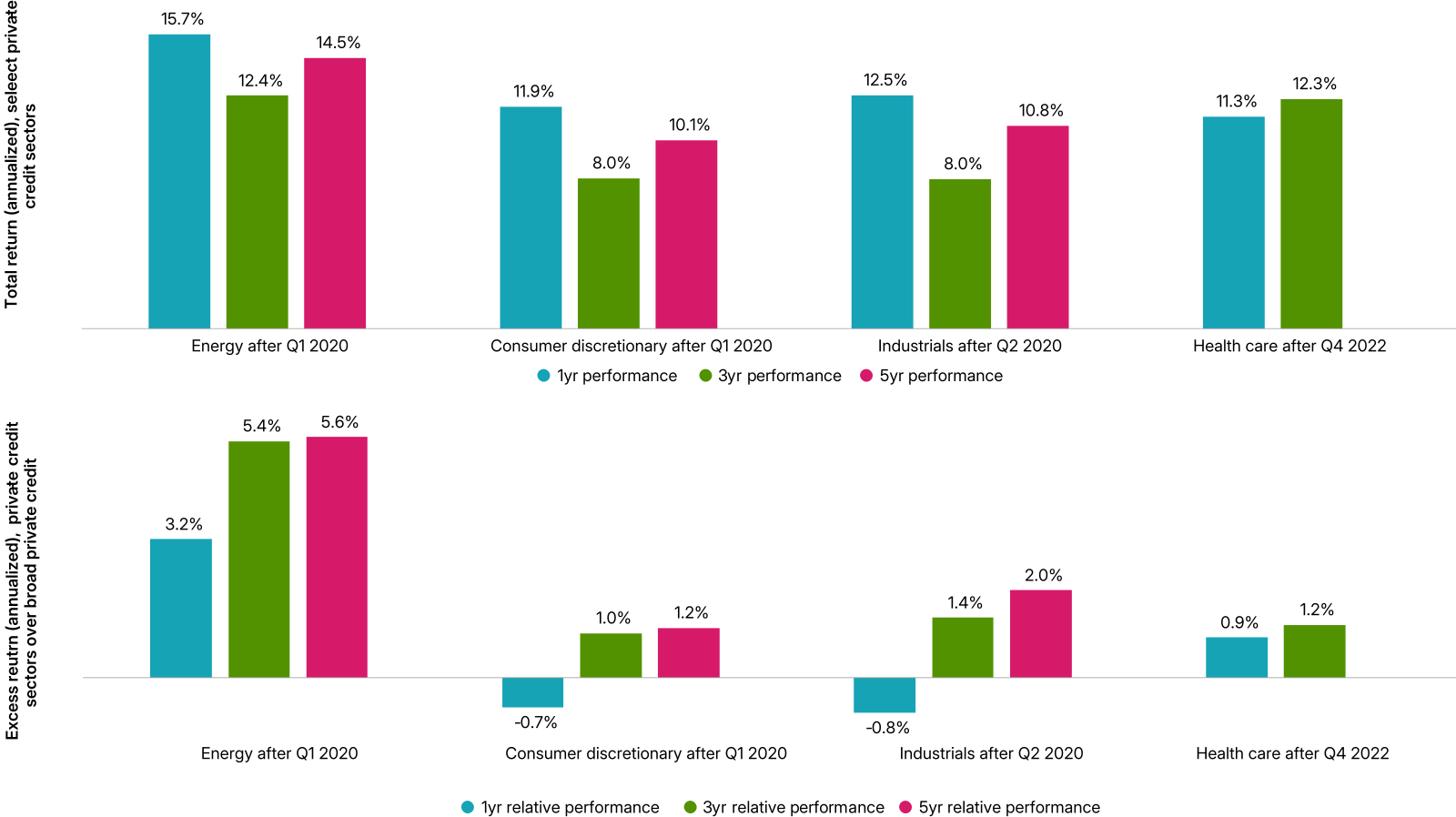
Broad private-credit index is the MSCI Global Private Credit Closed-End Fund Index; sector indexes are based on a subset of constituents from the index.
Across such episodes, private-credit holdings exposed to the stressed sector subsequently outperformed the broader private-credit universe by 0.7% on average over a one-year horizon, and 2.2% on average annualized over a five-year horizon. The pattern points to initial “overshooting” followed by mean reversion as high default rates don’t materialize, and the high-yielding private-credit debt facilities return interest plus capital over time.
The early 2026 episode underscores a structural tension in listed and unlisted private-credit vehicles alike. In listed BDCs, market prices can diverge sharply from reported NAVs. In semi-liquid vehicles, the tension is different but related: The last reported NAV will necessarily look rosy when there is an adverse shock in the subsequent quarter, but there are no current market prices for fund interests available. And even though fund managers may adjust valuations perfectly at the end of the next quarter, for investors anchoring their valuation on the prior NAV, redeeming may appear attractive in anticipation of future valuation adjustments — even absent a grounded view on fundamentals.
This appears to be the dynamic playing out in some parts of the market: Following the bankruptcies of Tricolor and First Brands, several of the largest non-traded BDCs faced redemption requests exceeding the typical quarterly 5%-of-NAV threshold in Q4 of 2025. While Q1 2026 redemptions are not yet known for most semi-liquid BDCs, the pattern in Q4 has elements of a “run,” namely, investors redeeming not based on fund-specific risk, but because they fear being last in the queue. However, redemption gates exist precisely to prevent fire sales in such moments — and wealth investors are now discovering that “semi-liquid” indeed means semi-liquid.
The episode also highlights the importance of granular, timely information about private-credit portfolios. Insights into sector exposures, underlying borrower characteristics and fundamentals, and even high-level “nowcasted” valuations — updated more frequently to reflect market conditions — can allow investors to form independent views. Without such transparency, redemption decisions and price discovery rely on incomplete information, which can result in abrupt price movements and slower adjustment to underlying fundamentals.
The February repricing will ultimately be judged by how software borrowers perform over the coming quarters. For now, the evidence from listed markets points to rational differentiation rather than indiscriminate flight. Whether semi-liquid structures can retain and attract retail capital through (and after) stress episodes like this one remains to be seen.




Subscribe todayto have insights delivered to your inbox.
Why LPs in Private Credit Deserve Clearer Borrower Reporting
Limited partners in private credit should not have to guess when it comes to risks on individual borrowers. General partners can provide the transparency needed to advance investment confidence.
The Ascendance and Implications of Evergreen Funds in Private Markets
The rise of semi-liquid vehicles comes bundled with challenges for GPs, asset owners, wealth investors and regulators. MSCI US Evergreen Fund Monthly Indexes show the performance so far.
MSCI All Country Nowcasting (Daily NAV) Indexes
Decision-grade daily insight for private equity and private credit — built on established benchmarks, LP-sourced data and a rigorous governance framework.
1 We define a sector-specific stress event as occurring when the option-adjusted spread (OAS) of a U.S. sector is wider than 500 basis points (bps) and is 100 bps wider vs. the MSCI USD High Yield Corporate Bond Index. For events where these conditions were satisfied for multiple quarters, we pick the quarter with the widest OAS.
The content of this page is for informational purposes only and is intended for institutional professionals with the analytical resources and tools necessary to interpret any performance information. Nothing herein is intended to recommend any product, tool or service. For all references to laws, rules or regulations, please note that the information is provided “as is” and does not constitute legal advice or any binding interpretation. Any approach to comply with regulatory or policy initiatives should be discussed with your own legal counsel and/or the relevant competent authority, as needed.