
Scenario Analysis: When Stocks, Bonds and the Dollar Fall Together
- Escalating trade tensions have triggered rare “Triple-Red” episodes — most recently last April and again this January — when U.S. equities, Treasurys and the dollar all fell together, undermining traditional diversification.
- We introduce a framework for global multi-asset-class investors to assess portfolio risks in Triple-Red scenarios, drawing on the 1973-74 stagflation era.
- Using MSCI Analytics Models, we estimate that a global multi-asset-class portfolio could lose 13% in USD terms (and 19% for EUR-based investors), driven by a positive bond-equity correlation.
Rising trade frictions might raise the risk of a rare “Triple-Red” scenario — in which U.S. equities, Treasurys and the U.S. dollar fall in unison. This correlation breakdown, more frequent before 2000 but nearly absent since, erodes traditional diversification and compounds losses for foreign investors through both asset-price and currency depreciation. The April 2025 tariff episode offered a reminder of this risk. The parallels to the 1973-74 stagflation crisis are notable: Eroding policy credibility, central banks trapped between inflation and growth and external shocks — trade disruptions today, commodity volatility in the 1970s — rippling across asset classes. Under our stress test, calibrated to the 1973-1974 period, a global diversified portfolio could lose approximately 13% in USD terms, while for EUR-based investors the losses would total 19%.
Following the April 2025 tariff shock and renewed trade tensions with strategic allies in January 2026, episodic Triple-Red events have returned to markets after a two-decade absence. The key risk is their persistence. History offers two precedents for lasting Triple-Red regimes: the 1970s stagflation era, when the oil embargo and policy failures drove prolonged correlation breakdowns as policymakers could not curb inflation without deepening recession; and the late-1980s aftermath of the Plaza Accord, when coordinated efforts to weaken the dollar coincided with the 1987 equity crash and rising bond yields. In both periods, Triple-Red episodes lasted multiple years rather than appearing as isolated short-term shocks, fundamentally undermining diversification.
To gauge the severity of these events, we examined a hypothetical 60/40 portfolio from the perspective of a foreign investor and highlighted the worst historical losses during Triple-Red episodes (see the chart below). The most severe Triple-Red event occurred in 1987 and produced a cumulative drawdown of roughly 31% over four months. By comparison, the April 2025 tariff turmoil resulted in a sharper but shorter sell-off — around 12% in just two weeks.
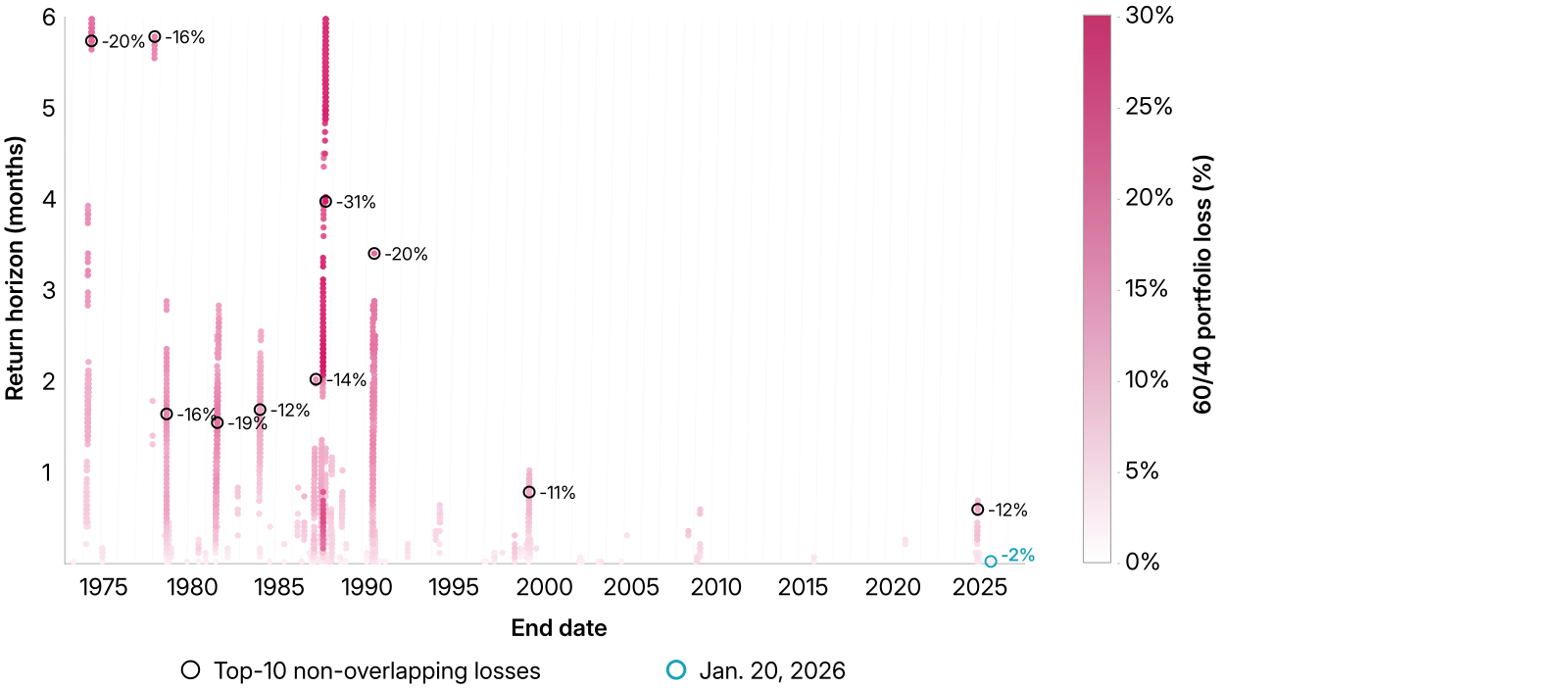
Triple-Red periods between January 1970 and January 2026. The x-axis shows the end date; the y-axis shows the return horizon in months. Each dot represents a period when U.S. equities (MSCI USA Index), Treasury bonds and the dollar index all moved adversely by more than one standard deviation over the specified horizon. Dot shading indicates the severity of drawdown for a hypothetical 60/40 portfolio held by a foreign investor, with darker dots representing larger losses. The black circled dots represent the 10 largest drawdowns.
Looking ahead, the 1973-74 stagflation crisis offers a useful historical parallel for today’s forward-looking narrative. That episode combined three critical elements: an erosion of policy credibility, a policy trap in which authorities could neither curb inflation nor support growth without worsening the other and an external supply shock — the oil embargo — that amplified domestic vulnerabilities. Current conditions echo this configuration: Elevated policy uncertainty is weighing on institutional confidence, tariff-driven price pressures complicate monetary easing despite rising growth risks and the prospect of coordinated foreign retaliation represents an external-shock channel that could magnify domestic policy constraints.
The six-month Triple-Red episode in 1974 saw equities fall by roughly 20%, Treasury yields rise by around 80 basis points and the dollar depreciate by 6%. We use these historical magnitudes to determine our shocks. In this scenario, trade disruption and geopolitical uncertainty affect U.S. and European markets simultaneously, with European economies experiencing more severe losses due to their higher export dependence. The table below provides the full scenario definition.1

Breakeven inflation (BEI) is measured in basis points (bps). Assumptions about risk-factor shocks are informed by analysis of historical data and judgment. This is not a forecast, but a hypothetical narrative of how the scenario could affect multi-asset-class portfolios.
To assess the scenarios’ impact on multi-asset-class portfolios, we used MSCI’s predictive stress-testing framework and applied the shocks from the table above to a hypothetical global diversified portfolio, consisting of global equities, U.S. bonds and real estate.2
In U.S. dollar terms, the scenario generates losses of roughly 13%, driven mainly by a sharp equity drawdown of about 20% while U.S. bonds also sell off. European bonds provide modest diversification benefits for USD-based investors, as euro appreciation boosts returns: European government bonds gain around 2% and EUR-denominated corporate bonds about 3% in USD terms. Losses are substantially larger for European investors due to dollar depreciation: Translated into local currency, the composite portfolio falls by approximately 19% in euros and 20% in Swiss francs.
Portfolio impact of the scenario based on market data as of Jan. 21, 2026. Source: S&P Global Market Intelligence, MSCI
Rather than treating recent Triple-Red episodes as transitory, investors may benefit from stress-testing portfolios for sustained correlation breakdowns, reassessing currency exposures and identifying allocations resilient to stagflation — recognizing that traditional safe havens may not perform as they have in recent decades.


Subscribe todayto have insights delivered to your inbox.
Investment Trends in Focus: Keeping Pace with the First-Half Market Reshuffle
The first half of 2025 flipped the investment script. Chief Research Officer, Ashley Lester, explores whether these shifts signal a momentary wobble or a tectonic realignment in global investing.
Macro Scenarios in Focus: Central-Bank Credibility and Portfolio Risk
Weakening Federal Reserve credibility could fuel stagflation. We model three macroeconomic scenarios and their impact on a multi-asset-class portfolio.
Investment Trends in Focus: Key Themes for 2026
Markets are moving faster than ever. Explore the research revealing and analyzing the key forces that will shape markets in 2026 — and what these forces could mean for investors.
1 Historical shock magnitudes were complemented by a severe shock on breakeven inflation. For discussion of potential upside risks to U.S. inflation in 2026 (not a forecast), see: Peter Orszag and Adam S. Posen, “The Risk of Higher US Inflation in 2026,” Peterson Institute for International Economics, Jan. 20, 2026.
2 The results are generated by using model correlations to propagate shocks to the portfolios, using MSCI's BarraOne®. MSCI clients can download the correlated BarraOne stress test and RiskMetrics® RiskManager® stress test. Note that the above stress-test results capture the effect of repricing the assets, not the income component. Treasury inflation-protected securities (TIPS) are represented by the iBoxx TIPS Inflation-Linked Index provided by S&P Dow Jones Indices. U.S. Treasurys, equities and corporate bonds are represented by MSCI indexes. Private equity and private credit are represented by model portfolios. U.S. real estate is represented by the MSCI/PREA U.S. AFOE Quarterly Property Fund Index. The composite portfolio is 35% global public equities, 24% U.S. Treasurys, 2% TIPS, 12% U.S. investment-grade bonds, 2% U.S. high-yield bonds, 10% U.S. real estate and 15% global private assets (13% private equity, 2% private credit).
The content of this page is for informational purposes only and is intended for institutional professionals with the analytical resources and tools necessary to interpret any performance information. Nothing herein is intended to recommend any product, tool or service. For all references to laws, rules or regulations, please note that the information is provided “as is” and does not constitute legal advice or any binding interpretation. Any approach to comply with regulatory or policy initiatives should be discussed with your own legal counsel and/or the relevant competent authority, as needed.