
Scope 2 Revisions and Investor Impact
- Proposed revisions on how companies calculate Scope 2 emissions under the Greenhouse Gas Protocol could result in higher market-based emissions, even without changes in the underlying electricity consumption.
- For climate-focused asset managers with overweight positions in the financials and services sectors, the shift could lead to step-changes in reported portfolio emissions and put alignment targets under renewed pressure.
- Without proactive recalibration, portfolio managers may misinterpret accounting-driven increases as underlying performance deterioration — potentially penalizing companies unfairly and weakening engagement strategies.
Proposed revisions to the Greenhouse Gas (GHG) Protocol’s Scope 2 guidance could lead some companies to report higher emissions, even if their electricity consumption and sourcing remain unchanged.1 For investors, the accounting mechanics of emission calculations may matter less than the potential disruption to emission trends, portfolio intensities and the interpretation of climate targets.
Scope 2 emissions reflect indirect emissions from purchased electricity. Under the GHG Protocol, companies typically disclose these emissions using either a location-based approach — based on the average emissions intensity of local energy grids — or a market-based approach. The latter incorporates contractual instruments such as renewable-energy certificates and power-purchase agreements.
Over time, the gap between location- and market-based figures has widened. MSCI data indicates that an increasing share of issuers now report market-based Scope 2 emissions materially below their location-based totals.
A widening gap between location- and market-based reporting
Dual reporters — companies disclosing both location- and market-based emissions — show a clear trend toward larger, market-based discounts. This becomes evident when grouping these companies by the ratio of market-based to location-based Scope 2 emissions.
For context, a ratio of 1.0 indicates parity, while values between 0 and 1.0 indicate that market-based emissions are lower than location-based figures.
From FY 2019 to FY 2024, we observed an increase in companies reporting either modest (ratio between 0.9 and 0.1) or large (ratio less than or equal to 0.1) differences between their location- and market-based emissions. Over the same period, fewer companies reported near parity (ratio greater than 0.9).
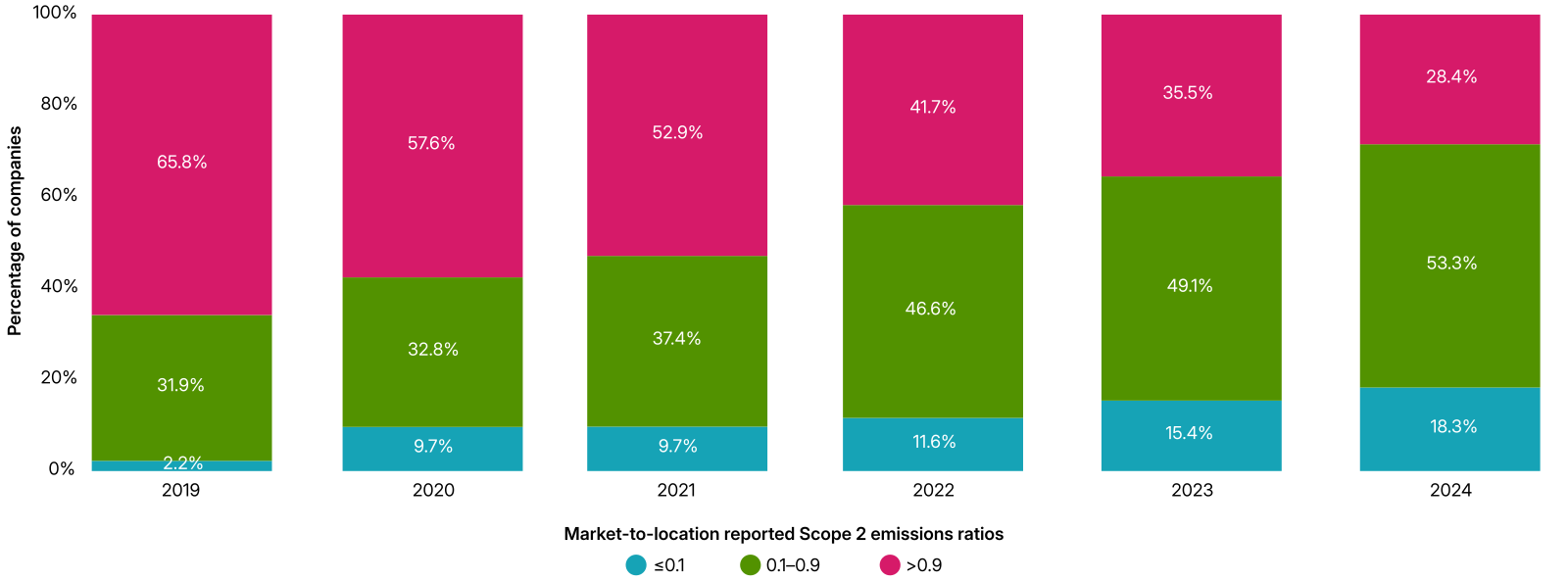
Data as of January 2026. Source: MSCI Sustainability & Climate. MSCI Sustainability & Climate products and services are provided by MSCI Solutions LLC in the United States and MSCI Solutions (UK) Limited in the United Kingdom and certain other related entities.
Sector-level reliance on contractual instruments
Our analysis also highlights differences across sectors in the use of contractual instruments, such as power-purchase agreements and renewable-energy contracts, to calculate market-based Scope 2 emissions.2
By FY 2024, the energy and utilities sectors remained close to parity between location- and market-based reporting (a ratio of 0.98). In contrast, several service-oriented sectors reported materially larger market-based discounts, including financials (0.34), information technology (0.50), real estate (0.51) and communication services (0.52).
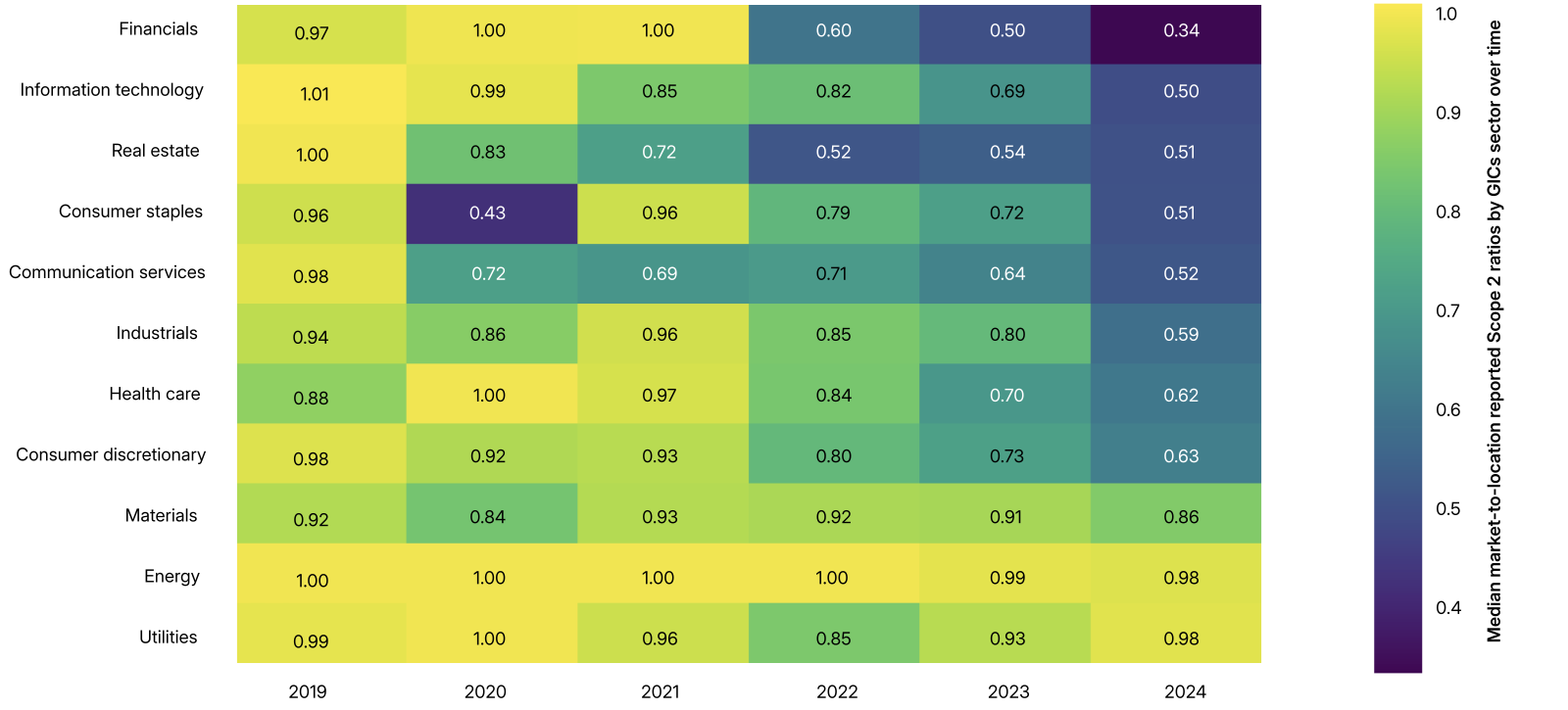
Data as of January 2026. Source: MSCI Sustainability & Climate
What the proposed tightening may mean for portfolios
Under the proposed revisions to the GHG Protocol’s Scope 2 guidance, dual reporting would be retained, but the requirements for market-based calculations would tighten, including provisions related to hourly matching and deliverability.3 Such changes could increase reported market-based Scope 2 emissions, particularly for companies that make extensive use of contractual instruments.
Any resulting step-change would affect not only reported emissions intensities and target progress at the company level, but portfolio-level metrics — particularly for strategies tilted toward financials or other service-oriented sectors, where the gap between location- and market-based emissions is wider.
Institutional investors may therefore seek to assess their portfolios’ exposure to these sectors and evaluate whether existing climate targets and engagement strategies remain fit for purpose under a revised methodology, particularly if implementation proceeds in 2027.


Subscribe todayto have insights delivered to your inbox.
Material, But Missing: Gaps in Scope 3 Reporting Persist
Despite offering broader Scope 3 disclosures, most companies do not report on their most material emissions. Investors may need to look beyond the numbers to understand true climate exposure.
Materiality-Weighted Portfolio Carbon Footprint
We found that, over the past decade, emissions-based transition risk had a stronger relationship with corporate earnings, stock performance and credit risk than previous academic studies suggested.
Bringing clarity to climate investing
MSCI can help you understand, monitor and manage the risk and return of climate exposures with our integrated data, analytical tools, indexes and research insights.
1 “Scope 2 Guidance: An Amendment to the GHG Protocol Corporate Standard,” World Resources Institute and World Business Council for Sustainable Development, 2015.
2 Sectors are defined according to the Global Industry Classification Standard (GICS®). GICS is the industry-classification standard jointly developed by MSCI and S&P Dow Jones Indices.
3 Sarah Huckins, “Upcoming Scope 2 Public Consultation: Overview of Revisions,” GHG Protocol, Sept. 29, 2025.
The content of this page is for informational purposes only and is intended for institutional professionals with the analytical resources and tools necessary to interpret any performance information. Nothing herein is intended to recommend any product, tool or service. For all references to laws, rules or regulations, please note that the information is provided “as is” and does not constitute legal advice or any binding interpretation. Any approach to comply with regulatory or policy initiatives should be discussed with your own legal counsel and/or the relevant competent authority, as needed.