
The Rise and Concentration Risk of Data Centers in Private Markets
- Data centers have become a key institutional allocation in private markets, with exposure across infrastructure, real-estate and private-equity closed-end funds totaling USD 122 billion as of Q3 2025.
- Investments by closed-end funds have significantly outperformed relative to key public- and private-market benchmarks since 2011, with a broad index of data-center investments showing annualized returns of 23.8%.
- Asset owners, consultants and general partners should be aware that asset-class diversification may obscure thematic concentration risk: Data-center exposure spans asset categories, but returns remain tied to computational demand.
Data centers have become an important investment theme for investors across public and private markets. Globally, construction starts of data centers rose from roughly USD 60 billion in estimated completed value in early 2020 to about USD 340 billion by 2025, according to MSCI Real Capital Analytics data, reflecting the sector’s rapid scaling in recent years.
To examine how this expansion is reflected in private markets, we analyzed 584 data-center companies and assets held by closed-end private-capital funds in the MSCI Private Capital Universe dataset, assessing capital investment, valuation growth and realized performance. Our definition of data centers covers companies that build, operate and enable digital compute across five categories: hyperscalers, colocation and wholesale operators, cloud providers, network-infrastructure companies and supporting software and service firms.1 As of Q3 2025, the aggregate valuation of these holdings was USD 122 billion.
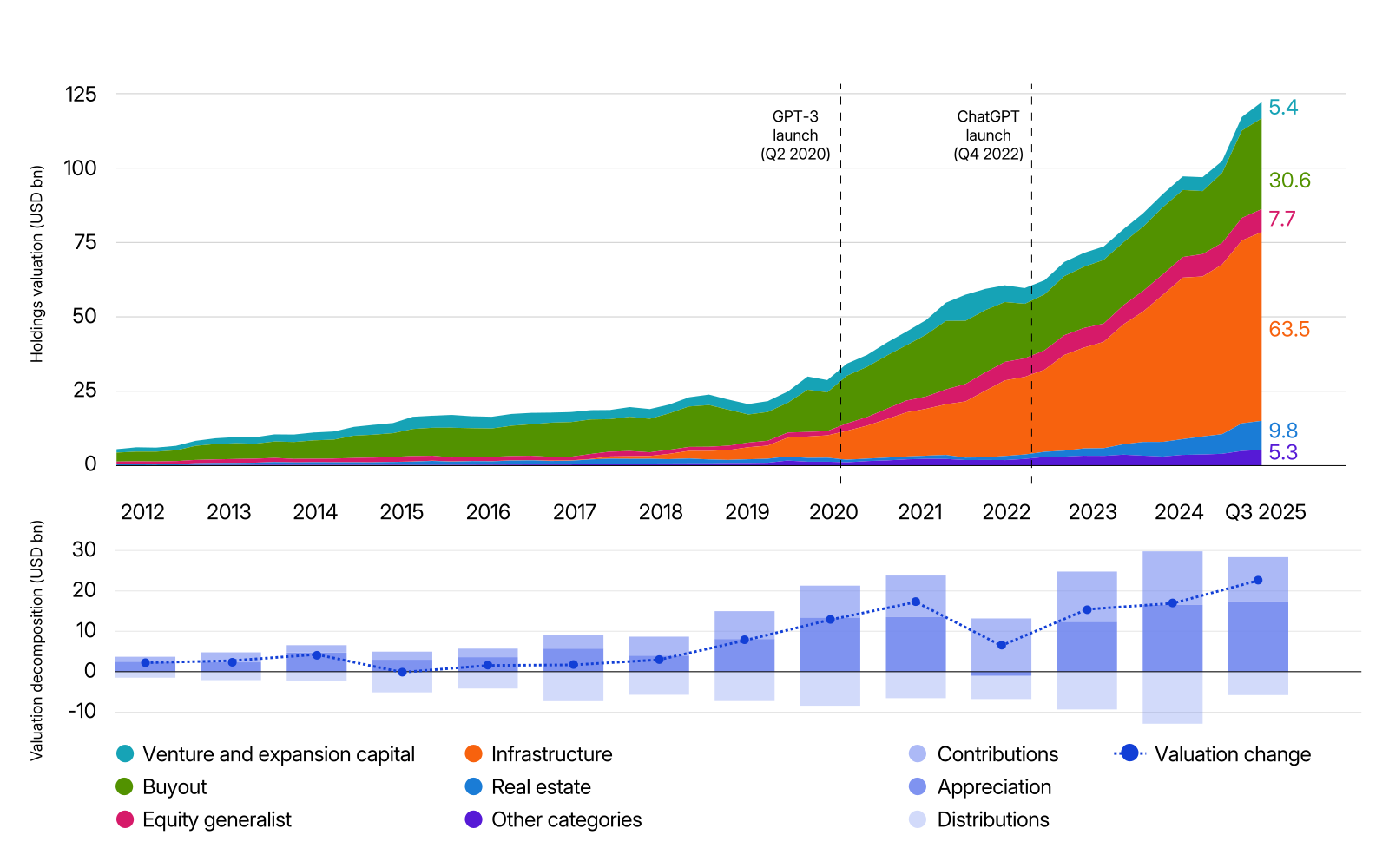
Holdings valuation chart shows the aggregate valuation of active holdings. OpenAI launched GPT-3 in May 2020 and ChatGPT in November 2022. MSCI Private Capital Universe data as of Q3 2025.
The data-center investment universe has evolved into a multi-asset-class segment, with exposure expressed across a range of strategies. As of Q3 2025, real assets (real estate and infrastructure) represent 60% of total exposure (USD 73.3 billion). Equity strategies account for a further 36% of the investment universe, reflecting buyout, expansion capital and venture capital. While real-asset strategies provide direct exposure to physical infrastructure, equity strategies capture a broader set of companies across the data-center value chain.
This cross-asset footprint carries important portfolio implications. Allocations may appear diversified by mandate yet remain anchored to a common economic driver: computational demand.2 Moreover, ownership frequently overlaps across strategies. Critically, as of Q3 2025, 13.6% of data-center companies were held by funds spanning multiple asset classes, meaning distinct allocations correspond to the same underlying assets. Asset-class diversification therefore does not eliminate thematic concentration.
Infrastructure investment accelerated before the commercialization of large language models, building capacity and power for advanced compute workloads. More rapid growth occurred after Q2 2020 (and OpenAI’s launch of GPT-3), when valuations began to increase significantly and new capital started to flow in. Following the release of ChatGPT in Q4 2022, investment momentum spread. Infrastructure valuations continued to rise, while real-estate exposure expanded alongside it, reflecting parallel growth to support increasing AI-driven compute density, power demand and energy intensity.
The pace of valuation growth was particularly pronounced in 2023 and 2024. Aggregate valuations increased by approximately USD 33 billion during these two years, driven by USD 26 billion in capital contributions and USD 29 billion in appreciation. At the same time, the sector generated USD 22 billion in distributions — that is, realized outcomes for investors.
To evaluate performance across this heterogeneous universe, we constructed two research indexes. First, a broad data-center investment index, comprising 584 companies and assets across all five data-center segments as described earlier. And second, an index of data-center physical operators, comprising 200 hyperscalers and colocation or wholesale operators, representing approximately USD 81.5 billion in aggregate valuation.
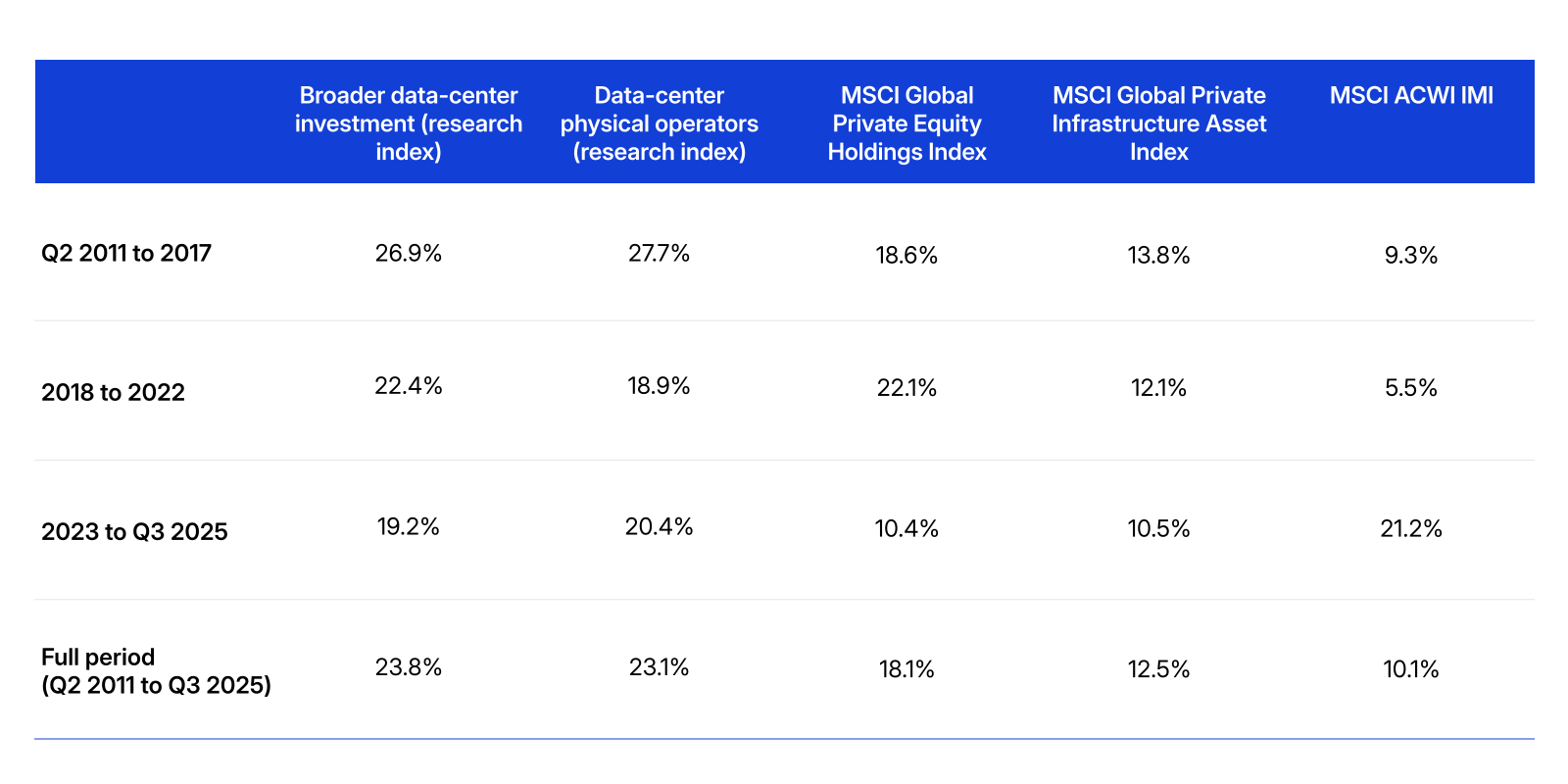
Over the long term, data-center investments have delivered sustained outperformance relative to public- and private-market benchmarks. From Q2 2011 to Q3 2025, the broader data-center index produced annualized returns of 23.8% and the physical-operators index returns of 23.1%, exceeding global private equity (18.1%), private infrastructure (12.5%) and public equities as measured by the MSCI ACWI Investable Market Index (10.1%).
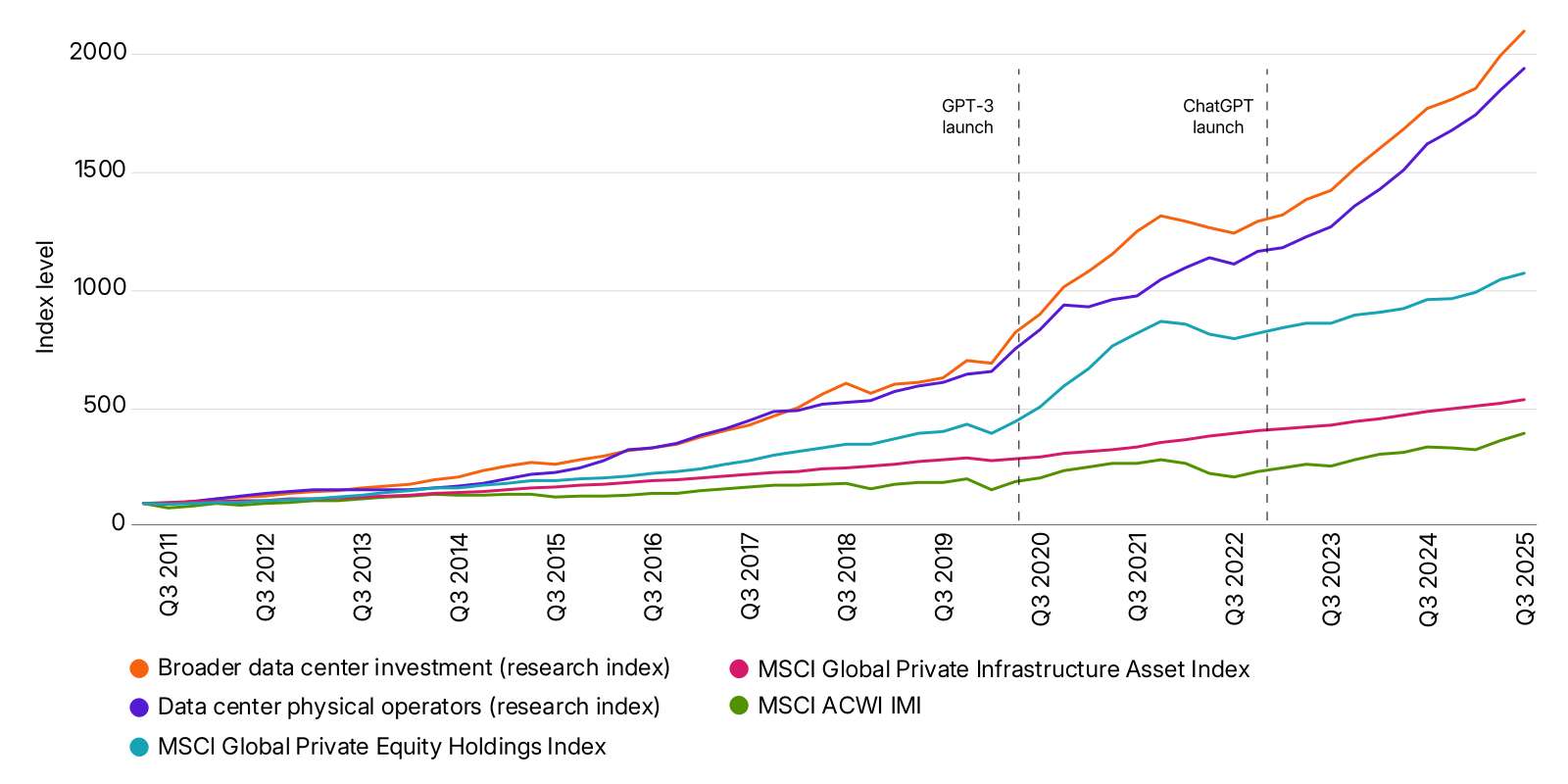
Data as of Q3 2025. Index values are normalized to 100 at the end of Q2 2011.
More recently, performance patterns have been less distinct. For 2023 to Q3 2025, the broader data-center index delivered an annualized return of 19.2%, outperforming global private equity (10.4%) but trailing global public equities (21.2%), the latter of which have been buoyed by the same AI enthusiasm since the launch of ChatGPT. The physical-operator index, meanwhile, delivered annualized returns of 20.4% in the period.
Data-center performance has been realized through large-scale institutional investments rather than niche allocations. Constituents of the operator index, for instance, were associated with large median investment sizes of USD 70.7 million and participation by managers overseeing USD 33.3 billion in assets on average. These investments produced stronger realized returns than other investments tracked in the MSCI Private Capital Universe, with a pooled gross total value to paid-in (TVPI) multiple of 2.17 and IRR of 23.2%, exceeding the corresponding figures of 2.03 and 19.4%. For the broader data-center index, constituents were also tied to stronger returns, larger investment sizes and bigger managers than the other investments.
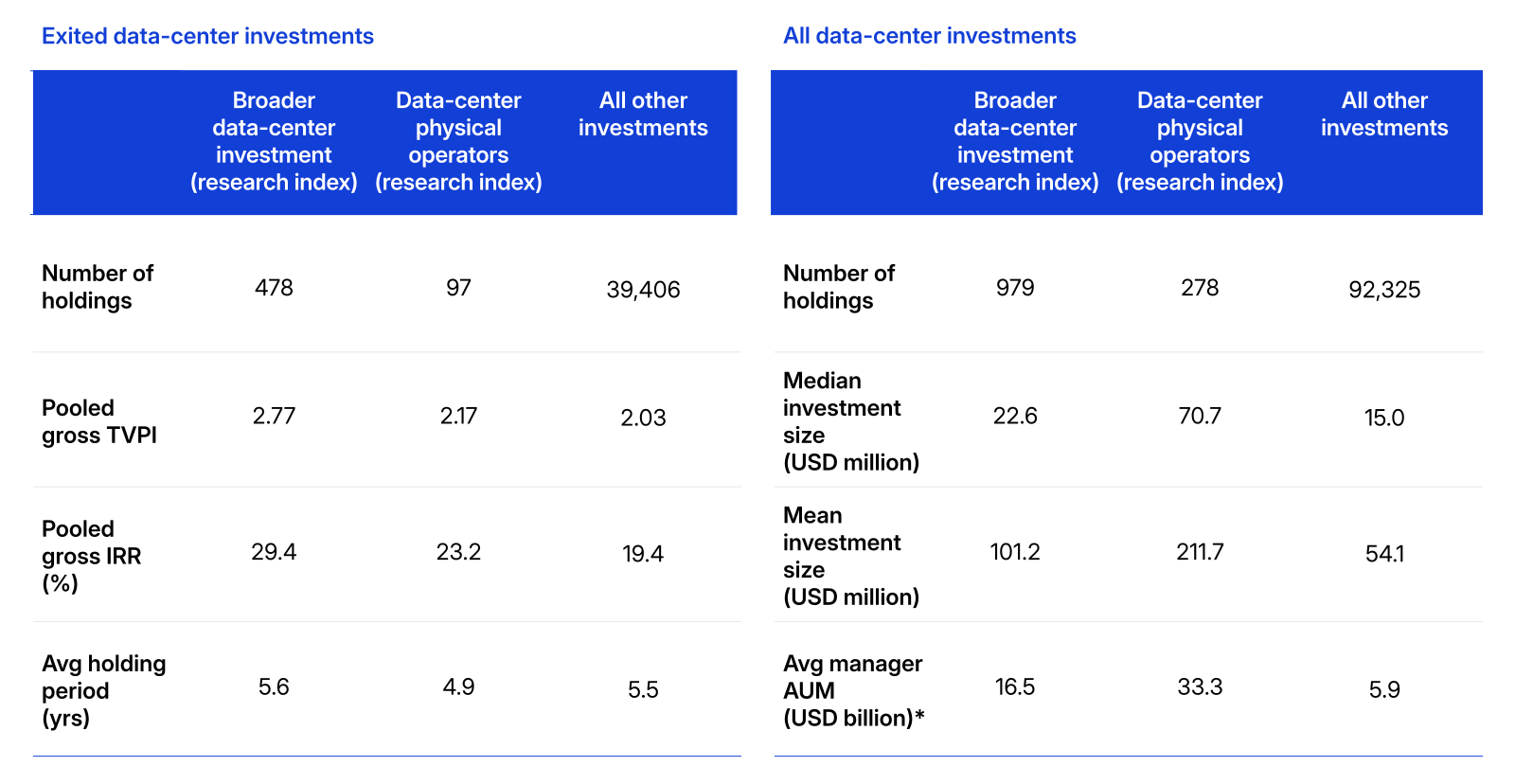
Data as of Q3 2025. Manager AUM represents the aggregate committed capital across all funds managed by the firm in the MSCI database as of Q3 2025.
Data centers have evolved into a mature and institutionally anchored segment, supported by sustained capital inflows, asset appreciation and meaningful distributions. Participation by large managers is evidence of the segment’s move from a niche play to a mainstream institutional allocation.
Long-term outcomes remain uncertain, however. Future performance may hinge on sustained technological adoption, alignment between the expansion of data-center capacity, and demand and the ability to manage emerging operational and scaling constraints. Investors should remain aware that while data-center exposure spans multiple asset classes, allocations are anchored to the same driver — computational demand — meaning that apparent diversification may not fully mitigate thematic concentration risk.
The authors thank Mehdi Alighanbari for his contributions to this blog post.



Subscribe todayto have insights delivered to your inbox.
When AI Meets Water Scarcity: Data Centers in a Thirsty World
Data centers are moving into water-stressed regions as AI demand grows — but how well are investors accounting for cooling risks, regulatory shifts and resource constraints?
MSCI Private Capital Benchmarks Summary Q3 2025
Leveraging data on more than 15,000 closed-end funds, we provide insights into key measures on cash flows, valuations, dry powder and performance across global private equity, credit and real assets.
1 Hyperscalers are large global technology companies that build and operate massive data centers to support their own cloud and AI services, while colocation and wholesale operators own facilities and lease space, power and connectivity to enterprise and cloud tenants.
2 McKinsey & Company projects 156 gigawatts of AI-related data-center demand by 2030 based on a continued-momentum scenario, with alternative scenarios reflecting faster or slower growth. Other scenarios are based on accelerated demand and constrained momentum. “The cost of compute: A $7 trillion race to scale data centers,” McKinsey, April 28, 2025.
The content of this page is for informational purposes only and is intended for institutional professionals with the analytical resources and tools necessary to interpret any performance information. Nothing herein is intended to recommend any product, tool or service. For all references to laws, rules or regulations, please note that the information is provided “as is” and does not constitute legal advice or any binding interpretation. Any approach to comply with regulatory or policy initiatives should be discussed with your own legal counsel and/or the relevant competent authority, as needed.