
What Lies Beneath: A Holdings-Level View on Private Equity
- Holding-level indexes allow participants in private markets to directly observe the performance of private assets decoupled from details of the vehicles that house them, such as fees, carry and leverage.
- These indexes isolate sector and regional drivers of performance that fund diversification can obscure. In buyout, APAC IT posted the strongest five-year returns across regions, while other APAC sectors lagged significantly.
- Together, fund- and holding-level indexes provide a more complete framework for industry participants evaluating private-equity performance and risk.
Fund-level benchmarks are essential to private-equity analysis, capturing realized investor experience through returns reported net of fees, carried interest and other expenses. These benchmarks offer a valuable high-level view in private equity but reveal little about the underlying companies that ultimately drive returns. Holdings-based indexes complement this view by reflecting gross company-level returns, separating underlying asset returns from fund economics and enabling more precise attribution across sectors, regions and strategies.
Why a more granular view matters
Crucially, the MSCI Private Equity Holdings Indexes allow for a better sector-aligned view of private markets, cutting through the diversified lens of fund-level performance that can obscure true sector outcomes. (Using MSCI PACS, private companies are mapped into established public-market industry frameworks.1) For example, for information technology, the buyout holdings index slightly outperforms the broader buyout holdings index. While perhaps unexpected, an index of IT-focused buyout funds slightly underperforms the broader buyout-fund universe. While these funds are “focused” on IT, however, they actually contain some holdings from other sectors as well, likely dampening their fund-level performance. For that reason, this holding-level approach delivers a more meaningful sector-level benchmark for investors, managers and analysts evaluating exposure, risk and performance.
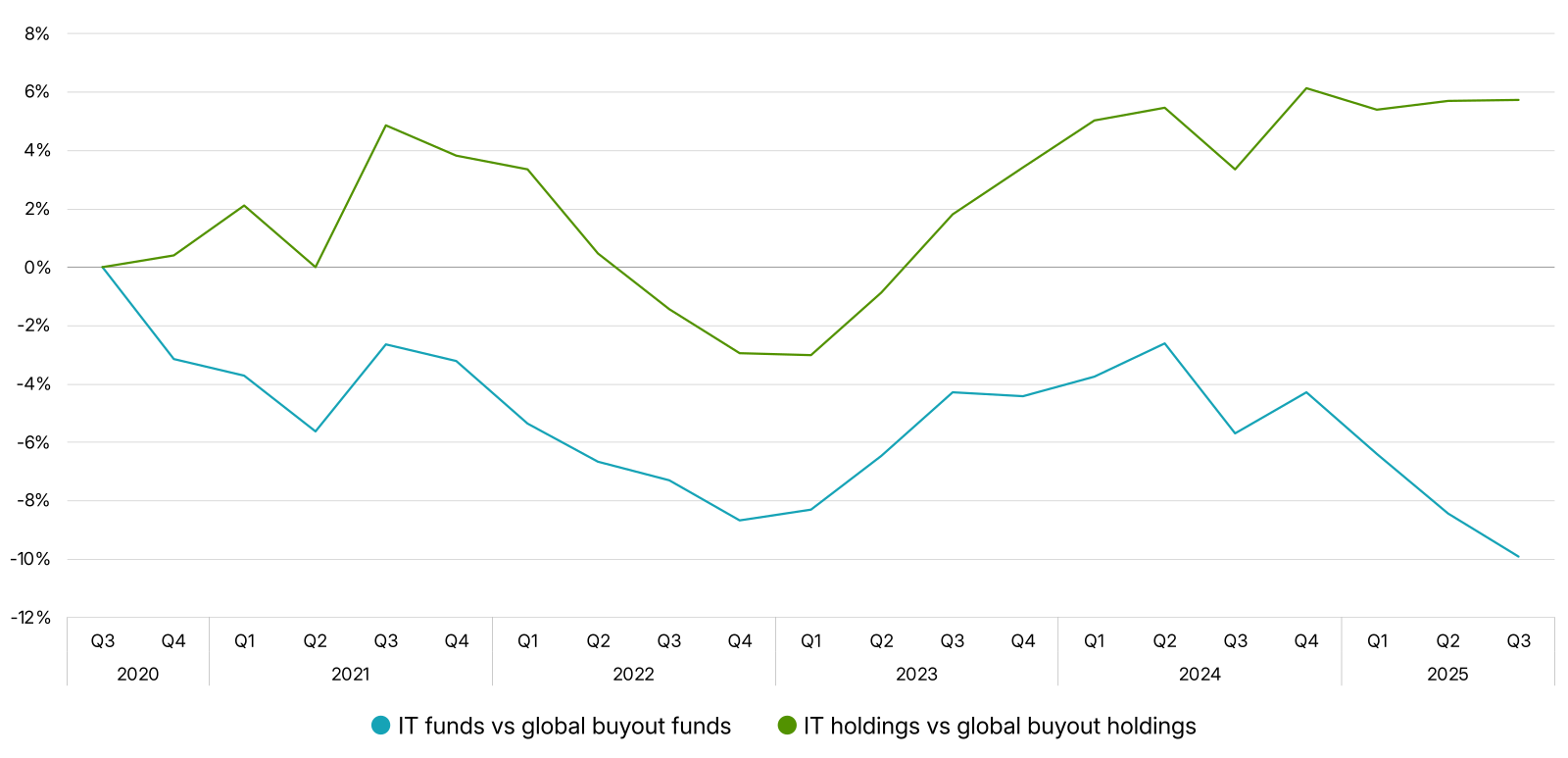
Difference in cumulative returns since Sept. 30, 2020, for IT buyout holdings and IT-focused buyout funds vs. their global buyout benchmarks. 0% on y-axis signifies performance equal to the benchmark.
Anatomy of buyout and venture-capital indexes
Before going deeper into performance, it’s worth examining the composition of these holdings-based indexes. Buyout and venture-capital (VC) strategies exhibit distinct structural profiles. Buyout portfolios tend to be broadly diversified across regions and industries, with North America accounting for roughly 60% of exposure and meaningful allocations to information technology, industrials and health care. Meanwhile, EMEA has more exposure to financials and consumer sectors than North America, and APAC carries significantly less IT exposure than the other two regions. VC portfolios, by contrast, are more concentrated, as North America is dominated by IT investments. At the holdings level, these differences highlight materially distinct geographic and industry compositions across buyout and VC strategies.
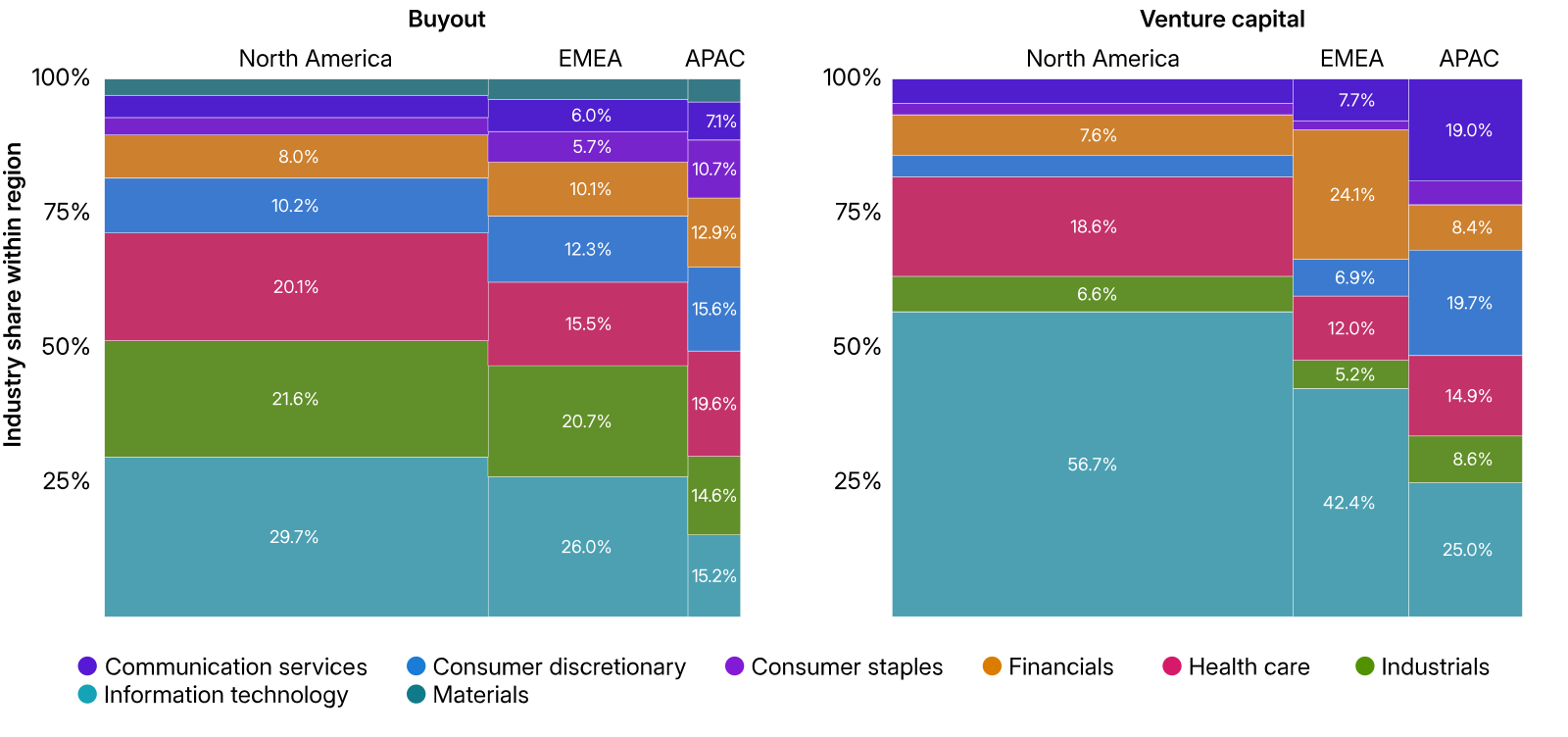
MSCI Global Buyout Holdings Index and MSCI Global Venture Capital Holdings Index. Region width indicates share of index. Data as of Sept. 30, 2025.
Digging deeper into performance drivers
While the sector and geographic exposures above provide important context, a closer look at performance begins to reveal the drivers behind results across the broader universe. For instance, in buyout, all three geographies have similar results when aggregated across all sectors, with APAC returns slightly lagging those of North America and EMEA. An even closer look in APAC reveals a different pattern in that market, however. Relatively, sectors within APAC show a much greater dispersion of results. APAC contains both the highest-performing buyout sector of the last five years (APAC IT, at a 26% annualized return), as well as the worst-performing sectors.
A dive into VC reveals some structural differences as well. While North America and EMEA experience similar returns both at the aggregate level and for IT (by far the largest sector in each), they differ in their other underlying sectors. In particular, VC in EMEA has delivered much better returns in the financial sector, largely explained by a handful of outperforming deals. Taken as a whole, these performance dynamics provide insight into the key drivers behind results across the broader universe.
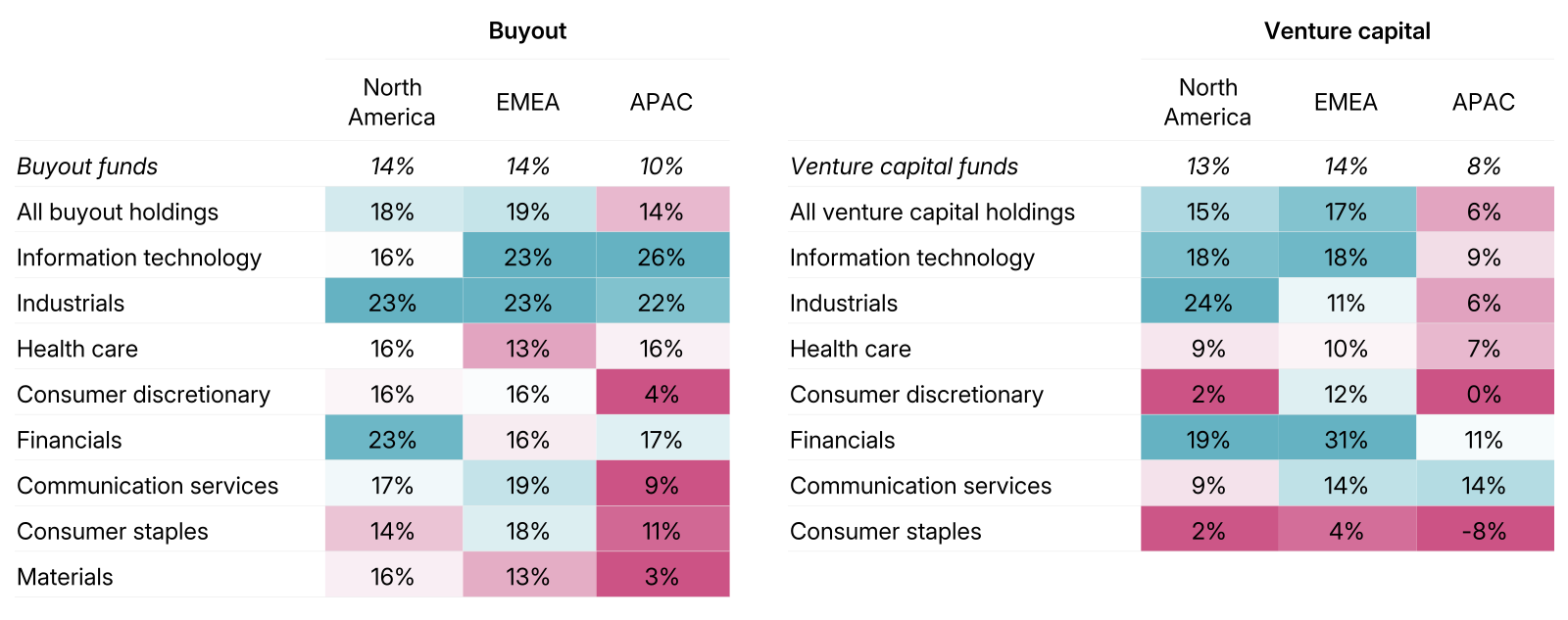
Five-year annualized return for the MSCI Global Buyout Holdings Index and the MSCI Global Venture Capital Holdings Index by sector. Data as of Sept. 30, 2025.
Expanding the attribution toolkit for private equity
Fund-level benchmarks remain the natural starting point for private-equity analysis. Investors commit capital to funds, measure outcomes net of fees and evaluate managers at the fund level. These benchmarks therefore remain indispensable for understanding the realized investor experience.
Yet fund-level results alone offer limited insight into the sources of performance. Holdings-based indexes provide the missing layer by isolating the underlying companies that drive returns, allowing for more precise attribution across sectors, regions and strategies — a topic we will explore more in future research. By pairing fund-level benchmarks with holdings-based analysis, investors can move beyond how private equity performed to better understand why — creating a more robust framework for evaluating buyout and venture capital in an increasingly complex market.

Subscribe todayto have insights delivered to your inbox.
MSCI Private Assets
Achieve greater transparency with our data, indexes and analytics for confident decision-making in private asset investing.
Private Capital in Focus: Trends to Watch for 2026
Satisfying investors’ unquenched thirst for liquidity, the rise — and risks — of private credit, and the hard work of buyout value creation shape private markets at the start of the year.
Has Private Equity Outperformed Public Equity?
In the Journal of Private Markets Investing, we examine whether private equity has outperformed public markets over 30 years — after adjusting for risk, size and leverage.
1 MSCI PACSTM is a global standardized taxonomy for private assets, including private companies, real estate, infrastructure and other alternative assets. It leverages MSCI's proprietary methodology, extending the Global Industry Classification Standard (GICS®) structure for companies and using MSCI's GRACSTM taxonomy for real estate and infrastructure. GICS is the industry-classification standard jointly developed by MSCI and S&P Dow Jones Indices.
The content of this page is for informational purposes only and is intended for institutional professionals with the analytical resources and tools necessary to interpret any performance information. Nothing herein is intended to recommend any product, tool or service. For all references to laws, rules or regulations, please note that the information is provided “as is” and does not constitute legal advice or any binding interpretation. Any approach to comply with regulatory or policy initiatives should be discussed with your own legal counsel and/or the relevant competent authority, as needed.