
Private Capital in Focus: Trends to Watch for 2026
Private markets enter 2026 focused on liquidity and a return to basics — a state of affairs that involves more tension than may first appear.
Private equity has traditionally relied on a combination of realized improvements as well as the promise of future growth to create value. As we saw in 2020 to 2021, this formula has been aided by market exuberance. Since then, we have seen a reliance on fundamental (but realized) growth to create value.
But liquidity was bounded, prompting the mantra of “DPI is the new IRR” to even appear on T-shirts.1 It also led to increased demand for secondary transactions and a rapid rise in the use of continuation vehicles — a form of liquidity that is controversial and, arguably, artificial. Despite this new tool for liquidity, distributions remain low. Several asset classes attempted a return to normality toward the end of 2024, but in 2025 distributions from private equity floundered, and those from real estate funds breached new lows. And then there was private credit.
Recent distributions from private credit were healthy, evidently aided by elevated rates. But even their distributions declined somewhat last year, a fact that can be explained by recent declines in rates, although increasing signs of distress could be starting to take a toll. For now, the dominant story in private credit has been the rise of semi-liquid funds.
Drawdown, or closed-end, fundraising has slowed, though after accounting for the dramatic rise in semi-liquid funds the trajectory in private credit is relatively steady. These new funds largely pull in new investors, inexperienced in private markets. The liquidity of these funds is extremely limited, perhaps motivating some to instead refer to them as evergreen funds. However, the liquidity they do provide is at subjective valuations — these are still private assets, after all. And such valuations open the door to some classes of investors timing their subscriptions and redemptions, potentially at the expense of others. “A terrible beauty is born,” providing opportunities for many, as well as novel risks.2
One of the most notable developments in private equity since 2021, when today’s still-low distributions first began to weaken, has been the rise of continuation vehicles. General partners (GPs) have increasingly turned to these structures as a means of creating liquidity events and extending the lives of assets that may still, in theory, hold potential upside. Continuation funds offer GPs more time to manage and monetize holdings while providing some liquidity to existing limited partners (LPs).
When we examine the ratio of contributions to continuation funds relative to distributions from mature PE funds (those 10 years or older), a clear trend emerges. Between 2016 and 2020 this ratio averaged just 6%, indicating limited use of continuation vehicles. However, from 2021 through Q3 2025, the average has jumped to 20%, reflecting a noticeable uptick in GP-led secondary activity. This shift underscores how continuation vehicles have become a meaningful driver of capital flows within private equity, reshaping how liquidity is managed in an otherwise weak exit environment.
The real test, however, will be whether investors continue embracing these structures as a pragmatic liquidity solution — or begin questioning whether they are simply stretching fund horizons in ways that complicate portfolio planning. Much of the existing continuation-fund universe has yet to deliver fully realized performance, and that track record — when it finally arrives — will serve as the true litmus test. For now, continuation vehicles are easing the pressure. How long they can do so remains an open question.
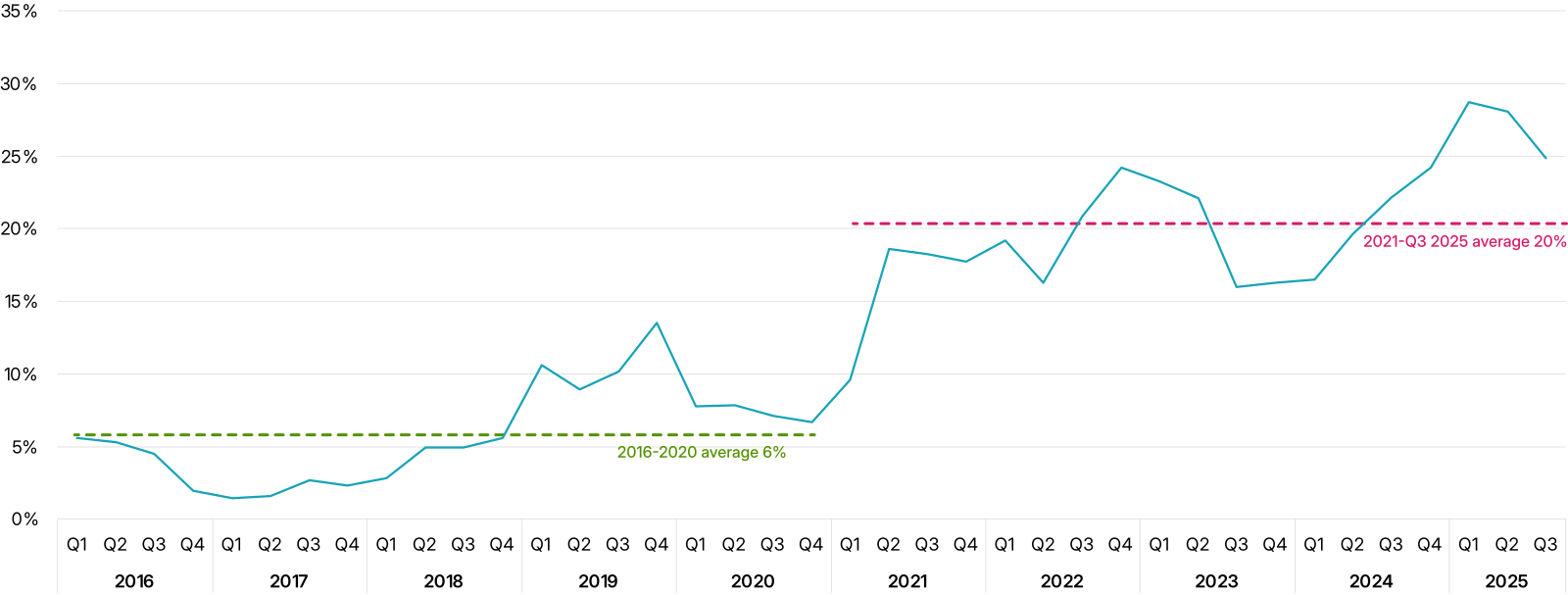
Rolling 1-year share of contributions to continuation funds vs. mature private-equity fund distributions. Mature funds are those 10 years or older, thus more likely to pursue liquidity events for limited partners. See also Night of the Living Fund: The Rise of Zombie Private Equity. Continuation-fund data for the vehicles tracked by MSCI; distributions data from the MSCI Private Capital Universe.
In an environment of still-elevated rates, equity-value creation in buyouts between acquisition and exit (known as the value bridge) has increasingly been driven by revenue growth. For buyout holdings that exited in 2022 to Q3 2025, revenue growth accounted for just under two-thirds of the incremental value generated above invested capital, with multiple expansion contributing less significantly and margin improvement adding a smaller uplift.
The picture on revenue marks a break from the past. In the 2020-2021 window, the same value bridge looked notably different: Over half of the incremental gain came from EBITDA-multiple expansion alone, underscoring the elevated exit-valuation multiples at the peak of the low-rate cycle. Go back further to 2015 to 2019 and the picture turns more balanced, with the bulk of the uplift split almost evenly between revenue growth and multiple expansion. While margin growth was a minor contributor to value creation in 2015–2019 exits, its role has slowly increased, indicating a growing emphasis on profitability.
This evolution has important implications for both liquidity and valuation risk. On the liquidity front, growth in fund-level distribution rates has closely tracked improvements in portfolio-company margins, reinforcing the idea that cash back to LPs is increasingly tied to portfolio companies’ fundamentals. On the valuation front, with revenue doing most of the lifting in the value bridge, any slowdown in top-line growth could directly threaten exit valuation and distribution potential.
In short, in 2026 LPs and GPs may find that crossing the buyout value bridge depends far less on market sentiment, and far more on whether portfolio companies can grow and sustain their fundamentals.
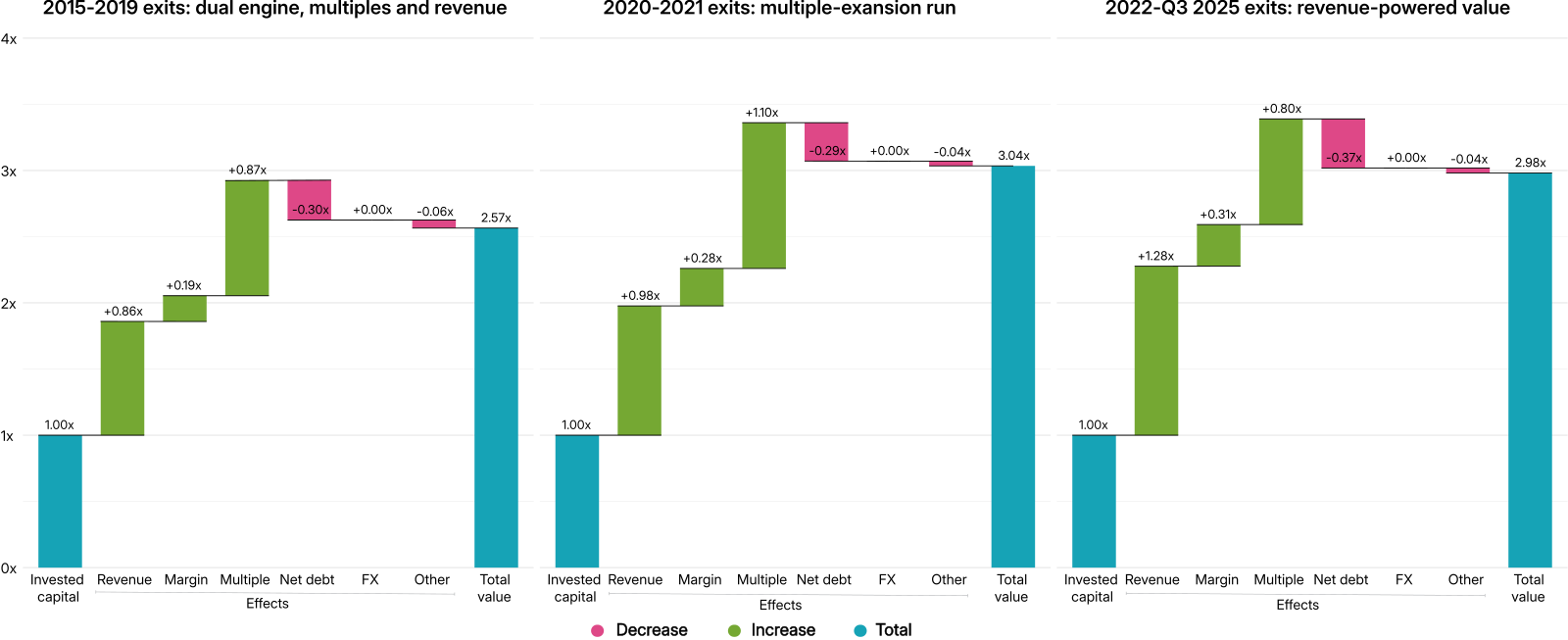
Data as of Q3 2025. Value-bridge figures are based on medians across a subset of exited buyout holdings. Invested capital is normalized to 1.0x. Total value equals cumulative distributions plus remaining net asset value (NAV), divided by cumulative invested capital, expressed as a multiple, gross of fees. Source: MSCI Private Capital Universe, MSCI Private Asset and Deal Metrics data
The growth of semi-liquid fund structures, commonly called evergreen or open-ended vehicles, is reshaping the fundraising in private credit. Annual flows into these funds have increased from just USD 10 billion in 2020 to a projected USD 74 billion in 2025, even as closed-end fundraising has slowed. The shift reflects a push by asset managers to broaden their investor base and access wealth channels and other semi-institutional pools that they believe value the flexibility of periodic subscriptions and redemptions, as opposed to traditional long capital lockups.
Genuine liquidity is not necessarily created by this perceived flexibility, however. Limited quarterly redemption windows and withdrawal gates mean investors still face constraints on access to their capital. When these investors do get liquidity, it is at GP-issued marks that are subjective and opaque — an important consideration as these products expand to investor segments with limited experience in private-market valuations. In many ways, these structures represent only a move toward liquidity, rather than a fundamental transformation.
Liquidity promises that rest on fundamentally illiquid, multi-year loans raise a familiar tension. Unlike public credit vehicles, semi-liquid private funds cannot readily sell underlying positions to meet withdrawals, since their loans are bespoke, unlisted and often negotiated directly with borrowers. Instead, managers rely on cash buffers, credit facilities or secondary sales. These tactics may function efficiently in benign markets but could prove inadequate under stress.
This model hasn’t faced a true test, so far. A spike in defaults, a freeze in secondaries or a surge in redemption requests could reveal weaknesses in the system, recreating the maturity mismatch that amplified stress during the 2008 global financial crisis, namely lending long and promising liquidity short.
Looking ahead, the question is not whether semi-liquid credit will continue to attract capital, but whether it can withstand a more volatile market backdrop. The next downturn may reveal just how durable this new architecture of “liquidity” in private credit really is.
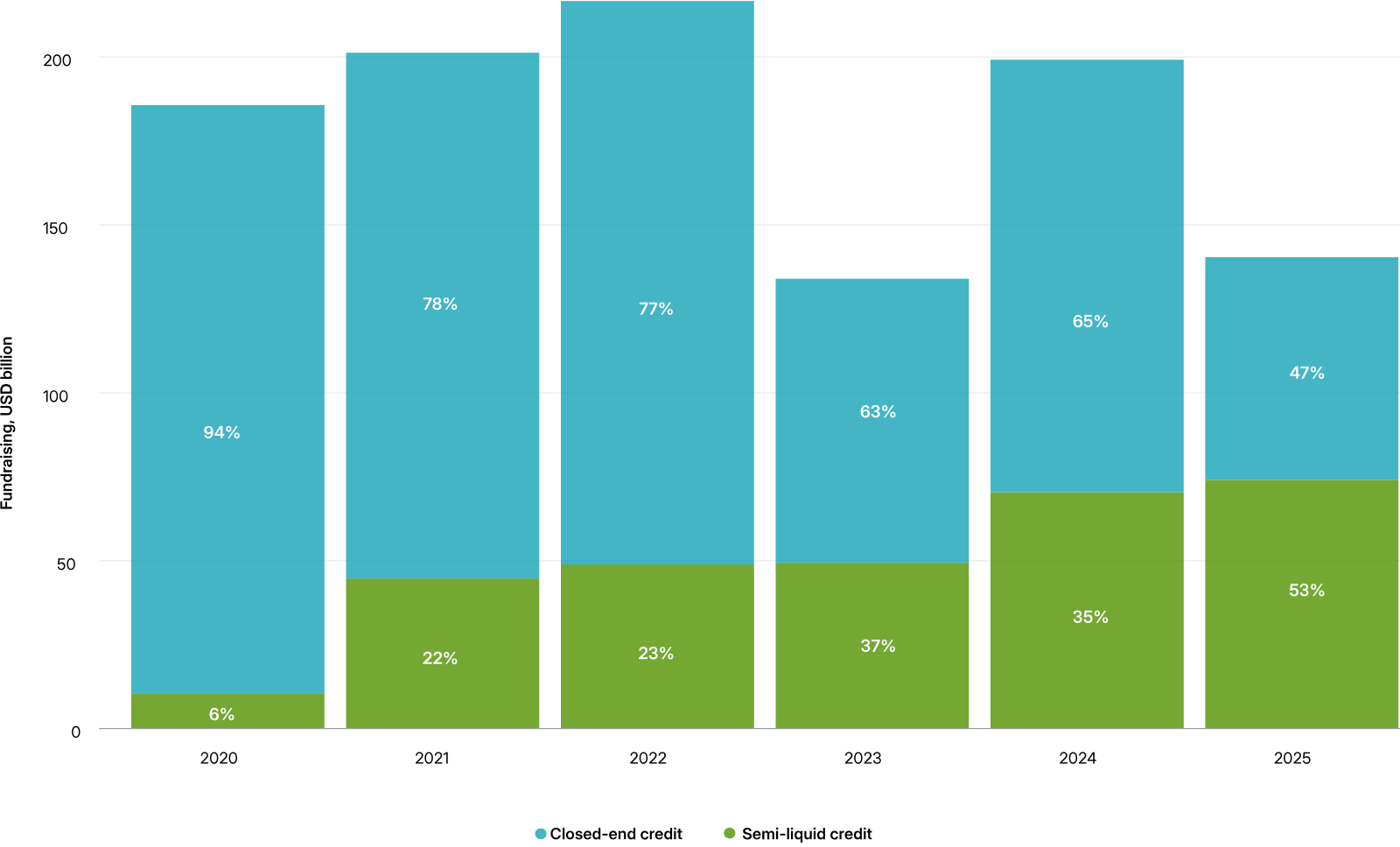
2025 shows projected totals. Data as of Nov. 25, 2025. Semi-liquid data from public filings; closed-end data from the MSCI Private Capital Universe.
Signs of deeper stress in private credit are seeping into view. Two years of elevated base rates have tested borrowers’ ability to absorb higher interest burdens, and what began in 2022 as a trickle of write-downs has grown into a larger leak.
For senior loans, write-downs of 20% — a rough threshold for distress — have more than tripled since interest rates lifted off in 2022. Loan values for about 11% of mezzanine loans had been cut in half, according to the Q2 2025 update of MSCI Private Capital Universe data. While GPs haven’t yet resorted to widespread restructurings to mop up troubled loans, repricings have deepened as they work to patch things over with loan amendments. More notably, those deeper impairments are creeping up the capital structure: More than 5% of senior loans have experienced such 50% write-downs.
These more aggressive markdowns suggest an increasing number of loans are circling the drain, sliding toward restructuring — the point where debt holders risk becoming equity holders. For now, loans are generating enough income to compensate for credit losses, but the drumbeat of bankruptcy news seems to be getting louder.
A continued decline in interest rates may give struggling borrowers enough room to repair their balance sheets and allow loan valuations to recover. But if stubbornly high inflation slows the pace of rate cuts, it will likely require more wrenching adjustments in marks. In 2026, the scattered signs of stress we see today may coalesce into a broader pattern that tests the resilience of private credit’s recent expansion.
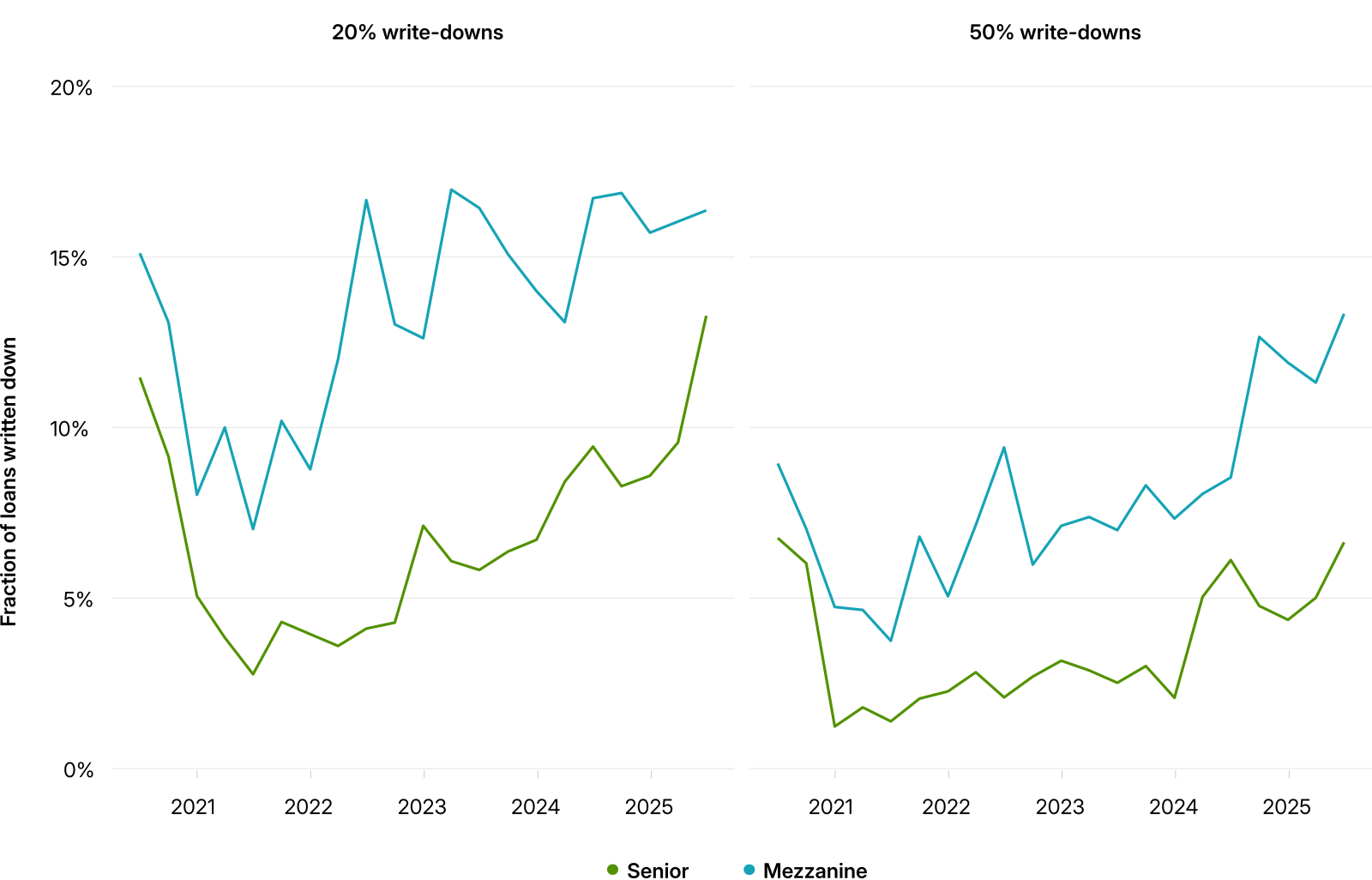
Data through Q2 2025. Source: MSCI Private Capital Transparency
The picture in private markets at the start of 2026 features liquidity that is harder to achieve and value creation that has become more grounded. Buyouts are relying less on market-driven multiple expansion and more on revenue growth and operating improvements. Continuation vehicles and other secondary transactions are an increasing presence, aimed at easing pressure from slow exits and investor demand for cash back, particularly in private equity and private real assets.
Still, fundraising continues apace for the largest managers in private equity and performance is steady, at least on paper, if not yet realized for funds’ investors. In private credit, the story of fundraising involves the shift to semi-liquid vehicles, as more novice investors in private markets seek more flexible investment structures. That perceived periodic flexibility, delivered at GP-issued valuations, has yet to be put through genuine market stress, however.
Indeed, the relative youth of private credit as a major investment class overall means it hasn’t undergone a full cycle. How investments perform when an increasing volume of borrowers struggle to pay back loans is an unknown. (There is also concern regarding the potential repercussions of failures in the significant amount of lending tied to the AI data-center buildout.) Signs of borrower stress after two years of elevated base rates have already emerged; whether a more settled economic outlook and a hoped-for downward path in central bank rates eases that pressure is yet to be seen.






Subscribe todayto have insights delivered to your inbox.
Real Assets in Focus: Trends to Watch for 2026
Real estate faces strong competition from infrastructure and private credit as liquidity remains tight. See why granular, asset-level insight may matter more than ever for real assets in 2026.
Deciphering the Distinctions in Private Credit
Private credit is not one market. Strategies differ sharply in leverage use, borrower profile, rate structure and security types — differences that can materially shift performance and risk outcomes for investors.
1 Distributions to paid-in capital (DPI) is a measure of how much capital a fund is distributing to its investors.
2 William Butler Yeats, “Easter, 1916.”
The content of this page is for informational purposes only and is intended for institutional professionals with the analytical resources and tools necessary to interpret any performance information. Nothing herein is intended to recommend any product, tool or service. For all references to laws, rules or regulations, please note that the information is provided “as is” and does not constitute legal advice or any binding interpretation. Any approach to comply with regulatory or policy initiatives should be discussed with your own legal counsel and/or the relevant competent authority, as needed.