
By Choice, Not by Chance: Small and Mid Caps in Portfolio Construction
Mentioned in this paper:
MSCI World Large Cap Index | MSCI World SMID Cap Index | MSCI Global Investable Market Indexes (GIMI) Methodology
Preview
Small- and mid-cap (SMID) companies make up most of the world’s listed companies, but only a small slice of a typical large-cap benchmark. In this paper, we treat a SMID allocation as a dial rather than a switch — the question is less whether to hold these companies and more how far to turn the dial. Combining SMID caps eases the liquidity and capacity constraints of a small-cap-only allocation, and a 20%-40% SMID share captures most of the reduction in concentration and gain in breadth without materially raising risk. We also present an indexed approach, built around roughly 300 constituents, designed to make that allocation easier to implement.
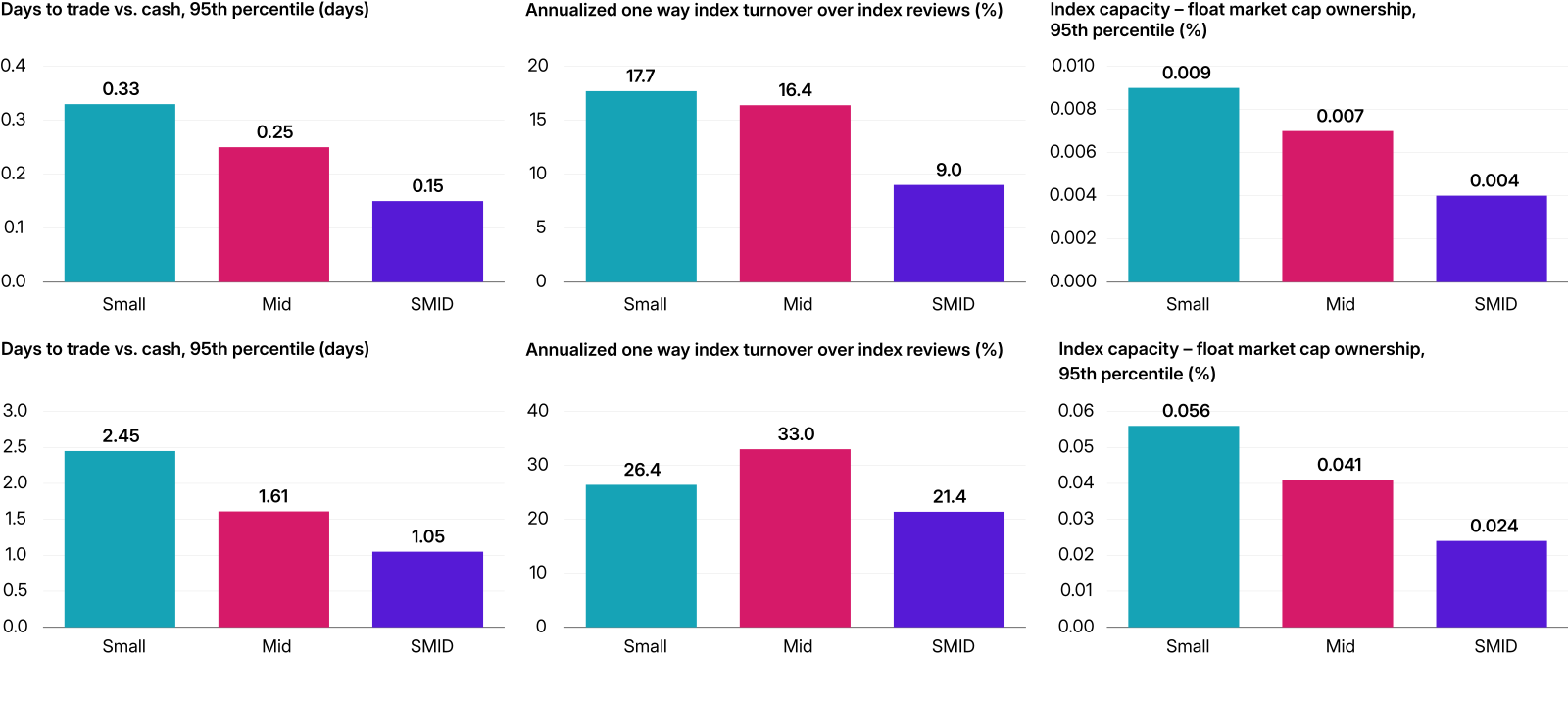
Period: Dec. 29, 2000 – Jun. 30, 2026. DM on top, EM below. Days to trade relative to cash at the 95th percentile, assuming a USD 1 billion fund, 20% maximum daily trading limit.


Read the full paper
Provide your information for instant access to our research papers.
Small Cap Indexes
MSCI offers small-cap indexes to help institutional investors gain insight into the small-cap universe across both developed and emerging markets.
Beyond the Name Game: Focus on Fundamentals
Name recognition of highflying stocks, as well as their performance, can be brief. The enduring value of thematic and fundamental analysis is the ability to uncover the macroeconomic and business dynamics that influence long-term stock returns.
The content of this page is for informational purposes only and is intended for institutional professionals with the analytical resources and tools necessary to interpret any performance information. Nothing herein is intended to recommend any product, tool or service. For all references to laws, rules or regulations, please note that the information is provided “as is” and does not constitute legal advice or any binding interpretation. Any approach to comply with regulatory or policy initiatives should be discussed with your own legal counsel and/or the relevant competent authority, as needed.