
The MSCI Private Equity Factor Model
Preview
Private equity has been an attractive asset class for institutional investors, drawn by extraordinary historical performance, a possible liquidity premium and the opportunity to take on large levels of active risk to exploit manager skill. There have been competing schools of thought on private equity’s role in a multi-asset-class portfolio — a spectrum of views that leads to four central questions for understanding private equity in the context of total plan risk and asset allocation:
- How large is the diversification effect of private equity?
- Is private equity’s performance due to a liquidity premium and manager skill, or to high beta?
- How much opportunity for active risk is there in private versus public equity?
- Do we get different answers when we examine global versus domestic private equity?
Unfortunately, two common approaches to understanding private equity — one based on private-equity valuations, the other proxies of publicly traded securities — can both lead to the wrong answers. To tackle the challenge, the MSCI Private Equity Factor Model consists of a suite of models and features:
- A Bayesian desmoothing methodology provides robust risk estimates using “small data” techniques to bring together limited datasets.
- The incorporation of proprietary private-equity data gauges the strong “pure private” component of private-equity returns.
- Use of public-equity and fixed-income models captures fundamental characteristics of private equity, and provides a consistent view of risk across public and private assets.
- Geographic coverage spanning 46 countries globally.
- Total coverage that spans 17 private-equity segments.
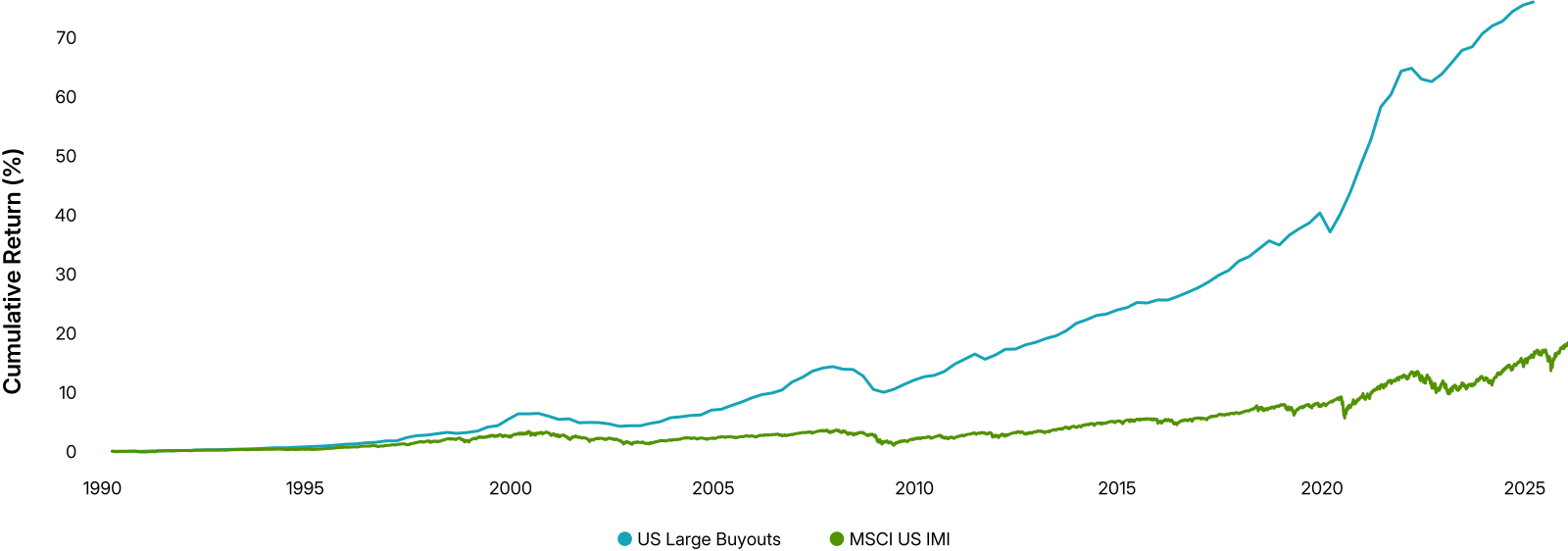
The cumulative returns of public and private equity (net of fees) show the striking outperformance of private equity. In the short run, the smooth valuations of private equity might suggest low risk. Similarly, the lag in returns leads to low contemporaneous correlations with public equity, at the quarterly horizon. However, these artifacts disappear at longer horizon, where large risk and high correlations are apparent.

Read the full paper
Provide your information for instant access to our research papers.
Tracking Private Equity. Understanding the fundamental drivers of private equity performance.
MSCI’s new deal-level fundamentals and private markets returns data can be used to separate what can be replicated in the public markets from the unique value added by private equity.
The MSCI Private Credit Factor Model
Investors in private credit contend with the challenges of opacity and illiquidity of the asset class and a dearth of public proxies. Our new model aims to illuminate this market.
MSCI World Private Equity Return Tracker Index
Target private equity-like returns with the liquidity of public markets with an innovative index designed to reflect the systematic drivers of private equity performance.
The content of this page is for informational purposes only and is intended for institutional professionals with the analytical resources and tools necessary to interpret any performance information. Nothing herein is intended to recommend any product, tool or service. For all references to laws, rules or regulations, please note that the information is provided “as is” and does not constitute legal advice or any binding interpretation. Any approach to comply with regulatory or policy initiatives should be discussed with your own legal counsel and/or the relevant competent authority, as needed.