
Fund Taxonomy Alignment Set to Grow as Rules Evolve
Under the newly proposed EU Taxonomy rules,1 we expect fund managers to see an increase in fund-level Taxonomy alignment, even without changes to portfolio composition or the Taxonomy alignment of fund constituents.
The proposed changes would stop portfolio-level alignment from being diluted by constituents without Taxonomy data.2 Notably, voluntarily reported data from companies out of scope of the Corporate Sustainability Reporting Directive (CSRD) does not currently contribute to a fund’s Taxonomy alignment, but would be permitted for inclusion under the proposed changes.3
At present, most Article 8 and 9 funds show less than 10% Taxonomy alignment. According to our estimates, the proposed approach could shift a significant portion of funds toward higher alignment. Specifically, around 40% of Article 8 funds and 41% of Article 9 funds are expected to move from Taxonomy alignment of below 10% to above 10%, based on capital expenditure (capex), with the figures at 23% and 40%, respectively, when measured by turnover.
The proposed calculation rules, as well as higher fund alignment, could raise the Taxonomy alignment reported by financial companies. This underscores the importance of understanding changes in reporting requirements, rather than interpreting them solely as improvements in underlying portfolio quality.
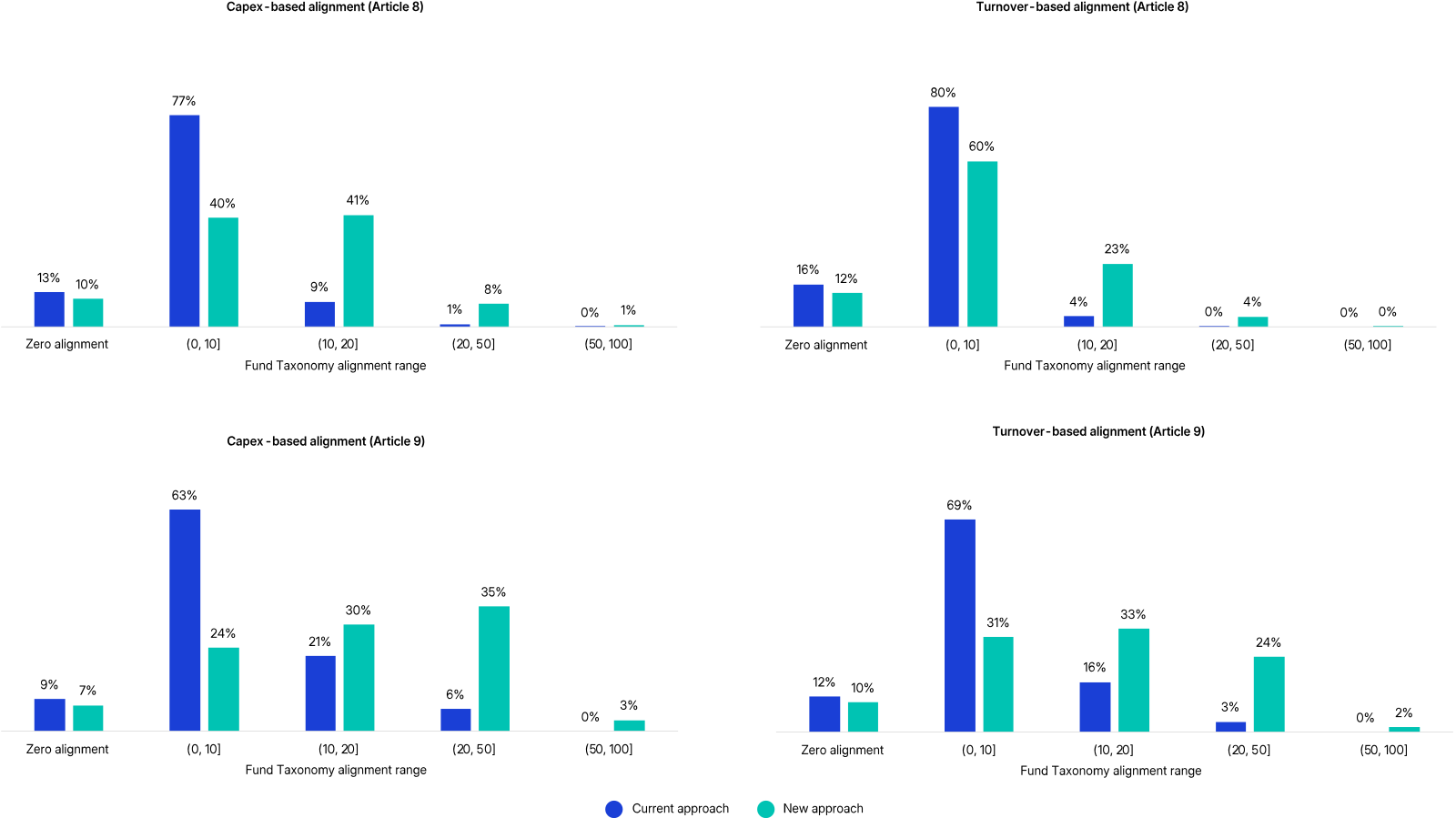
Data as of Oct. 1, 2025. Sample: 826 Article 9 funds and 9,679 Article 8 funds in MSCI’s standard fund universe. Current alignment metrics follow Article 7 of the EU Taxonomy Disclosures Delegated Regulation (EU 2021/2178). New approach metrics are MSCI Solutions estimates, based on the assumption that the scope of the numerator and denominator include holdings of CSRD-eligible and voluntary reporters only. Other securities and materiality threshold were not assessed. Metrics apply to EU Taxonomy disclosure within Annex templates for financial institutions. Source: MSCI Sustainability & Climate Research Services
The information is provided "as is" and does not constitute legal advice or binding interpretations of the supervisory expectations and associated requirements.



Subscribe todayto have insights delivered to your inbox.
CSRD: Raising the Burden or Raising the Bar?
Our materiality assessment indicates that simplifying the current CSRD reporting framework to as few as 300 to 500 data points may improve usability and interoperability, while still maintaining most investor-critical disclosures.
EU's Omnibus Proposal: What You Need to Know
NOTE: The first 12:10 of this episode provides a background of what the Omnibus proposal actually proposes. If you just want our takes on the good, the bad, and the future of this proposal, skip that section!
Funds and the European Sustainable Finance Landscape 2024
We evaluate European funds’ performance under sustainability regulations, including SFDR article 8 and 9 funds, EU Taxonomy alignment and new fund-naming guidelines, offering insights into regulatory developments and data improvements.
1 European Commission (2025). Commission Delegated Regulation (EU) …/… of 4 July 2025 amending Commission Delegated Regulation (EU) 2021/2178 as regards the simplification of the content and presentation of information to be disclosed concerning environmentally sustainable activities, and Commission Delegated Regulations (EU) 2021/2139 and (EU) 2023/2486 as regards simplification of certain technical screening criteria for determining whether economic activities cause no significant harm to environmental objectives. Not yet published in the Official Journal (under EP/Council scrutiny as of October 2025). Commission document C(2025) 4568 final.
2 Under the current EU Taxonomy regulation, sovereign exposures (central governments, central banks and supranational issuers) are excluded from the denominator of the alignment ratio; the numerator also excludes non-CSRD-eligible companies. Under the proposed amendment (July 4, 2025), holdings without Taxonomy data (e.g., derivatives, cash, cash equivalents, commodities, etc.) and non-CSRD-eligible exposures are excluded from both the numerator and denominator, unless financial undertakings opt to include Taxonomy data reported voluntarily by companies out of the scope of CSRD.
3 The scope of companies subject to CSRD and the EU Taxonomy is set out in Articles 19a and 29a of the Accounting Directive (EU) 2013/34. Currently, disclosures apply to large undertakings or parent groups with over 500 employees and undertakings that qualify as public-interest entities (PIEs).
The content of this page is for informational purposes only and is intended for institutional professionals with the analytical resources and tools necessary to interpret any performance information. Nothing herein is intended to recommend any product, tool or service. For all references to laws, rules or regulations, please note that the information is provided “as is” and does not constitute legal advice or any binding interpretation. Any approach to comply with regulatory or policy initiatives should be discussed with your own legal counsel and/or the relevant competent authority, as needed.