
Is Board Equity Ownership Linked to Returns?
A joint study by FCLTGlobal and the MSCI Institute, covering 2,137 companies in the MSCI ACWI Index from 2020 to 2025, found that the amount of equity your board holds, and for how long, tracks closely with your company's long-term performance. Companies where independent directors steadily increased their ownership were associated with higher shareholder returns than those of peers.1 Boards that reduced their stakes also saw weaker returns.
Growing board ownership, stronger returns
A sustained 5% increase in independent directors’ equity ownership over five years was associated with 35 to 40 percentage points higher cumulative five-year total shareholder return (TSR), and roughly 50 points higher risk-adjusted returns, relative to companies without that growth. Higher director ownership also tracked with 3% higher research and development intensity and, when independent directors held more equity than executives, volatility was 50.9% lower over five years.
Declining ownership, weaker returns
When independent directors reduced their holdings over five years, shareholder returns fell an average of 9.7%, and risk-adjusted returns fell 11%, relative to peers. Despite this, board ownership remains inconsistent: Nearly one in five companies in the study had no director equity ownership at all.
Independent directors’ equity holdings showed a stronger link to shareholder value creation than nonexecutive directors’: Each 1% increase in average annual holdings was associated with roughly 7.6% higher five-year TSR outperformance for independent directors, compared with about 4.1% for nonexecutive directors.
What companies should consider
For companies, board equity ownership is worth examining as part of long-term governance.
The research raises questions about the appropriate length of director shareholding periods, whether ownership should extend throughout a director's tenure, and how director stakes compare with those held by executives. These considerations could inform a review of your board’s equity-ownership policy as part of your regular governance process.
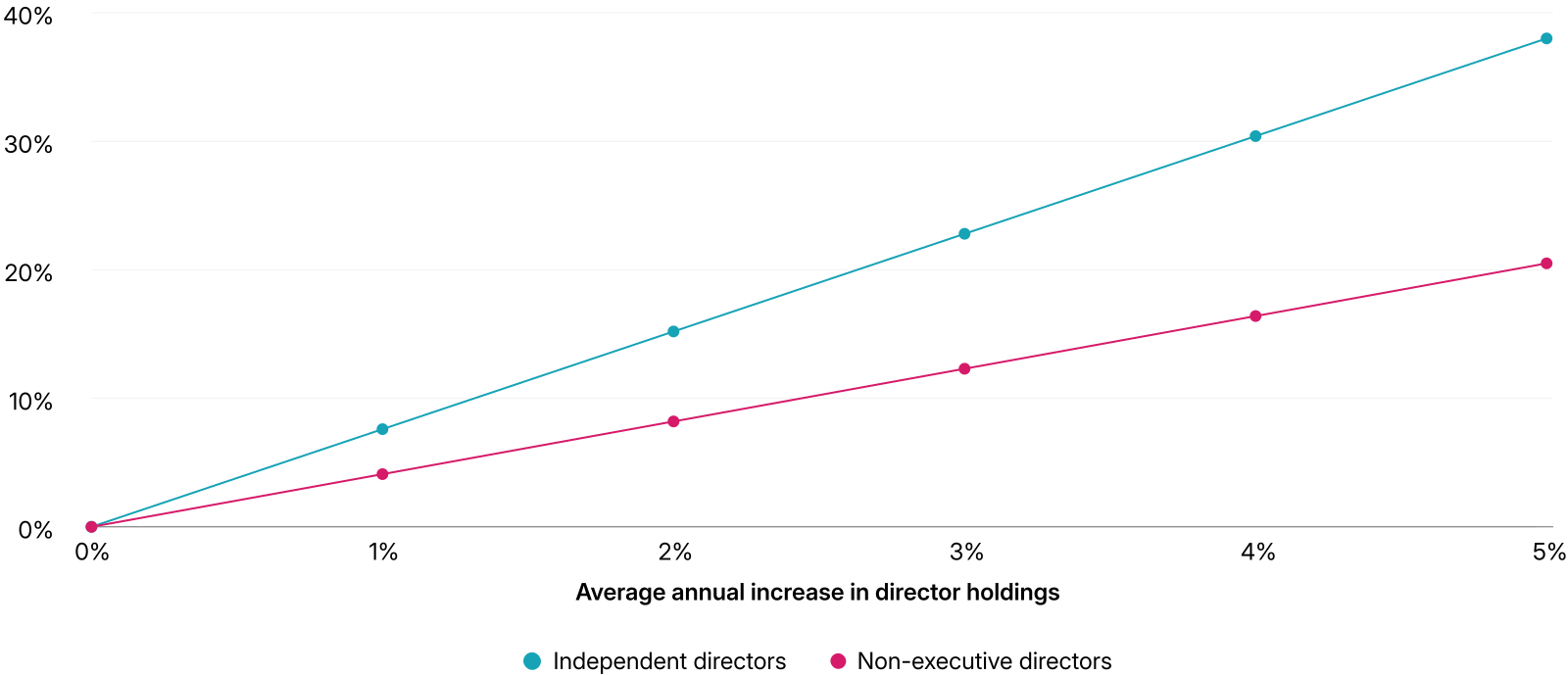
Data as of Nov. 4, 2025, based on a universe of 2,137 companies that were continuous constituents of the MSCI ACWI Index between 2020 and 2025. Source: MSCI Sustainability & Climate Research, FactSet. MSCI Sustainability & Climate products and services are provided by MSCI Solutions LLC in the United States, MSCI Solutions (UK) Limited in the United Kingdom, MSCI Solutions (Deutschland) GmbH in the EU and certain other related entities.
You can read the full research that this quick take is based on here.

Subscribe todayto have insights delivered to your inbox.
How Ownership Can Shape Outcomes
Who owns a company can define its success. Discover how trends in ownership concentration impact shareholder value and why investors should factor ownership into long-term equity analysis.
How Company Ownership Shapes Performance
Controlled companies now outnumber widely held ones. New MSCI research shows that this market shift has significant implications for shareholder returns.
Get clarity, move with conviction.
Understand how investors assess your company and what drives index inclusion. MSCI helps corporate finance and sustainability leaders act with confidence.
1 MSCI Sustainability & Climate defines an independent director as a nonexecutive director who does not have any material relationship with the company or its management or is not a significant shareholder. A nonexecutive director is a board member who is not part of the company’s executive management team and does not hold an executive role within the company but is not necessarily independent.
The content of this page is for informational purposes only and is intended for institutional professionals with the analytical resources and tools necessary to interpret any performance information. Nothing herein is intended to recommend any product, tool or service. For all references to laws, rules or regulations, please note that the information is provided “as is” and does not constitute legal advice or any binding interpretation. Any approach to comply with regulatory or policy initiatives should be discussed with your own legal counsel and/or the relevant competent authority, as needed.