
Managing Sustainability Risks, More Stable Businesses
Not all sustainability investments carry equal weight for corporate performance. For executives making the internal case, our analysis offers a clear takeaway: Companies that strongly managed their most financially material sustainability risks tended, over a 12-year study period, to run more stable and predictable businesses than peers that did not.
The finding draws on data from more than 13,500 companies. Controlling for size, sector and region, those in the top quintile of MSCI ESG Ratings showed consistently lower variability in both sales and cash flows than bottom-quintile peers — a difference significant at the 99% confidence level. The pattern held across 10 of 11 sectors, suggesting a structural rather than incidental relationship.
The results are consistent with the logic underpinning MSCI’s ESG Ratings model, which identifies environmental and social risks that are industry-specific and financially material, rather than treating sustainability as a uniform set of obligations. A chemicals company, for example, faces a different risk profile from a retailer or a bank.
Governance as a key channel to financial performance
A second finding relates specifically to governance. Companies with higher governance scores tended to exhibit higher gross profitability, driven primarily by more efficient use of assets rather than wider margins. This suggests that the governance component of ESG — through stronger oversight, accountability and capital discipline — may be a key channel linking sustainability management to bottom-line performance.
For executives, that framing matters. The question is not how much to spend on sustainability in aggregate, but whether the risks most likely to affect the bottom line are being effectively identified and managed.
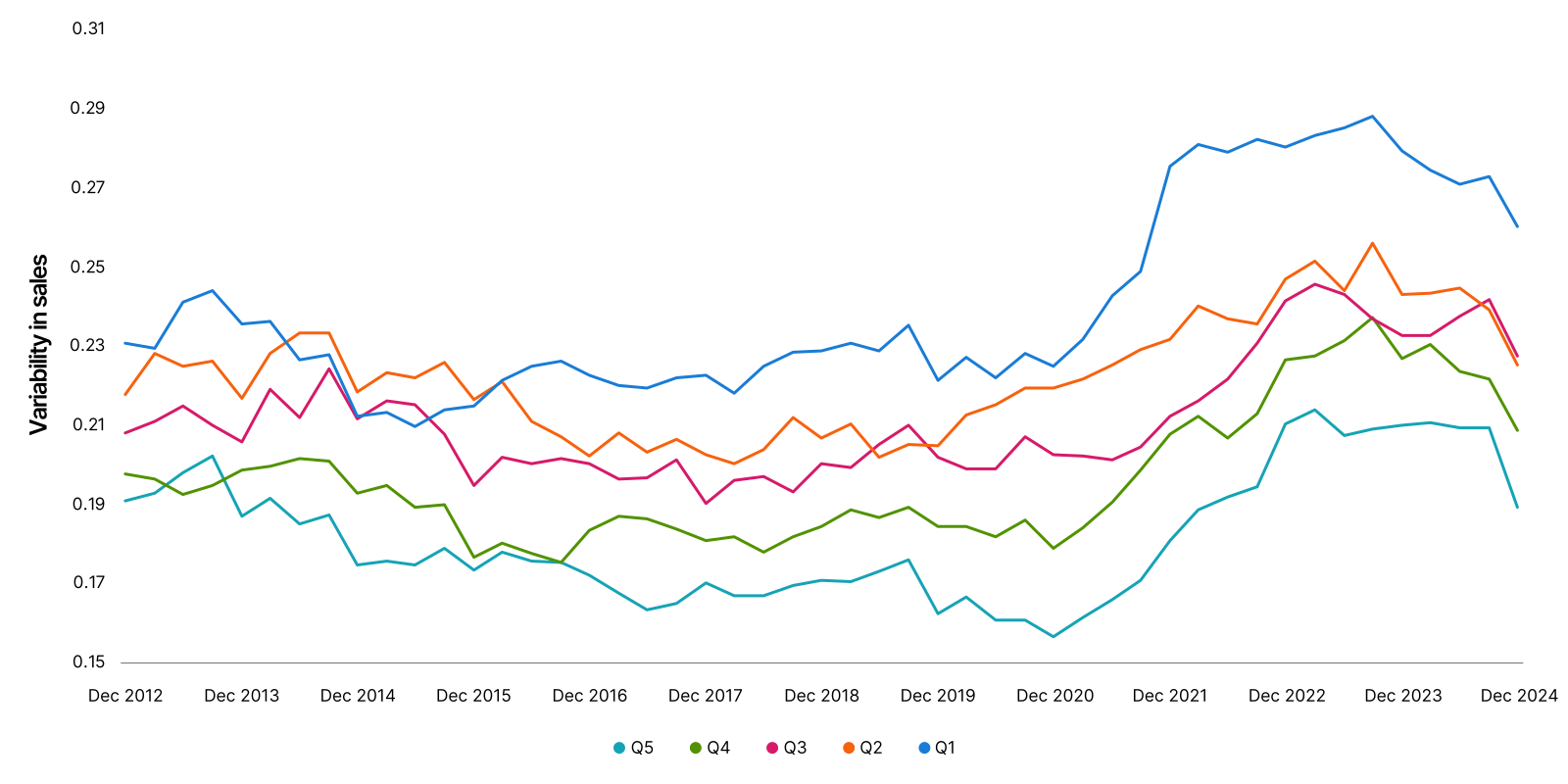
Data from December 2012 to December 2024. Q5 represents the highest-rated companies; Q1 the lowest. Lower values indicate more stable sales. Source: FactSet, MSCI Sustainability & Climate, based on “Insights on MSCI ESG Ratings and Business Performance.” MSCI Sustainability & Climate products and services are provided by MSCI Solutions LLC in the United States and MSCI Solutions (UK) Limited in the United Kingdom and certain other related entities.


Subscribe todayto have insights delivered to your inbox.
Insights on MSCI ESG Ratings and Business Performance
Do ESG ratings indicate better business performance? See what the data reveals about the connection between sustainability, operational stability and efficiency and long-term business performance.
ESG Ratings in Global Equity Markets: A Long-Term Performance Review
Companies with higher MSCI ESG Ratings outperformed their lower-rated counterparts across two global indexes over more than a decade, we write in the Journal of Impact & ESG Investing.
ESG Ratings
Measure a company’s resilience to financially relevant, industry-specific sustainability risks.
The content of this page is for informational purposes only and is intended for institutional professionals with the analytical resources and tools necessary to interpret any performance information. Nothing herein is intended to recommend any product, tool or service. For all references to laws, rules or regulations, please note that the information is provided “as is” and does not constitute legal advice or any binding interpretation. Any approach to comply with regulatory or policy initiatives should be discussed with your own legal counsel and/or the relevant competent authority, as needed.