
Not All Carbon Emissions Carry the Same Risk
Mentioned in this quick take:
MSCI ACWI Index | MSCI USA Index | MSCI EM (Emerging Markets) Index
Carbon footprints can help investors assess portfolio transition risk. But MSCI research suggests that treating every ton of CO2 equally can overstate some risks and understate others. For corporate leaders, the implication is clear: Investors may focus less on total emissions and more on the emissions most exposed to financial pressure.
The emissions that matter vary by industry
MSCI developed a materiality-weighted carbon footprint that identifies, at the GICS sub-industry level,1 which emission scopes (operational, upstream or downstream) are most exposed to real business pressure from carbon pricing or technology substitution.2 The result is a significantly narrower lens through which to view financial materiality of the issuer’s carbon footprint. Across the MSCI ACWI Index, only 6% of Scope 3 upstream emissions qualified as material, compared to 78% of Scope 1 and 2 and 62% of Scope 3 downstream. For sectors like energy and consumer discretionary, downstream product emissions dominate the risk picture. For consumer staples, upstream supply-chain emissions carry more weight.
Carbon efficiency was associated with stronger earnings growth
Our analysis comparing the most and least carbon-efficient companies within each sector over the past decade found significant performance differences. More carbon-efficient companies outperformed more carbon-intensive peers even after controlling for all other factors. Critically, this gap widened when emissions were materiality-weighted rather than measured in total, suggesting that emissions facing the greatest business pressure may provide a sharper signal of financial risk.
What this could mean for your company
Investors are becoming more precise about which emissions may signal financial risk, with greater focus on the scopes facing the most significant business pressure. Companies may want to consider which parts of their value chain investors view as financially relevant when prioritizing decarbonization and disclosure. Where material emissions are concentrated in Scope 3 downstream (as with energy and auto manufacturers), investor scrutiny may concentrate there.
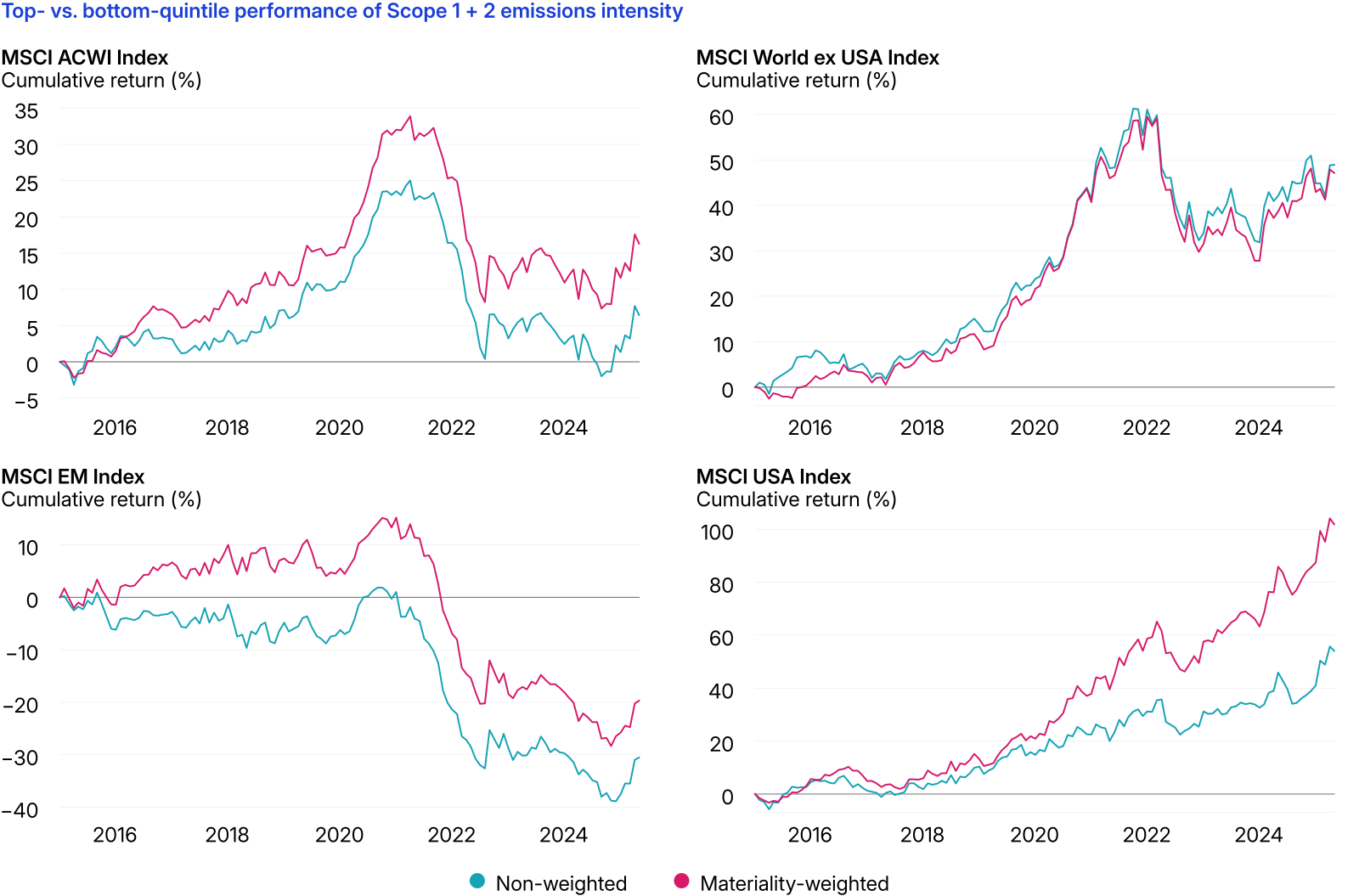
Data from Dec. 31, 2014, to March 31, 2025. Past performance, whether actual, backtested or simulated, is no indication or guarantee of future performance. Source: MSCI Sustainability & Climate. MSCI Sustainability & Climate products and services are provided by MSCI Solutions LLC in the United States, MSCI Solutions (UK) Limited in the United Kingdom, MSCI Solutions (Deutschland) GmbH in the EU and certain other related entities.
The author would like to acknowledge the contributions of Anett Husi, Chris Cote, Gabriela de la Serna, Harinakshi Raina and Jakub Malich to the original paper on which this quick take is based.
You can find the full research here.

Subscribe todayto have insights delivered to your inbox.
Materiality-Weighted Portfolio Carbon Footprint: A More Accurate Measure for Transition Risk
Same ton of carbon, different risk. Materiality-weighted emissions beat total footprint at predicting earnings, stock and credit performance — new MSCI research in The Journal of Portfolio Management.
Material, But Missing: Gaps in Scope 3 Reporting Persist
Despite offering broader Scope 3 disclosures, most companies do not report on their most material emissions. Investors may need to look beyond the numbers to understand true climate exposure.
MSCI Climate Solutions
MSCI can help you understand, monitor and manage the risk and return of climate exposures with our integrated data, analytical tools, indexes and research insights.
1 GICS is the global industry-classification standard jointly developed by MSCI and S&P Dow Jones Indices.
2 The business-pressure score assesses the level of financially relevant pressure on the company to decarbonize its business based on the expected emissions intensity and commercial adoptability of relevant emissions-mitigation technologies.
The content of this page is for informational purposes only and is intended for institutional professionals with the analytical resources and tools necessary to interpret any performance information. Nothing herein is intended to recommend any product, tool or service. For all references to laws, rules or regulations, please note that the information is provided “as is” and does not constitute legal advice or any binding interpretation. Any approach to comply with regulatory or policy initiatives should be discussed with your own legal counsel and/or the relevant competent authority, as needed.