
Scenario Analysis: Multi-Asset-Class View of a Tech Sell-Off
Our earlier blog post found that waning confidence in AI-driven growth could trigger a tech-led equity sell-off, hitting semiconductors hardest while defensive sectors outperform.1 We extend this scenario by adding interest-rate-shock assumptions to translate the scenario into a multi-asset-class impact, helping investors assess potential diversification benefits.
How a US tech sell-off could ripple across asset classesWe apply the same equity shocks, with the sharpest shock to U.S. semiconductors, reflecting stretched valuations. Growth stocks are rerated lower as expectations normalize, while firms with stronger capital discipline (management quality) provide partial offset.
We combine this with two potential narratives for interest rates:2
- Growth scare: Fears about economic weakness dominate, leading to yields dropping while the yield curve steepens — a similar pattern as observed during the dot-com bubble.
- Policy hold: Amid key economic-data delays in the U.S. and inflation uncertainty, the Federal Reserve holds rates. Longer yields, reflecting fiscal and inflation concerns, edge higher.
These shocks are propagated across asset classes using the MSCI Multi-Asset Class (MAC) Factor Model.
Fixed income may provide some relief, or not …
In the growth-scare scenario, a hypothetical multi-asset-class portfolio falls about 10% in USD terms (and 12% to 18% for non-USD investors as the dollar weakens). Losses are led by equities — global equities drop roughly 18% and U.S. equities 22% — while sovereign bonds and high-quality credit partially offset declines as yields fall. In the policy-hold scenario, the portfolio loses around 12% in USD terms, as bond values drop and diversification benefits fade. In this scenario, the dollar is flat.3
Overall, high-quality fixed income cushions losses when policy turns supportive, but offers less protection when rate cuts are withheld. While defensive equity industries could provide diversification across asset classes, gains in quality fixed income may help offset losses during tech-led downturns.
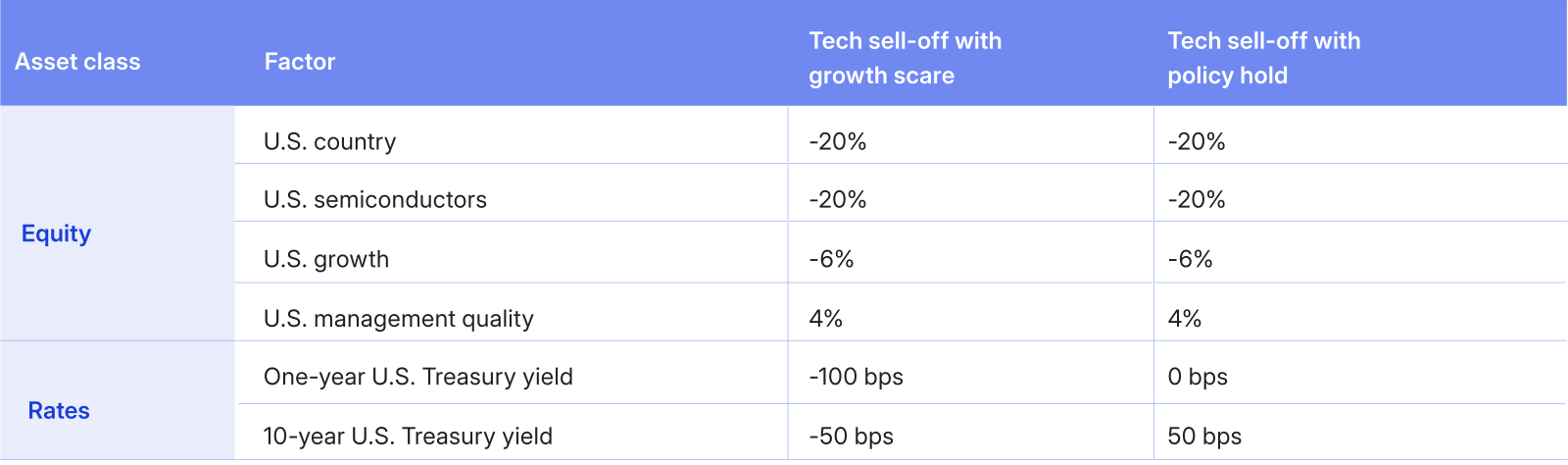
Note that the U.S.-semiconductors factor shock is net of the market, hence in addition to the –20% on the U.S. country factor. Assumptions about risk-factor shocks are informed by historical analysis and judgment.
Portfolio impact as of Nov. 17, 2025. Source: S&P Global Market Intelligence, MSCI


Subscribe todayto have insights delivered to your inbox.
Scenario Analysis: What Could a US Tech Correction Look Like?
The AI-fueled tech rally has left markets top-heavy. What happens if investor confidence falters? Explore how a U.S. tech correction could affect global industries — and what might stay resilient.
A Historical Look at Market Downturns to Inform Scenario Analysis
When investors assess risk, they construct narratives around the data. Investment managers and asset allocators can look to the long history of market sell-offs for context, to better anticipate future drawdowns and prepare portfolios for what the future may hold.
Markets in Focus: The Price of US Exceptionalism
U.S. equities have weathered repeated shocks over 2025. Our research examines the drivers of their resilience and the outlook for continued dominance.
1 Sectors and industries are defined by the Global Industry Classification Standard, or GICS®, which is the industry-classification standard jointly developed by MSCI and S&P Dow Jones Indices.
2 For more details about the equity shock assumptions, see our previous blog post. For interest rates under the growth-scare scenario, we assumed shocks similar to those observed during the dot-com bubble; however, as yield levels were higher then, we applied the relative shock to today’s yield levels. For the policy-hold scenario, the short end remains fixed while the long end increases slightly due to increased term premium.
3 The results are generated by applying model correlations to propagate shocks to the portfolios using MSCI's BarraOne®. MSCI clients can download the correlated BarraOne stress test and RiskMetrics® RiskManager® stress test. Treasury inflation-protected securities (TIPS) are represented by the iBoxx TIPS Inflation-Linked Index provided by S&P Dow Jones Indices. U.S. Treasurys, equities and corporate bonds are represented by MSCI indexes. Private equity is represented by model portfolios and U.S. real estate is represented by the MSCI/PREA U.S. AFOE Quarterly Property Fund Index. The composite portfolio consists of 50% global equities (35% public and 15% private), 10% Treasurys, 10% TIPS, 10% U.S. investment-grade bonds, 10% U.S. high-yield bonds and 10% U.S. real estate.
The content of this page is for informational purposes only and is intended for institutional professionals with the analytical resources and tools necessary to interpret any performance information. Nothing herein is intended to recommend any product, tool or service. For all references to laws, rules or regulations, please note that the information is provided “as is” and does not constitute legal advice or any binding interpretation. Any approach to comply with regulatory or policy initiatives should be discussed with your own legal counsel and/or the relevant competent authority, as needed.