
Venture-Debt Loan Marks in Deteriorating Health
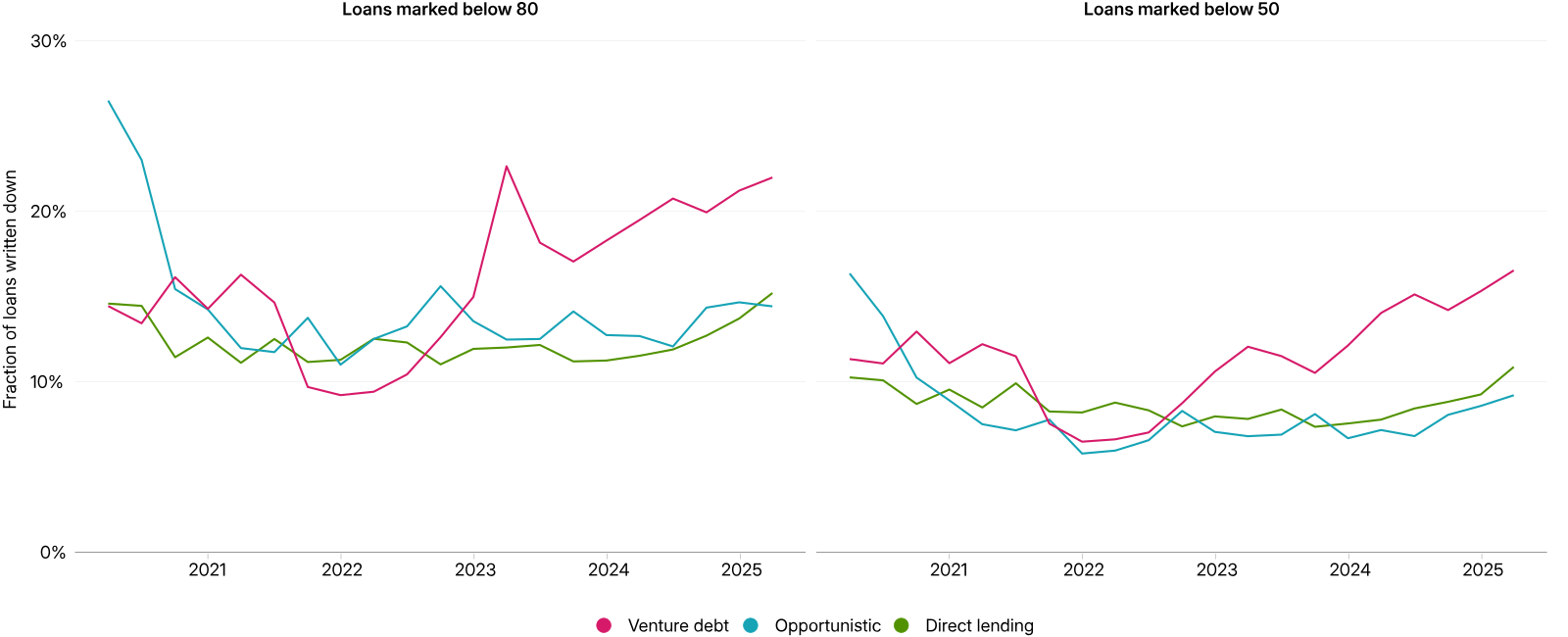
Since early 2022, loan valuations in venture debt have diverged sharply from other corporate-lending strategies in private credit. The share of loans marked at least 20% below principal — a level typically associated with borrower distress — has more than doubled, rising to 24% in Q3 2025 from 9% in Q1 2022. More severe fair-value write-downs of 50% or greater have also leapt over the same period.
In contrast, write-downs in private-credit funds focused on opportunistic and direct lending have risen more modestly. As of Q3 2025, their rates of both moderate and severe write-downs were roughly one-third lower than those observed across venture-debt portfolios.
The divergence has also appeared in recent fund-level performance. Venture debt posted a quarterly return of -1.5% in Q3 2025, compared with positive returns for direct lending and opportunistic strategies, suggesting that write-downs have been exerting pressure on strategy-wide performance.
Given venture debt’s sector composition, IT exposure would seem a natural explanation for the rise in distress. IT represents nearly 40% of the net asset value in venture debt, compared with 19% for direct lending and 7% for opportunistic funds. However, it’s health-care borrowers that have largely driven the recent venture-debt write-downs, while technology loans have exhibited below-average rates of distress.
The contrast with health-care borrowers in other credit strategies suggests that the issue is not sector-wide. Such borrowers financed by direct lending and opportunistic funds have experienced materially lower rates of write-downs than their venture-backed peers.
Venture debt’s resilience outside of health care may yet be tested, however. Given the strategy’s sizable exposure to IT, growing jitters in that sector could weigh more heavily on marks going forward.1 If distress broadens beyond health care to include tech, venture debt’s sector concentration could compound the growing write-downs already observed.
MSCI Private Capital Transparency data as of Feb. 17, 2026.

Subscribe todayto have insights delivered to your inbox.
Deciphering the Distinctions in Private Credit
Private credit is not one market. Strategies differ sharply in leverage use, borrower profile, rate structure and security types — differences that can materially shift performance and risk outcomes for investors.
MSCI Private Capital Benchmarks Summary Q3 2025
Leveraging data on more than 15,000 closed-end funds, we provide insights into key measures on cash flows, valuations, dry powder and performance across global private equity, credit and real assets.
1 Lynn Doan and Carmen Reinicke, “What’s Behind the ‘SaaSpocalypse’ Plunge in Software Stocks,” Bloomberg, Feb. 4, 2026.
The content of this page is for informational purposes only and is intended for institutional professionals with the analytical resources and tools necessary to interpret any performance information. Nothing herein is intended to recommend any product, tool or service. For all references to laws, rules or regulations, please note that the information is provided “as is” and does not constitute legal advice or any binding interpretation. Any approach to comply with regulatory or policy initiatives should be discussed with your own legal counsel and/or the relevant competent authority, as needed.