
Deciphering the Distinctions in Private Credit
- Private credit is a spectrum of diverse strategies with differences in rate and equity exposure, borrower profiles and leverage that can materially shift performance and risk outcomes.
- Grouping all private-credit funds together can muddy investors’ benchmarking and make manager comparisons misleading in this rapidly evolving market.
- A more granular framework can improve analysis and portfolio construction, helping investors evaluate individual strategies on a like-for-like basis and better understand what’s driving risk and returns.
Private credit’s evolution over the past decade has been explosive — from a specialist source of mezzanine capital to a multi-trillion-dollar market covering everything from first-lien corporate loans to asset-backed lending. But with that breadth comes complexity, and grouping all private-credit funds together risks obscuring the nuances that define their risk and return profiles.
A look at recent performance as shown by the recently launched MSCI Private Credit Closed-End Fund Indexes highlights just how differently these segments can behave. In the chart we show four key credit strategies. While cumulative returns have been consistently positive across the board, strategies higher in the capital stack have lagged those that assumed greater credit risk over the five-year period. Opportunistic lending led performance, supported by its higher-yielding loans and post-pandemic deployment of flexible capital solutions.

Cumulative returns for selected MSCI Global Private Credit Closed-End Fund Indexes through Q2 2025. Solid lines represent returns computed in USD, dotted lines represent local-currency returns.
Senior direct lending, which typically targets secured, first-lien loans, was resilient through the 2022 rate shock, experiencing only a brief markdown as valuations adjusted to higher discount rates. Returns quickly rebounded as loans reset at higher yields and corporate borrowers met their obligations — either repaying or refinancing at those higher rates — underscoring the strategy’s defensive nature.
Notably, senior direct lending also exhibited the largest divergence between its USD index and local-currency returns, most prominently in 2022 and over 2025, reflecting this segment’s relatively higher share of non-USD-denominated funds. This represents an important consideration for global investors, whose own returns vary depending on their own relative currency mix and resulting foreign-exchange interactions in portfolios.
Senior direct lending lagged its subordinated counterpart. Subordinated direct lending, which takes on greater credit risk, made handsome gains despite periodic repricing, as write-downs weren’t enough to offset the strategy’s yield advantage. Real estate debt followed a more modest trajectory, tied closely to the health of property markets and refinancing challenges.
Collectively, these patterns highlight how segment positioning along the capital stack can shape outcomes across cycles in global private credit.
One of the most important distinctions among private-credit strategies lies in how loans are structured, particularly around rate exposure. Most private-credit loans are floating-rate and benchmarked to a reference index, providing investors with some protection against rising interest rates. (Borrower stress can increase when funding costs climb, however.)
The dominance of floating-rate loans does vary across strategies. Loans made by senior direct lending funds are overwhelmingly floating rate, minimizing duration risk and aligning income with prevailing market rates. Subordinated direct lending, on the other hand, includes a much larger share of fixed-rate loans often associated with mezzanine or junior tranches. These instruments sit below senior debt in the capital structure, offering higher yields but also greater exposure to credit losses.
Opportunistic lending stands out for its variety. These funds invest flexibly across the credit spectrum, sometimes in stressed or distressed companies, sometimes in bespoke financing situations where standard lending markets fall short. Their rate structures are more balanced, reflecting both fixed and floating elements as managers adjust to shifting opportunity sets. Real-estate-debt strategies also tend to exhibit modest exposure to fixed-rate loans, influenced by the structure of commercial-property loans and refinancing cycles.
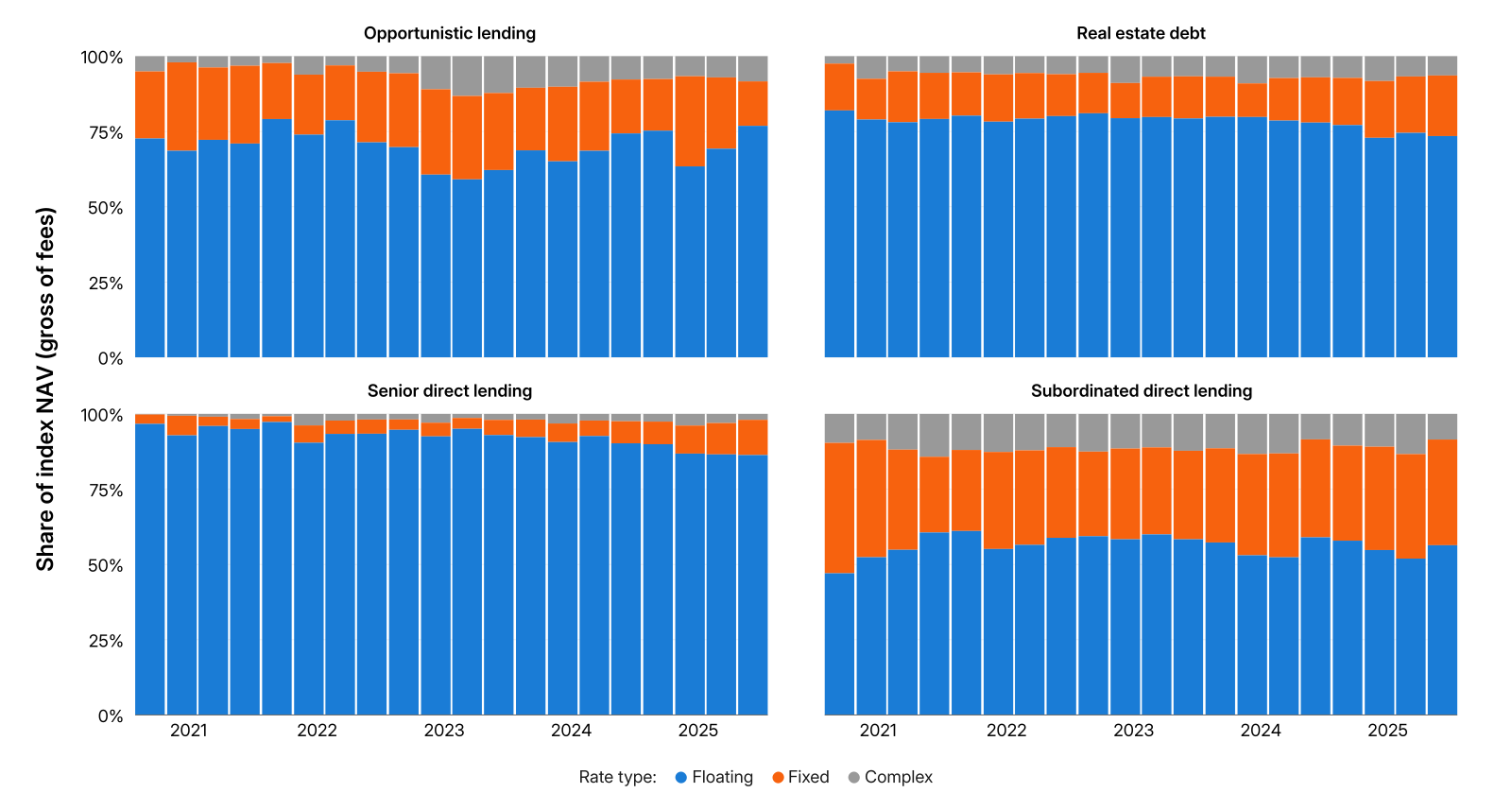
NAV is net asset value. MSCI Private Credit Security Terms data through Q2 2025.
While private credit is fundamentally a debt asset class, it is not exclusively so: Subordinated direct lending and opportunistic lending frequently include significant equity participation. This might come through warrants, convertible structures or co-investments in the common equity alongside the private-equity sponsors, designed to enhance upside potential. In distressed or special-situations investing, this can be a key driver of total return where these funds may end up owning equity stakes through restructurings. In contrast, senior direct lending and real estate debt remain almost purely debt-focused, with minimal equity exposure.
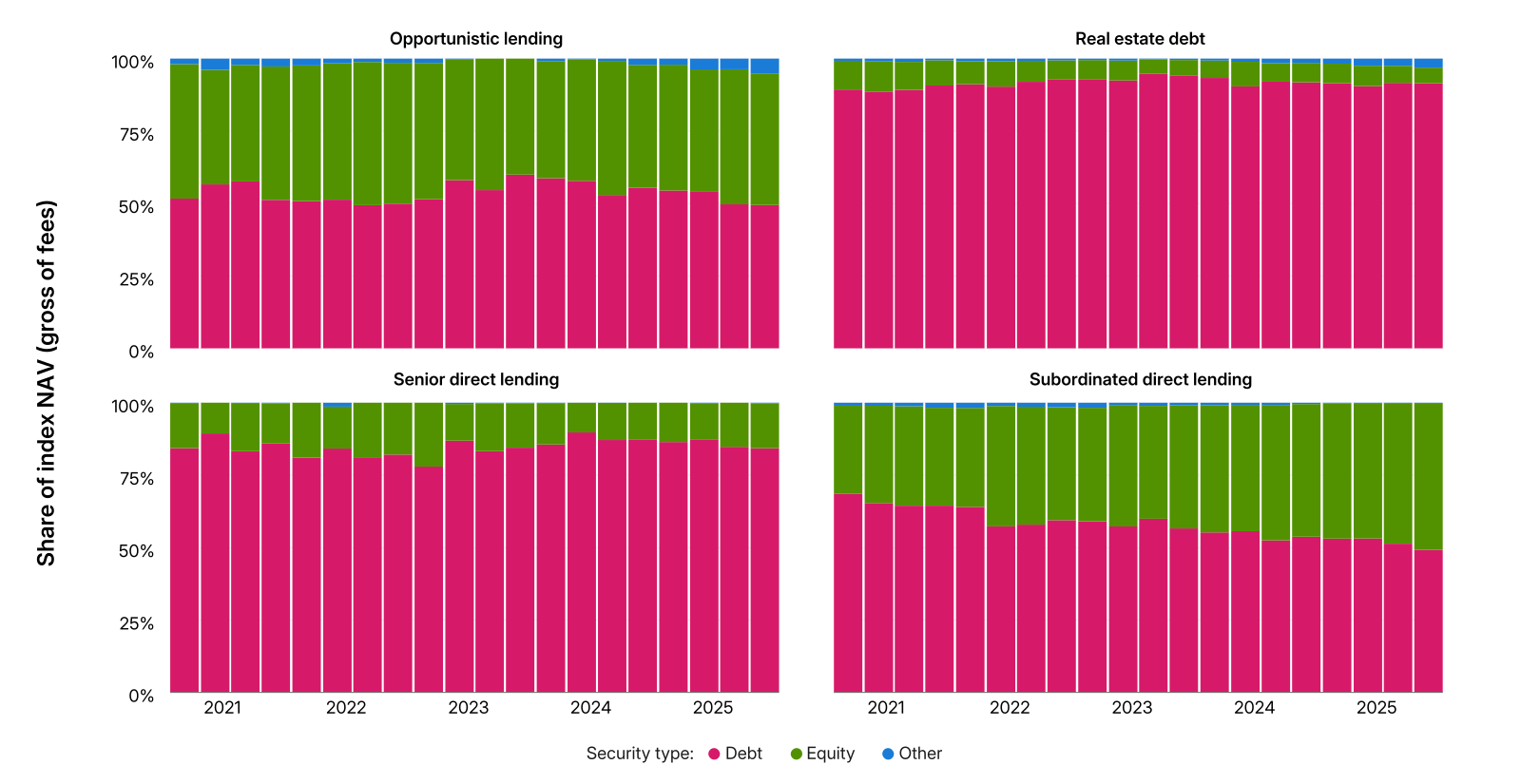
MSCI Private Credit Security Terms data through Q2 2025.
It might be tempting to assume that levered and unlevered private-credit funds invest in similar portfolios, with leverage simply amplifying returns. In practice, however, the data shows they are structurally distinct segments of the market differing not only in financing approach but also in borrower profile and risk characteristics.

Composition of indexes based on the share of NAV by borrowers’ trailing 12-month EBITDA. MSCI Private Capital Transparency data as of Q2 2025.
Segmenting MSCI’s levered and unlevered direct-lending indexes by borrower profile shows a distinct pattern: Levered funds, senior and subordinated alike, lend more to higher-EBITDA borrowers. These upper- and upper-middle-market borrowers are typically more mature, with deeper capital structures and broader access to financing markets — characteristics that investors often associate with lower credit risk.
The concentration is most evident in levered subordinated direct lending, where over three-quarters of NAV is in loans to the borrowers generating over USD 100 million in EBITDA. In contrast, unlevered indexes show higher allocations to mid-sized and smaller borrowers, where opportunities may be less competitive but carry higher idiosyncratic risk.
This divergence underscores that levered strategies are not merely amplified versions of unlevered strategies. They represent different risk-return profiles and market niches, shaped by manager mandates, investor tolerance for leverage and the underlying borrower universe.
For investors, understanding all these differences is essential for portfolio construction and risk management. A more granular breakdown provides investors and allocators with a more precise view of this rapidly evolving asset class and the forces shaping its risks and returns. Knowing what sits inside private credit matters just as much as understanding how it performs.

Subscribe todayto have insights delivered to your inbox.
Bridging Public and Private for a Total Equity View
A lag-free, higher-frequency benchmark for private equity underpins a global daily performance index for public and private equity, giving investors a full perspective on the asset class.
Why LPs in Private Credit Deserve Clearer Borrower Reporting
Limited partners in private credit should not have to guess when it comes to risks on individual borrowers. General partners can provide the transparency needed to advance investment confidence.
The content of this page is for informational purposes only and is intended for institutional professionals with the analytical resources and tools necessary to interpret any performance information. Nothing herein is intended to recommend any product, tool or service. For all references to laws, rules or regulations, please note that the information is provided “as is” and does not constitute legal advice or any binding interpretation. Any approach to comply with regulatory or policy initiatives should be discussed with your own legal counsel and/or the relevant competent authority, as needed.