
Water Scarcity Already Costs Companies USD 485 Billion a Year
Mentioned in this quick take:
MSCI’s Nature Financial Risk Metrics · GeoSpatial Asset Intelligence
Capital markets are becoming increasingly aware of nature as a source of risk, but quantifying this risk at the company level remains challenging. MSCI’s Nature Financial Risk Metrics offer a first look at nature-related financial materiality, putting annual losses from water scarcity — the most wide-spread nature-related risk — at USD 485 billion a year. The numbers show that not all losses are created equal: Some companies may face much bigger problems than others, and significant losses are hidden where investors previously were unable to look — upstream, in companies’ supply chains.
Across roughly 9,500 equity and fixed-income issuers globally, companies’ own water-stressed operations account for an estimated USD 327 billion in annual losses, with another USD 158 billion transmitted through supply-chain disruptions. These estimates are probability-weighted annual losses, informed by empirical data from billions of dollars in drought-related financial losses documented over the last 25 years. The losses cover both revenue disruption from water-stressed operations and cost inflation from stressed suppliers, allocated to companies using their geospatial asset locations and funneled through MSCI’s supply-chain model.
The resulting USD 485 billion is highly concentrated: 66 issuers each face USD 1 billion or more in annual losses, and the 100 largest exposures account for 37% of the total. Industrials (USD 87 billion) and energy (USD 85 billion) lead by sector, facing substantial losses through both direct operations and supply chains.1 Energy's supply-chain component stands at USD 35 billion, or 41% of its total. Other sectors are not off the hook: Supply-chain cost increases account for a third of total losses in consumer staples.
For investors, the era of nature-related financial materiality has begun. The numbers show both the scale of the problem and its uneven distribution, revealing the business end of nature-related financial risk: who is exposed, where the exposure lies and how much it may cost.
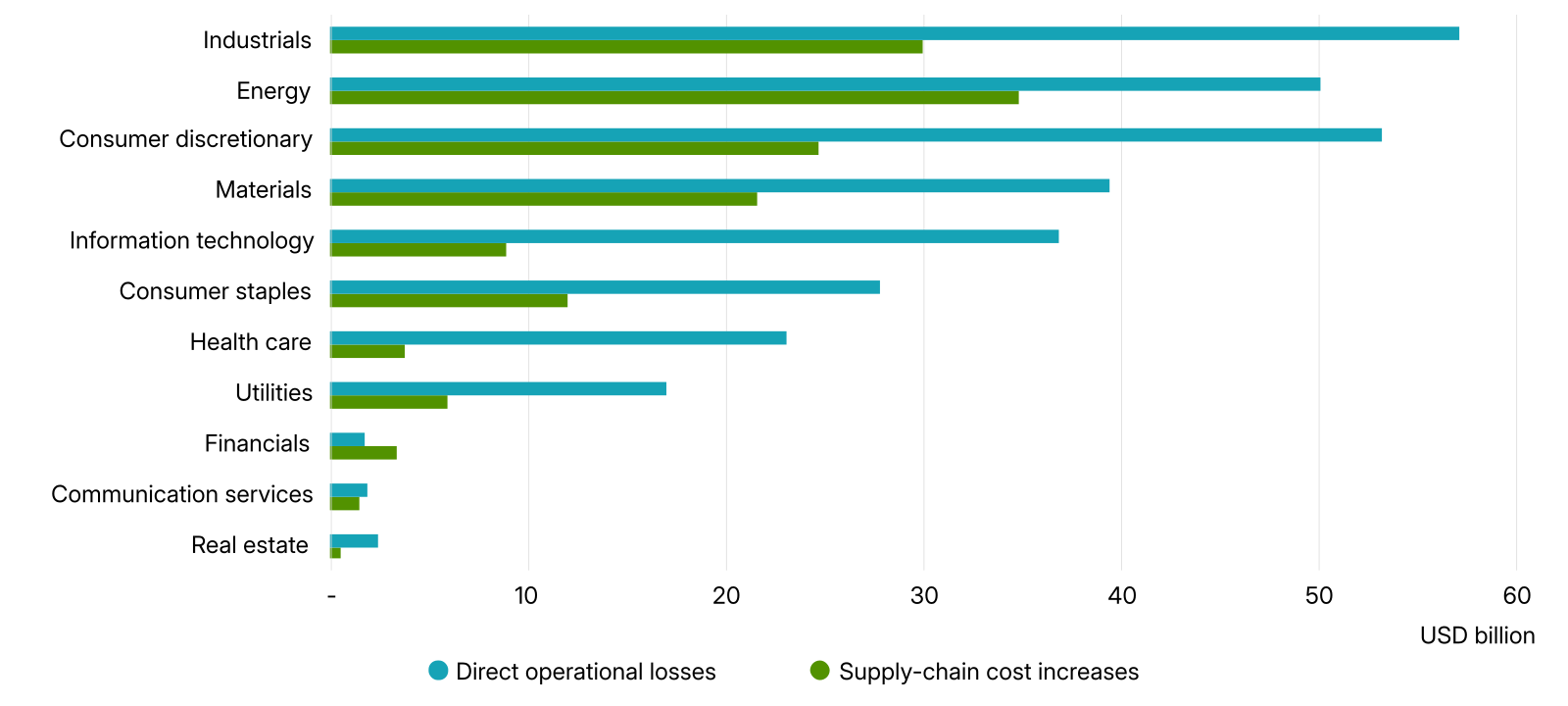
Source: MSCI Sustainability & Climate. MSCI Sustainability & Climate products and services are provided by MSCI Solutions LLC in the United States and MSCI Solutions (UK) Limited in the United Kingdom and certain other related entities. Analysis based on MSCI’s Nature Financial Risk Metrics for water scarcity. Estimates are probability-weighted annual losses and are not Value-at-Risk figures. Figures rounded to the nearest USD billion.

Subscribe todayto have insights delivered to your inbox.
An Investor's Guide to Nature and Biodiversity Risks and Impacts
What could nature loss mean for your returns? Our new guide can help you assess impacts, manage rising risks and capture opportunities as markets shift toward a nature-positive future.
Uncovering Nature Risks Through Geospatial Analysis
Nature loss is a rising risk to the global economy, disrupting supply chains, raising costs and slowing growth. Investors — such as asset managers, insurers and banks — who use geospatial analysis are better positioned to manage these location-specific risks.
1 Sector definitions based on GICS®, the global industry-classification standard jointly developed by MSCI and S&P Dow Jones Indices.
The content of this page is for informational purposes only and is intended for institutional professionals with the analytical resources and tools necessary to interpret any performance information. Nothing herein is intended to recommend any product, tool or service. For all references to laws, rules or regulations, please note that the information is provided “as is” and does not constitute legal advice or any binding interpretation. Any approach to comply with regulatory or policy initiatives should be discussed with your own legal counsel and/or the relevant competent authority, as needed.