
From Broad to Bespoke: How Much Should You Customize Your Private-Capital Benchmark?
- For an asset owner, the right private-capital benchmark is fixed by the decision under scrutiny. Allocation, strategy mix, commitment pacing and manager selection are four separate questions, and no single index answers all four.
- Benchmark customization is a ladder: Each rung strips out another source of noise, from strategy mix to vintage. A 50/50 buyout/venture capital portfolio that beats a 75/25 index may owe most of its outperformance to tilt, not manager skill.
- Climbing too high on the ladder of customization can backfire and hide the very calls on allocation that asset owners are supposed to be judged on.
Private capital is now a core institutional allocation and, for asset owners, benchmarking this allocation has moved from a technical afterthought to a governance priority. Asset owners are increasingly moving away from public-equity benchmarks, and previously, we argued that these are poorly suited to private-capital portfolios, and that a private-capital index is the better foundation. That leaves the harder question: which benchmark? Private-capital benchmarks come in a complex menu of options and vary widely in customization, and the choice determines what they actually measure.
Start with the question, not the indexThe right benchmark depends on which decision or skill is being evaluated: Was the asset allocation sound? Was the strategy mix well chosen? Was capital deployed at the right time? Or, were managers well selected? Each calls for a different benchmark design.
The first question is whether moving into private capital was worthwhile to begin with. For an LP, this is an asset-allocation judgment, and the natural comparison is an opportunity cost. Public-market equivalents and “public index plus a spread” constructions have a legitimate role here, not as performance benchmarks but as strategic reference points.
Once that allocation is made, the questions change and the portfolio should be judged against the opportunity set it actually faced. Was the strategy mix well chosen? A credit portfolio that outperformed because spreads tightened is not the same as one that did so because managers were well selected. Were commitments well timed or did the investment program actively decide to sit out what were the strongest returning vintage years? Were the right managers chosen? No single benchmark answers all of these at once.
Each question calls for a different benchmark, as the exhibit below shows — ranging from a broad index to one fully matched to the portfolio. In practice, asset owners rarely rely on one benchmark: A primary policy benchmark answers the central governance question, with secondary references providing broader context.
With that framing in place, the main benchmark constructions form a ladder, each rung neutralizing one more source of noise and answering a different question.
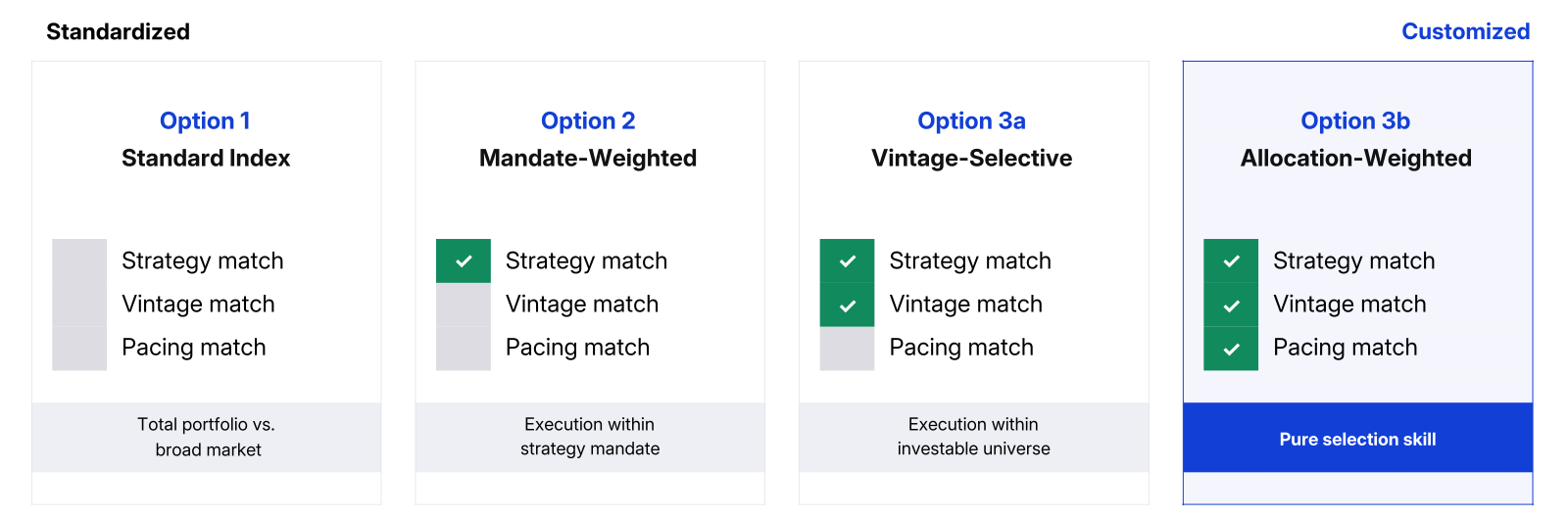
A broad standard index (Option 1) sits at the bottom: It pools all funds, weighted by the market’s own allocation. It is transparent and easy to communicate, but may differ sharply from a given mandate. An LP whose private-equity portfolio split evenly between buyout and venture, benchmarked against an index weighted 75/25 toward buyout, will post relative performance that partly reflects that mismatch rather than any investment decision. The broad index answers “how did the asset class do?” far better than “how did this portfolio do within its mandate?”
A mandate-aligned composite (Option 2) climbs a rung by recombining sub-strategy indexes to match the portfolio's own allocation. In private credit, that might mean weighting direct lending, opportunistic lending and asset-backed lending indexes to reflect the portfolio's actual mix. Relative performance now reflects decisions within the strategy allocation. What it still misses is vintage: The composite keeps a market-based vintage profile, which can distort comparisons for portfolios still in build-out.
A vintage-selective benchmark (Option 3a) goes further, restricting the universe to the vintages the portfolio actually invested in and removing distortions from cohorts it never held. This matters most when a portfolio's vintage exposure is concentrated or skewed relative to the market — typically younger programs still early in the J-curve, but also any program with lumpy commitment pacing where it was entirely precluded from allocating to certain vintage years.1 As a portfolio’s vintage exposure comes to resemble the market's, the gap from a mandate-aligned composite narrows.
A fully allocation-weighted benchmark (Option 3b) sits at the top, matching the portfolio by strategy and by the weight of each vintage cohort, neutralizing both allocation and pacing. What remains is mostly manager and fund selection — usually the dimension over which an investment team has the most direct control. This is the most precise tool for evaluating execution, although its closeness to the portfolio demands careful governance to stay credible.
Skill or just tilt? An illustrative exampleTo make these choices concrete, picture three private-equity portfolios built from buyout and venture but composed differently from the market. The MSCI Global Private Equity Closed-End Fund Index is roughly 75% buyout and 25% venture as of Q4 2025. The backdrop matters: In calendar-year 2025, venture sharply outperformed buyout (+19.5% vs. +9.4% pooled), with gains concentrated in 2022–24 vintages. That outperformance was also highly uneven. While pooled venture returned +19.5%, the median venture fund managed only +2.6%, so holding venture and holding the right venture funds were very different things.
Portfolio A has a 50/50 buyout-venture split against the universe's 75/25. In 2025 that venture overweight captured the surge, so against a broad index, A looks like a clear outperformer. Whether that is the right verdict depends on where the tilt came from. If overweighting venture was a deliberate allocation decision, the broad index is the fair benchmark — rightly crediting a call the team made and got correct. If instead the tilt was outside their control (set by mandate, inherited or forced by limited access), then the broad index rewards them for something they did not choose, and a composite matched to their own 50/50 mix is the more accurate yardstick, isolating how well they actually selected funds.
Portfolio B is an older program with most of its capital in earlier vintages. In 2025 it sat out the recent-vintage rally that lifted the broad index, so it looks like a laggard. Matched to a benchmark of its own vintages, the picture inverts: B is ahead of its true peers. Here, customization does not deflate a flattering number. It removes a handicap, and a more representative benchmark gives B the credit the broad index was denying it.
Portfolio C has a market-like mix and an ordinary vintage profile, yet outperforms against almost any benchmark. Even with strategy and vintage effects stripped away, the excess return persists, which is the signature of good fund selection. In a year when the median venture fund returned +2.6% against a pooled +19.5%, that distinction was worth a great deal.
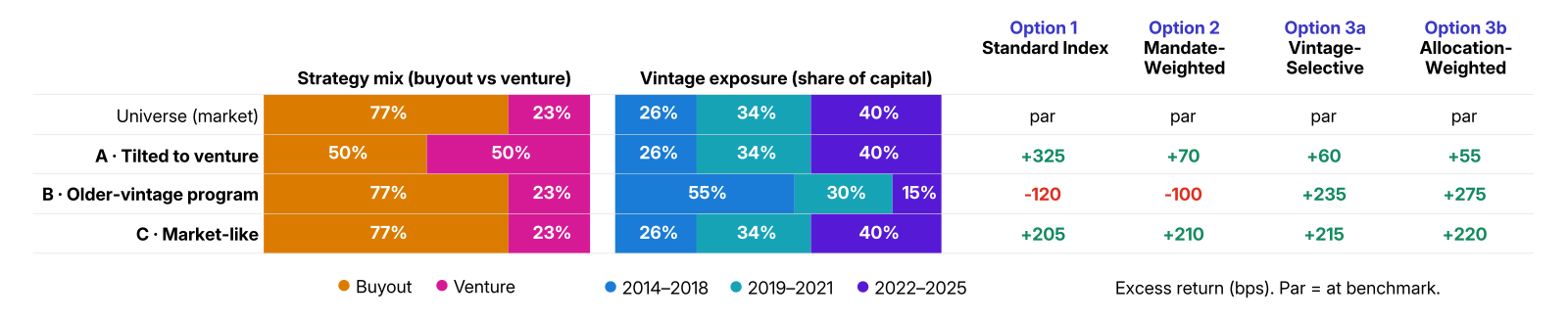
Illustrative results for calendar-year 2025. Source: MSCI Private Capital Universe
For an asset owner, benchmark customization is ultimately a governance choice, and how far to climb the ladder depends on what the benchmark is meant to measure. A low-customization benchmark is usually the right anchor for policy and reporting, while the more customized rungs are better seen as analytical tools that help an asset owner disentangle their relative performance.
Customization earns its keep most when a portfolio is fundamentally different from the broad market for reasons the asset owner did not choose, like a restrictive mandate. The discipline is knowing where to stop. The further customization reaches into the asset owner’s own calls, sector tilts, position sizing and deal selection, the more the benchmark comes to reflect those decisions rather than test them. The practical starting point for an asset owner is to identify the primary question the benchmark needs to answer and customize only as far as that demands.


Subscribe todayto have insights delivered to your inbox.
Private Capital Intel
Benchmark performance with one of the largest private capital datasets. Report, allocate, pace, report and assess risk and return.
Aligning Benchmarks with Asset-Class Reality: The Case for Private-Capital Indexes
Benchmarking private equity to public equity ignores fundamental differences between the two, leading investors to seek private-capital indexes as true benchmarks of the asset class.
The Cornerstones of Benchmarking Private Capital
Indexes can provide vital benchmarks for investors navigating private markets, a significant but relatively opaque investment ecosystem. We explain the hallmarks of building a foundational dataset and creating indexes that are reliable and robust.
1 Private-capital funds exhibit a so-called J-curve, where early returns are biased downward due to the presence of fees, costs and limited appreciation in the early investment phase, but tend to improve later as investments mature.
The content of this page is for informational purposes only and is intended for institutional professionals with the analytical resources and tools necessary to interpret any performance information. Nothing herein is intended to recommend any product, tool or service. For all references to laws, rules or regulations, please note that the information is provided “as is” and does not constitute legal advice or any binding interpretation. Any approach to comply with regulatory or policy initiatives should be discussed with your own legal counsel and/or the relevant competent authority, as needed.