
Mapping Geopolitical Risk Across the Value Chain
- Geodiversity has helped explain stock returns during major geopolitical events over the past decade. Companies with more concentrated value chains tended to be more vulnerable during periods of heightened geopolitical tension.
- Geodiversity measures the geographic concentration of a company's suppliers, production facilities and customers. Initial results suggest that higher concentration may be associated with greater exposure to disruption.
- Investors seeking to understand their geopolitical exposures may find value in mapping their portfolios along these three value-chain dimensions.
Geopolitical risks have become a growing concern for institutional investors. Trade disputes, tariffs, conflicts between countries, domestic politics and macroeconomic and monetary-policy shifts can all create uncertainty. Yet standard risk models may miss important aspects of a company's underlying economic footprint. A company's headquarters location reveals little about where it may face geopolitical risk. What matters is where it operates, where its suppliers are located and where it generates revenue. Looking at equity risk only through the lens of industry, country or style-factor exposure may not fully capture these risks.
To explore how geopolitical risk may materialize, we examined the relationship between companies' underlying geographic exposures and their equity-market performance during a selected set of geopolitical events over the past decade. We found that companies with more geographically diverse revenues, operations and suppliers were less impacted than their peers during some of the decade's most significant geopolitical events, even after controlling for traditional equity factors.
Geodiversity as a measure of geopolitical risk
To capture geopolitical risk through value-chain structure, we developed three geodiversity exposures: one for supply-chain concentration (using MSCI Supply Chain Intelligence), one for operational concentration (using MSCI GeoSpatial Asset Intelligence) and one for revenue concentration (using MSCI Economic Exposure). Each metric measures how concentrated a company's geographic footprint is along a different dimension of its value chain.1 In the current implementation, countries are weighted equally and country-specific risk characteristics are not incorporated.
We incorporated each of the three exposures individually into the MSCI Global Equity Model for Long Term Investors (GEMLT). We identified 48 dates between 2016 and 2026 on which at least one of the three factors showed strong explanatory power for stock returns (z-scores exceeding 3). We then examined whether geopolitical events coincided with those dates.
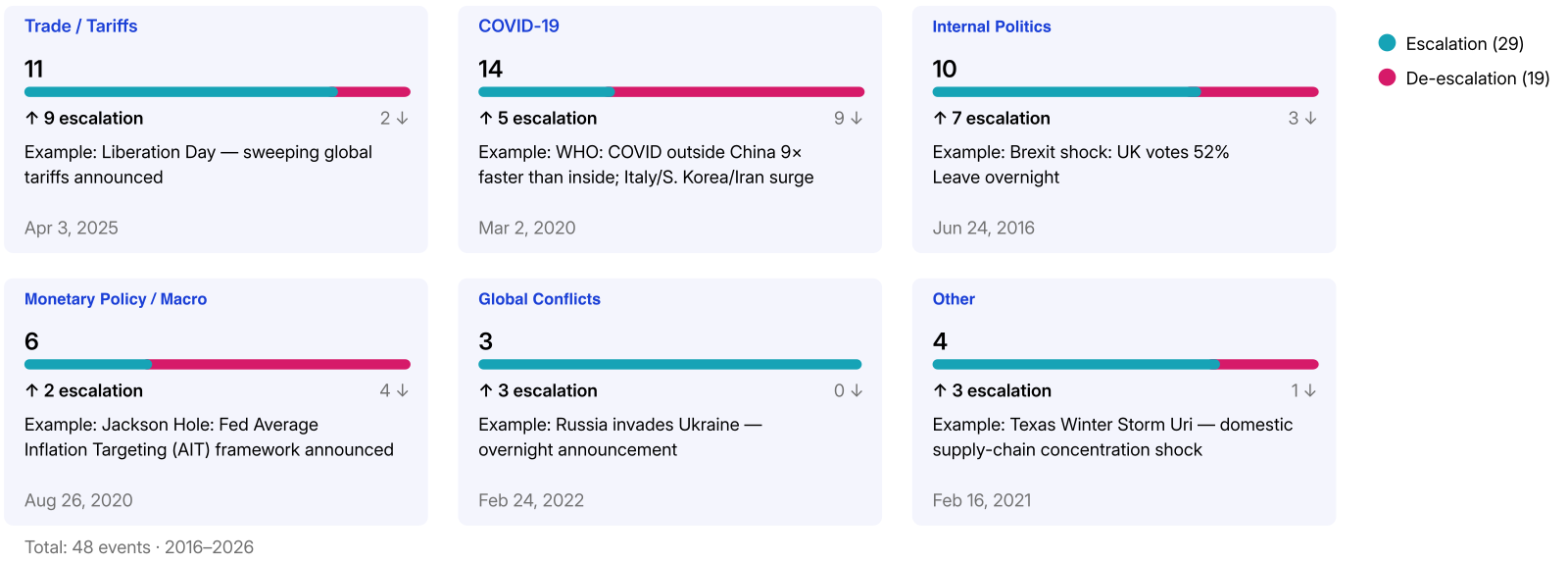
The dates with the strongest geodiversity-factor performance coincided with a range of geopolitical events, including the U.S. tariff announcements in April 2025, Russia's invasion of Ukraine in 2022 and the U.K.'s Brexit referendum in 2016.
Across the 48 dates in our sample, all three geodiversity factors showed explanatory power for stock returns. The relationship was asymmetric: Geographically concentrated companies tended to underperform more during periods of escalating geopolitical tension than they outperformed when tensions eased. During the 29 escalation events, mean factor returns were -12.4 basis points (bps) for supply-chain concentration, -10.5 bps for operational concentration and -13.9 bps for revenue concentration. During the 19 de-escalation events, the corresponding factor returns were +4.8 bps, +8.1 bps and +7.5 bps.
Tariffs and conflict: When geodiversity mattered the most
Events in the trade and tariffs category coincided with some of the strongest geodiversity-factor performance. During escalation events, average factor returns were -20.9 bps for supply-chain concentration, -13.3 bps for operational concentration and -16.9 bps for revenue concentration. During de-escalation events, the corresponding returns were +9 bps, +7 bps and +6 bps. This suggests that when tariffs are announced, companies with more concentrated suppliers, operations or customers may be more vulnerable to disruption.
The strongest relationship between geodiversity and stock performance in our sample occurred during global conflict events, including Russia's invasion of Ukraine and subsequent escalations.
Bars show mean factor returns (bps) on event dates within each category. Dark bars = escalation events; light bars = de-escalation events. We examined 48 events, including 29 escalation events and 19 de-escalation events. Factor returns were negative during escalation events and positive during de-escalation events in our sample. Universe: MSCI ACWI Index, 2016–2026. "Upstream / Supply chain": Captures the geographic concentration of a company's suppliers. During escalation events in our sample, companies with more diversified supply chains outperformed those with more concentrated supply chains. "Company / Production": Captures the geographic concentration of a company's physical assets and operations. During escalation events in our sample, companies with more diversified operations outperformed those with more concentrated operations. "Downstream / Revenue": Captures the geographic concentration of where a company generates revenue. During escalation events in our sample, companies with more diversified revenue exposure outperformed those with more concentrated revenue exposure.
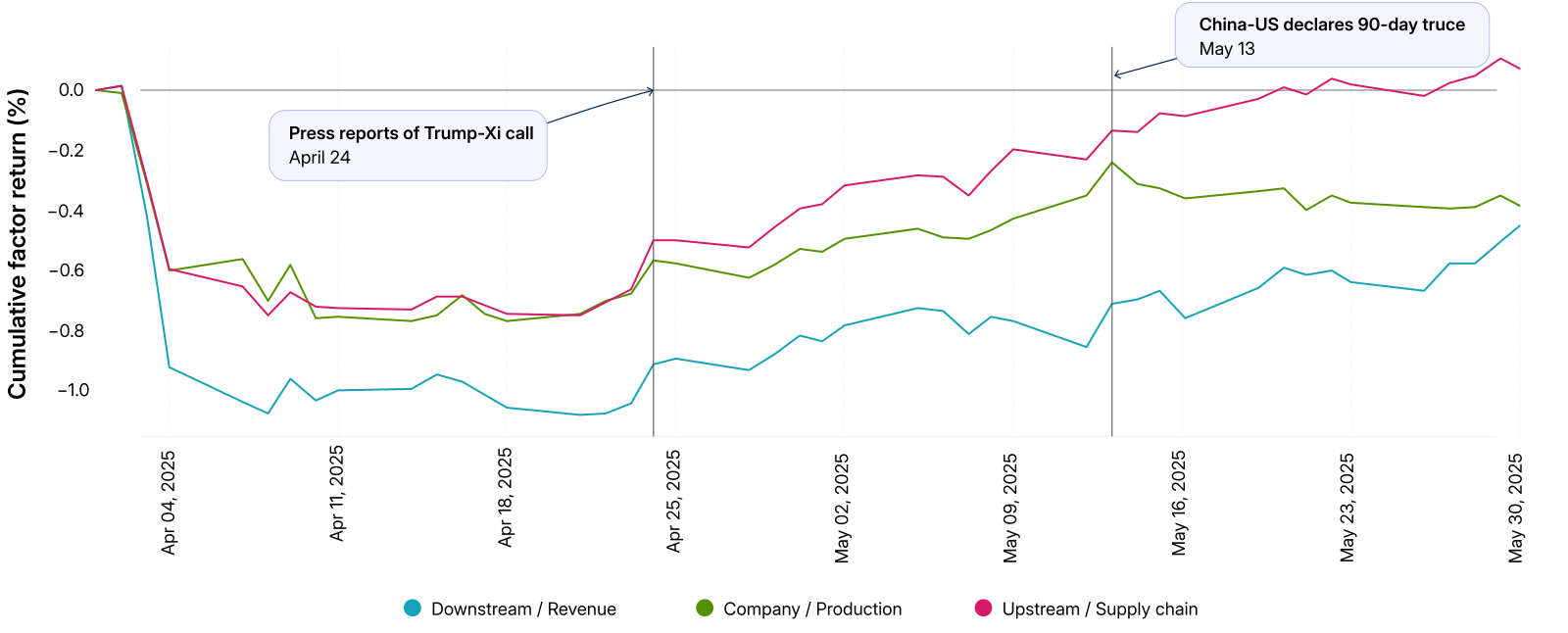
This dynamic was evident following the April 2025 tariff announcements. In the two trading days after the April 3 announcement, the revenue-, operations- and supply-chain-concentration factors fell by a cumulative 95.8 bps, 61.3 bps and 63.6 bps, respectively, indicating that geographically concentrated companies underperformed their peers.
As signs of de-escalation emerged, the factors began to recover and had regained most of their losses by the end of May. The largest positive move occurred on April 24, following press reports of a phone call between the leaders of the U.S. and China, alongside additional signals of de-escalation from the U.S. administration.2 Factor returns rose by 13 bps, 11 bps and 17 bps, respectively.3 The second-largest positive move occurred on May 13, when the U.S. and China agreed to roll back most tariffs and announced a 90-day truce. Factor returns rose by 14 bps, 11 bps and 10 bps, respectively.4
This analysis provides an initial exploration of how a company's underlying geographic footprint relates to its equity-market performance during geopolitical events. Our findings suggest that geodiversity exposures may complement traditional risk models in periods of heightened geopolitical uncertainty by capturing value-chain concentration risks that standard factor models do not directly address.
This remains a new area of research and further testing across a broader and more comprehensive set of geopolitical events is needed to assess the robustness of these relationships.
Investors seeking to better understand their geopolitical exposures may find value in mapping their portfolios across these three value-chain dimensions and monitoring how those exposures evolve as geopolitical conditions change.



Subscribe todayto have insights delivered to your inbox.
Uncovering Supply-Chain Risks in the Iran War
The Iran war hit global markets unevenly. We map three hidden channels — revenue, operations and supply chains — revealing where conflict risk truly sits in equity portfolios.
Hormuz Disruption Highlights Supply-Chain Risk in Fertilizer Stocks
Middle East gas disruption revealed how indirect supply-chain exposure drove divergent fertilizer-stock performance, highlighting hidden risks beyond direct operations and geographic revenue exposure.
GeoSpatial Asset Intelligence
GeoSpatial Asset Intelligence delivers asset-level nature and physical risk data to help investors, banks and insurers identify and manage risk.
1 Each geodiversity exposure was measured using the Herfindahl-Hirschman Index (HHI), a standard measure of concentration adapted here to geographic diversification. The HHI is calculated as the sum of squared country weights for each company and ranges from near 0 (highly diversified) to 1 (fully concentrated in a single country).
2 Eric Cortellessa and Sam Jacobs, “Read the Full Transcript of Trump's '100 Days' Interview,” TIME, April 22, 2025.
3 Kevin Breuninger and Eamon Javers, “Bessent Says He Expects 'De-Escalation' in U.S.-China Tariff Fight in the 'Very Near Future,'” CNBC, April 22, 2025.
4 Megan Cerullo, “U.S.-China Tariff Truce Offers Temporary Relief — and Plenty of Uncertainty,” CBS News, May 13, 2025.
The content of this page is for informational purposes only and is intended for institutional professionals with the analytical resources and tools necessary to interpret any performance information. Nothing herein is intended to recommend any product, tool or service. For all references to laws, rules or regulations, please note that the information is provided “as is” and does not constitute legal advice or any binding interpretation. Any approach to comply with regulatory or policy initiatives should be discussed with your own legal counsel and/or the relevant competent authority, as needed.