
Hormuz Disruption Highlights Supply-Chain Risk in Fertilizer Stocks
When conflict in the Middle East disrupted gas exports through the Strait of Hormuz in late February 2026, market attention focused on oil prices and shipping lanes. However, the impact extended through supply chains into unexpected corners of the global economy, including nitrogen-based fertilizer production, where natural gas is the primary raw material.
Uneven impact across fertilizer producers
The disruption was not evenly distributed. Some fertilizer producers were significantly affected, while others saw limited impact. This divergence can be explained by differences in company-level supply chains — a risk that may be identified in advance.
Using MSCI GeoSpatial Asset Intelligence and MSCI supply-chain data, we modeled dependencies among nitrogen-based fertilizer producers. Importantly, we looked not only at direct supplier relationships but also indirect (tier 2) suppliers, a layer that is often difficult to trace but can materially affect input costs. We found a clear relationship between companies’ indirect supply-chain reliance on disrupted energy exports and their share-price performance.
CF Industries Holdings Inc. and Nutrien Ltd., with minimal reliance on Middle East energy supplies, outperformed during the period. Yara International ASA, also with relatively low exposure, posted gains even as European gas prices surged 70% in March 2026, as higher nitrogen prices offset increased input costs. By contrast, Indian producers, which rely heavily on liquefied natural gas imports from Qatar, faced government-imposed gas rationing, threatening production curtailment at a critical point in the agricultural calendar.1
Indirect supply-chain exposure as a driver of performance
This analysis highlights how location-based risks can emerge from deep within supply chains. In this case, pressure stemmed not from revenue exposure, domicile or direct business relationships, but from indirect suppliers. Mapping these relationships may help investors identify vulnerabilities and assess risk ahead of future disruptions.
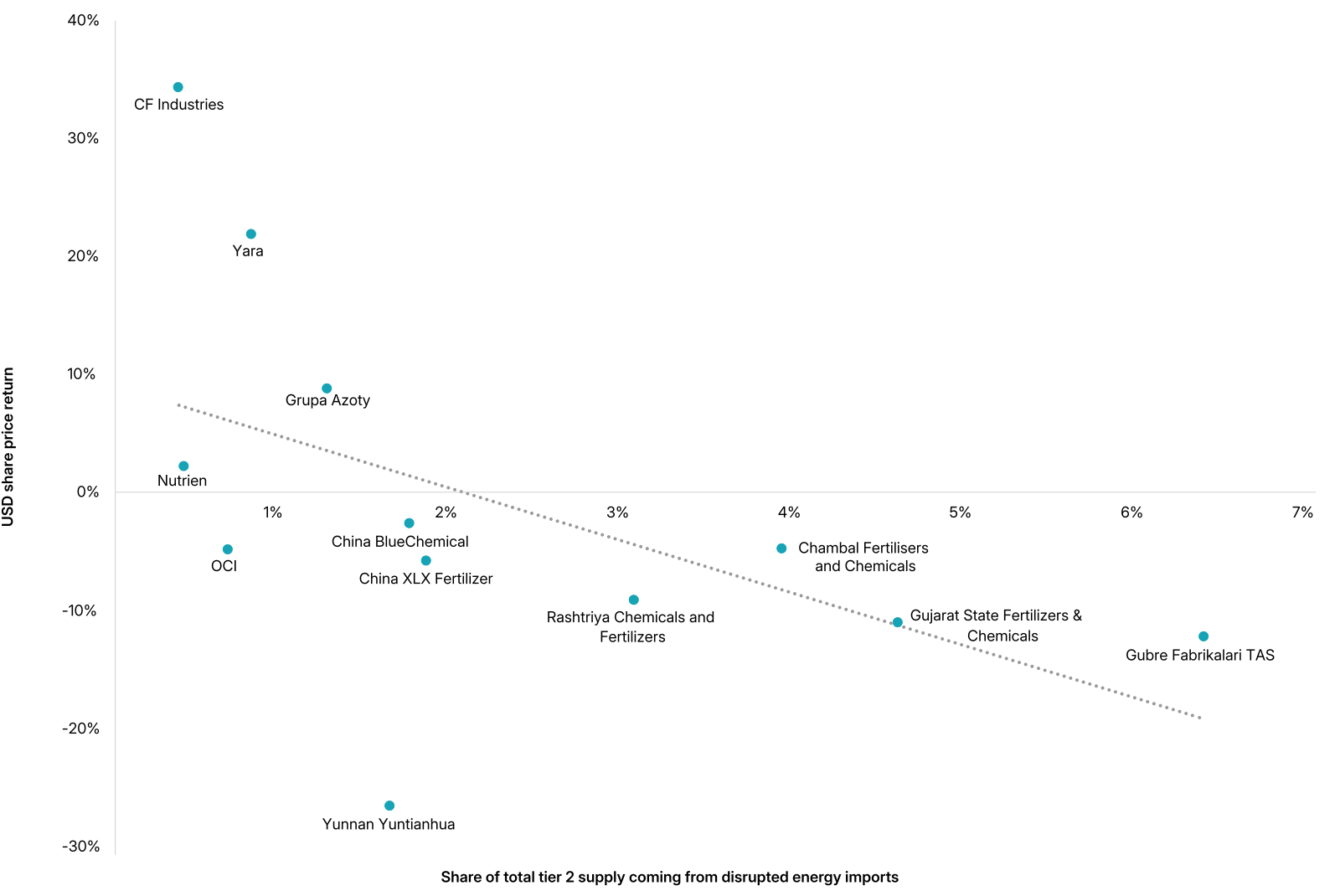
Study period from Feb. 28, 2026 to April 7, 2026. Analysis covers constituents of the fertilizers and agricultural chemicals subindustry within the MSCI ACWI IMI Index, filtered for companies with significant revenue exposure to nitrogen-based fertilizer production and excluding those domiciled in the Middle East. Supply-chain analysis captures indirect reliance on energy-related segments in Saudi Arabia, Qatar, Kuwait, Bahrain, Iraq and Iran. Energy-related segments defined as: natural gas distribution; oil and gas extraction; petroleum refineries; petroleum and petroleum products; other petroleum and coal-products manufacturing; industrial-gas manufacturing.



Subscribe todayto have insights delivered to your inbox.
Iran War Exposed Distinctions for Importing Oil vs. Gas
Oil shocks hurt airlines. Gas shocks hit manufacturers. Treating them as the same “energy exposure” misses the mechanism — and specific risk. Find out which industries face which channel.
Uncovering Supply-Chain Risks in the Iran War
The Iran war hit global markets unevenly. We map three hidden channels — revenue, operations and supply chains — revealing where conflict risk truly sits in equity portfolios.
1 “India invokes force majeure, gives priority to gas sales to key sectors”, Reuters, March 10, 2026.
The content of this page is for informational purposes only and is intended for institutional professionals with the analytical resources and tools necessary to interpret any performance information. Nothing herein is intended to recommend any product, tool or service. For all references to laws, rules or regulations, please note that the information is provided “as is” and does not constitute legal advice or any binding interpretation. Any approach to comply with regulatory or policy initiatives should be discussed with your own legal counsel and/or the relevant competent authority, as needed.