
‘Ranking’ Prepayment Impact on Asset-Liability Management
- Rate risk, particularly for negatively convex assets, creates fundamental challenges for banks’ asset-liability management (ALM), driving nonlinear net-interest-income (NII) changes and elevated volatilities as rates move.
- Accurate prepayment models are essential to ensure asset cash-flow projections are properly aligned with liability behavior. We apply a rank-based algorithm to quantify NII impacts from the late-2025 refinance wave.
- A comprehensive, integrated ALM solution — empowered by well-calibrated prepayment models — is critical to help banks identify, measure and manage interest-rate risk, which has direct implications for a bank’s earnings, economic value and balance-sheet stability.
Interest-rate risk lies at the heart of banks’ asset-liability management (ALM), as assets and liabilities reprice, amortize and respond asymmetrically to changes in rates. Even modest rate movements can materially reshape the cash flows of negatively convex agency mortgage-backed securities (MBS) in highly nonlinear ways. The late-2025 refinance wave — characterized by higher-than-expected but seemingly transitory prepayment activity — provides a timely case study to evaluate the resulting impact on net-interest-income (NII) cash flows, using our proprietary prepayment-error ranking methodology.
Silicon Valley Bank’s collapse in 2023 highlighted how deficiencies in managing rate risk and mortgage cash-flow modeling can rapidly escalate into systemic balance-sheet stress. As rates rose sharply, unrealized losses mounted and assumptions of cash-flow stability proved illusory, leaving the bank vulnerable to liquidity pressure as rate-sensitive deposits exited. By contrast, in 2025 — after rates appear to have reached a new post-tightening equilibrium — the stress has shifted direction: Accelerating refinance activity now poses a renewed threat to cash-flow stability.1
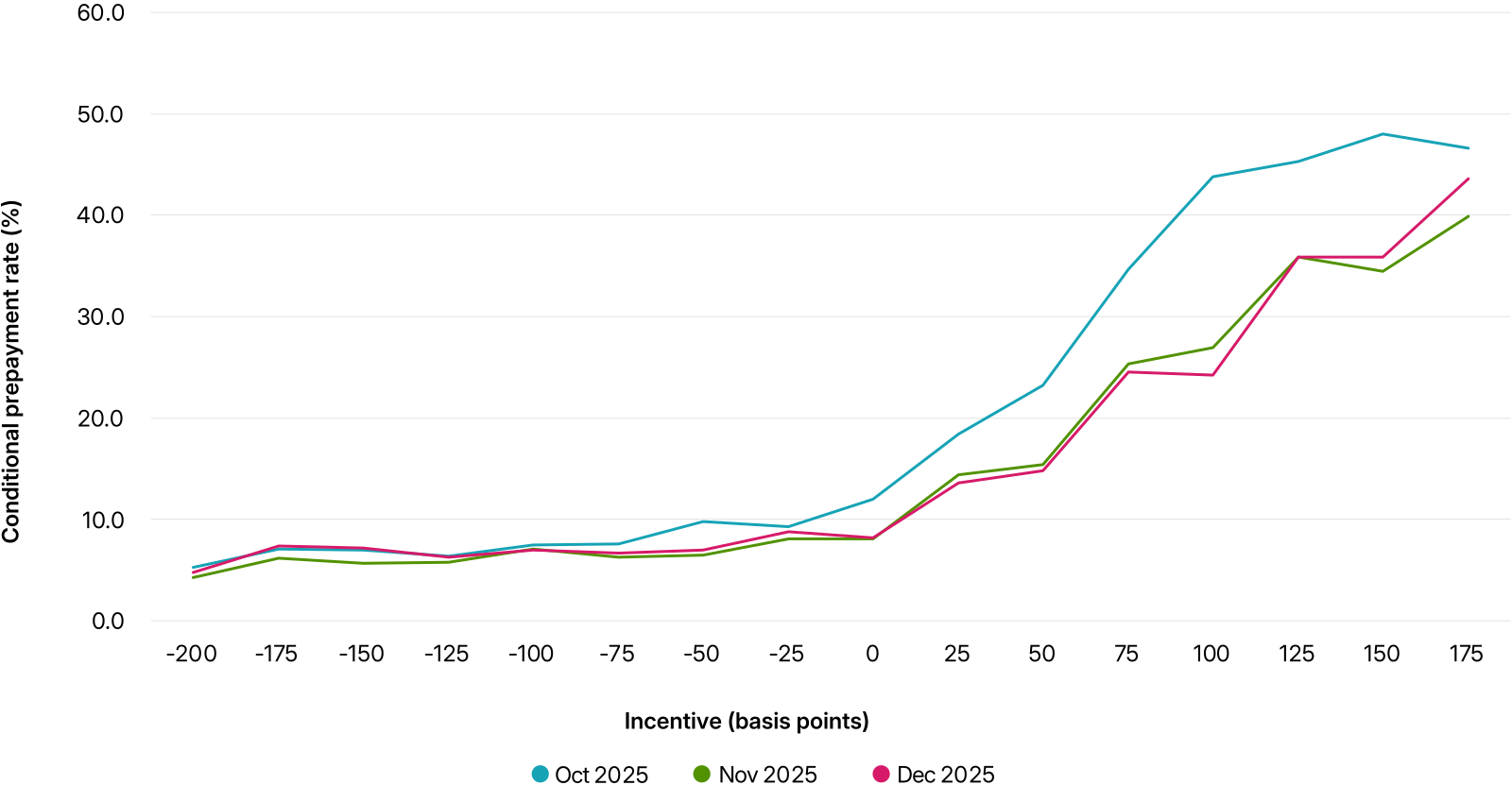
Since September 2025, mortgage rates have declined from roughly 7% to 6.25%, triggering a sharp pickup in refinance activity. Even before October prepayment data was released,2 investors raised concerns that higher-than-expected speeds — particularly for higher-coupon bonds — might necessitate model recalibration. Subsequent analysis suggests, however, that the October refinance S-curve represented more of a short-term outlier than a structural regime shift, as prepayment responses moderated and S-curves flattened in the following months.
Source: Fannie Mae, Freddie Mac, Recursion Co, MSCI
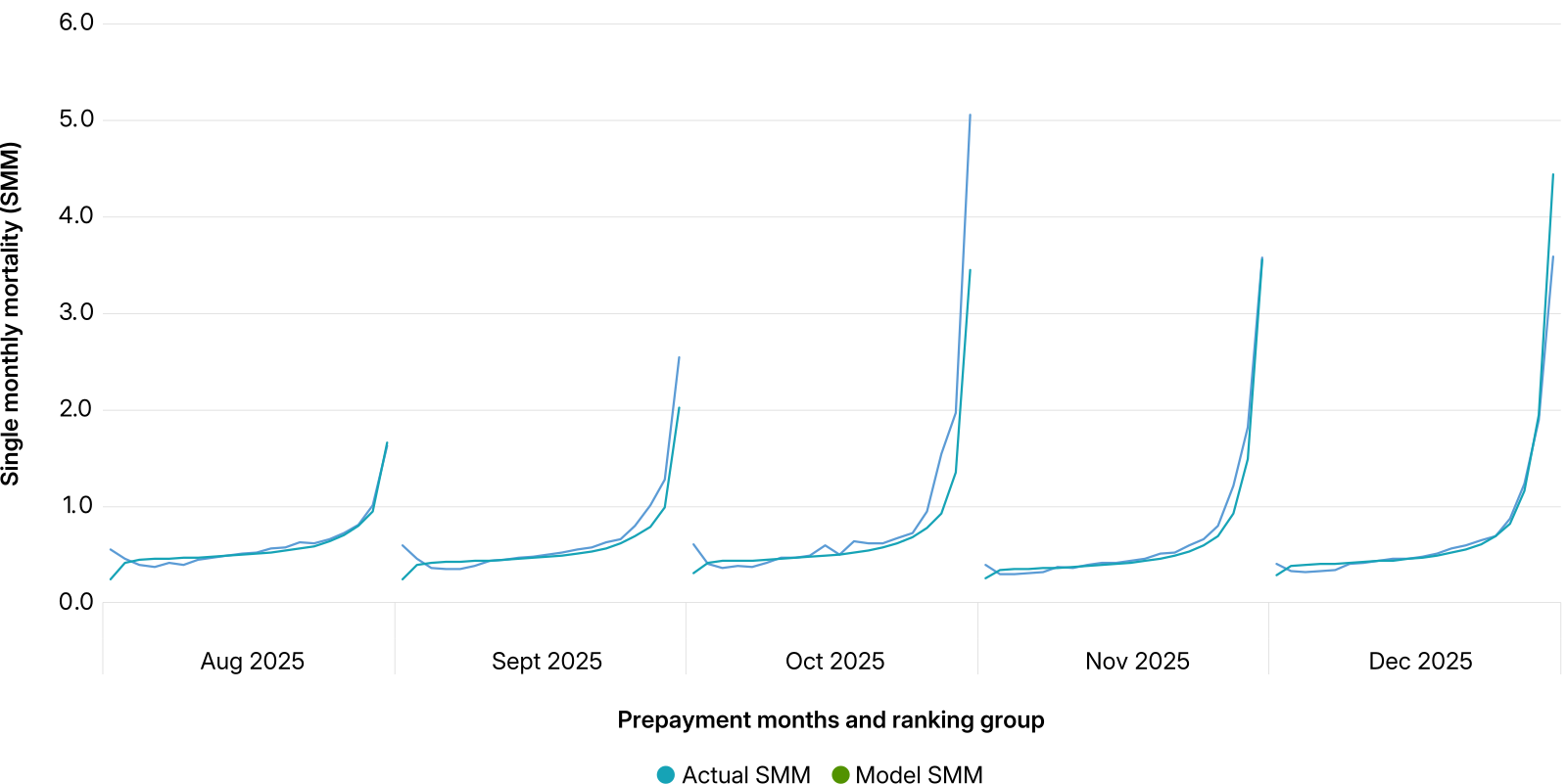
We used MSCI’s proprietary rank-based prepayment error-tracking algorithm as a lens to uncover deeper insights into prepayment behavior. The methodology ranks the relevant bond universe by model-implied prepayment speeds, from lowest to highest, and then overlays realized speeds to identify systematic lift and bias across the distribution.
Using this framework, we observed that the prepayment pickup began as early as September, effectively front-running the model as mortgage rates started to decline meaningfully. This early response reflects the ability of certain lenders to complete refinance applications within the same month. In October, a stronger-than-expected media effect — combined with a faster pull-through timeline — pushed realized prepayment speeds well above levels implied by recent history.
Importantly, subsequent months showed a clear deceleration in prepayment intensity, with realized speeds gradually converging back toward MSCI’s longer-term model expectations rather than signaling a sustained regime shift.
Source: Fannie Mae, Freddie Mac, Recursion Co, MSCI
We observe that some MBS prepayment models have been recalibrated to incorporate the unusually strong October prepayment data, potentially resulting in an overestimation of prepayment sensitivity. This raises an important question: How do such modeling choices affect projected NII and portfolio cash flows under different interest-rate scenarios?
To illustrate the impact, we analyze a simple stylized portfolio consisting of a USD 100 million universal-MBS (UMBS) 6.5% asset, with monthly paydown reinvested in a par-bond UMBS, and a USD 80 million non-maturing deposit liability indexed to the federal-funds rate, with a 200-basis-point contractual spread and asymmetric deposit betas of 90% for rate increases and 80% for rate decreases.
The table below summarizes NII projections generated by the MSCI ALM system using the MSCI production prepayment model and an experimental model calibrated to October 2025 refinance intensity. While both models broadly capture the directional effects of various yield-curve shocks and distinguish between asset- and liability-driven impacts, the experimental model tends to overstate prepayment responses — particularly under shocks to longer maturities.3 As a result, it produces more volatile and potentially misleading NII and cash-flow projections, underscoring the importance of avoiding overfitting to short-lived prepayment anomalies.

Bear flattener: One-month goes up 100 basis points (bps); three-year and above stay the same; everything in-between with linear interpolation. Bear steepener: Three-year and below stay the same; 10-year and above goes up 100 bps; everything in-between with linear interpolation. Bull flattener: Three-year and below stay the same; 10-year and above goes down 100 bps; everything in-between with linear interpolation. Bull steepener: One-month goes down 100 bps; three-year and above stay the same; everything in-between with linear interpolation. Source: MSCI Asset Liability Management via RiskManager
Using the recent MBS refinance wave as a case study, we demonstrate that a comprehensive, integrated ALM solution — empowered by robust and well-calibrated mortgage modeling and analytics components — is critical for identifying, measuring and managing interest-rate risk. Effective implementation and timely utilization have direct and material implications for a bank’s earnings, economic value and balance-sheet stability.



Subscribe todayto have insights delivered to your inbox.
1 This blog post focuses on the asset-side of the ALM cash flow.
2 We note that market participants often rely on leading weekly indicators — such as the Fannie Mae and Freddie Mac refinance prepayment indexes — for early assessment and near-term model calibration.
3 For instance, the U.S. housing agencies' potential USD 200 billion mortgage-bond purchase may significantly bull-flatten the curve, leading to lower mortgage rates and refinance pickup.
The content of this page is for informational purposes only and is intended for institutional professionals with the analytical resources and tools necessary to interpret any performance information. Nothing herein is intended to recommend any product, tool or service. For all references to laws, rules or regulations, please note that the information is provided “as is” and does not constitute legal advice or any binding interpretation. Any approach to comply with regulatory or policy initiatives should be discussed with your own legal counsel and/or the relevant competent authority, as needed.