
Scenario Analysis in Japan: Policy Normalization Meets Political Uncertainty
- History shows that Japanese policy transitions can trigger "Triple-Red" outcomes — in which government bonds, equities and the yen fall together.
- We provide three scenarios for asset owners and managers with Japan exposure to assess how Bank of Japan normalization and political uncertainty could affect multi-asset-class portfolios.
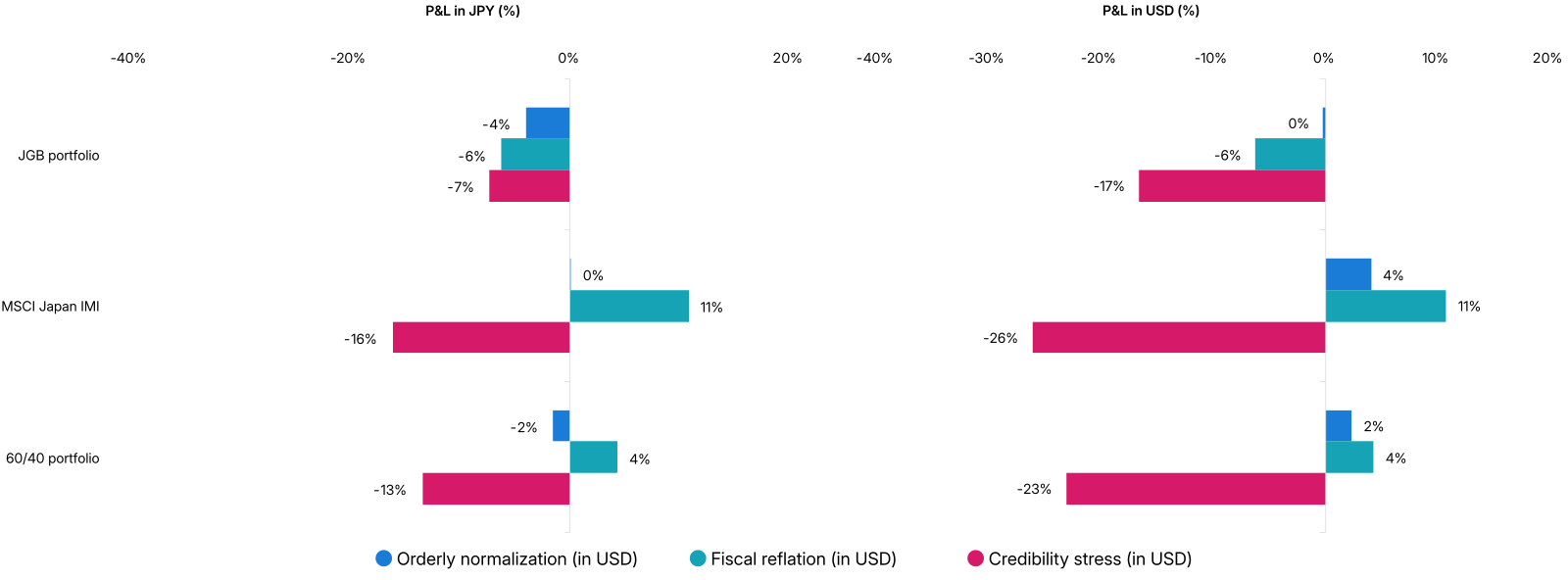
- Under our credibility-stress scenario, Japanese bonds could lose 7% and equities 16% for JPY-based investors. USD-based investors face even steeper losses of 17% and 26% as the yen collapses.
Japan's great monetary unwind is colliding with political reality. As the Bank of Japan (BOJ) attempts to exit decades of ultra-loose policy, elections are adding political uncertainty to expectations around the normalization process. The current three-month 6% loss on Japanese government bonds rivals the worst episodes of the past 25 years, driven by a historic surge in yields across the entire curve. For investors, the question is what the downside risks are and which historical stress episode provides the right template for risk assessment. The historical episodes most relevant to today also share a common pattern: Government bonds, equities and the yen fell together — leaving investors with nowhere to hide.
Japan’s rate regime shift
Yields of Japanese government bonds (JGBs) are undergoing a historic regime shift. Since COVID-19, the 10-year has moved from negative to above 2% — the 30-year to nearly 4% — and short rates are now well into positive territory. This reflects the unwind of ultra-easy policy: The BOJ scrapped yield-curve control in 2024 and raised policy rates for the first time since 2007, marking an exit from negative interest rates amid sustained inflation and wage growth.
This normalization creates meaningful portfolio risks. With gross government debt exceeding 200% of GDP, even modest rate increases translate into substantial fiscal costs, limiting the BOJ's room to maneuver and raising questions about policy sustainability. Meanwhile, real short rates remain deeply negative, meaning the BOJ is still far from restrictive territory despite nominal rate increases.
For two decades, JGBs mostly traded in a narrow range as the BOJ suppressed volatility. But when that range broke, losses were severe and sudden. The key question is which historical stress episode provides the right template for today.
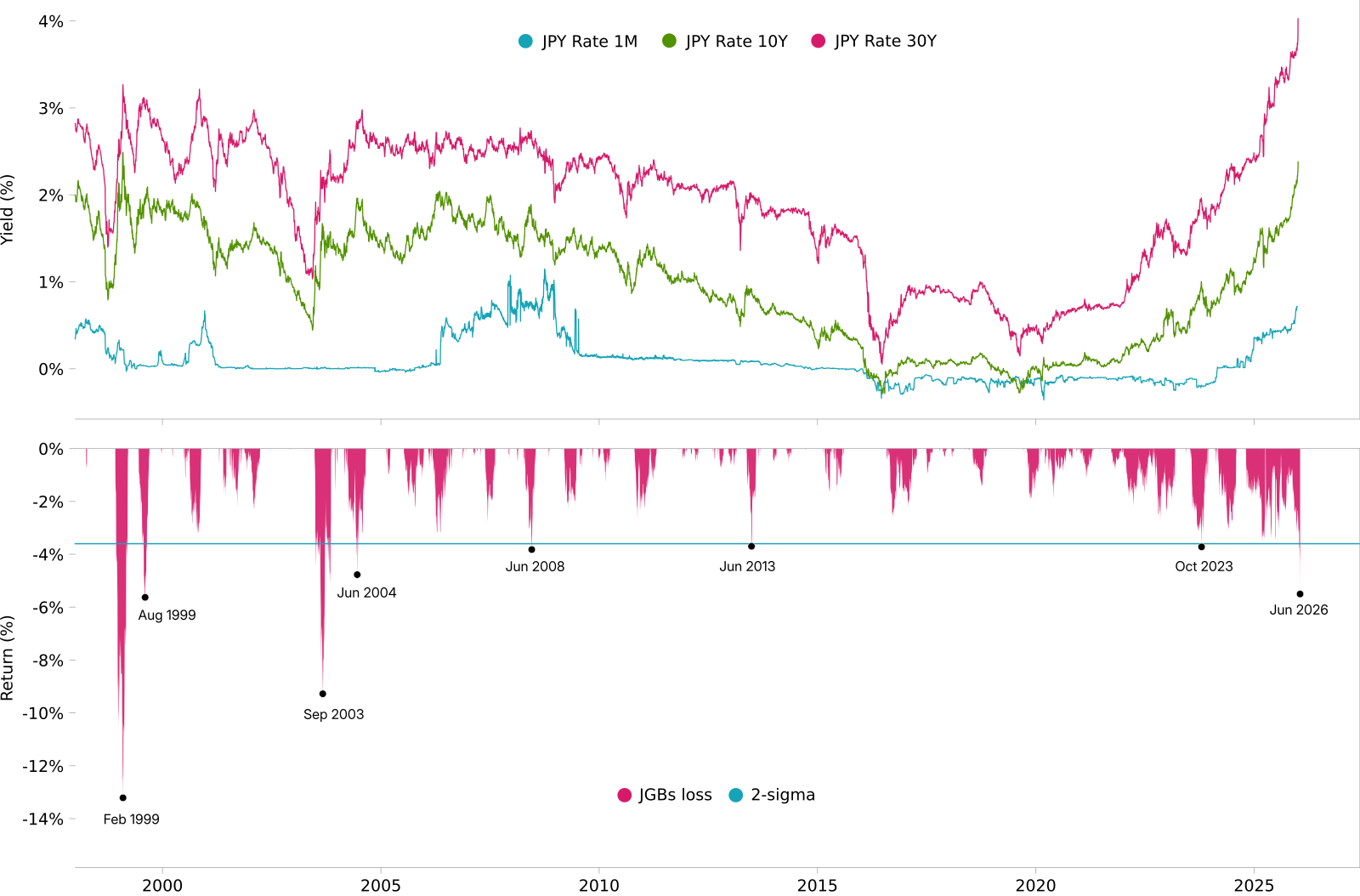
Top panel: evolution of select JGB yields. Bottom panel: rolling three-month historical downside returns of a representative JGB portfolio, based on the Japanese part of the MSCI Developed Markets Government Bond Index. Linear repricing using key rate durations and historical changes in the Japanese sovereign yield curve. The worst non-overlapping events exceeding two standard deviations are marked. Data between Jan. 1, 1998, and Jan. 20, 2026.
Most of the episodes shown in the table below — summarizing the largest three-month sell-offs — don't apply to today. The 2003 and 2008 sell-offs were driven by global moves, not domestic policy stress. February 1999's 13% loss was extreme but required a banking collapse and debt crisis, fears that aren't present now. June 2013’s volatility was largely technical and driven by quantitative and qualitative easing (QQE) and liquidity strains.
The June 2004 and October 2023 episodes offer the most relevant parallels. In 2004, mere expectations of an eventual QQE exit repriced the long end; equities held flat, but bonds and the yen both fell. In 2023, doubts about the sustainability of yield-curve control produced a Triple-Red outcome — in which JGBs, equities and the yen fell together. Today's environment combines both drivers: actual normalization under credibility pressure, with political uncertainty adding a third dimension of risk.
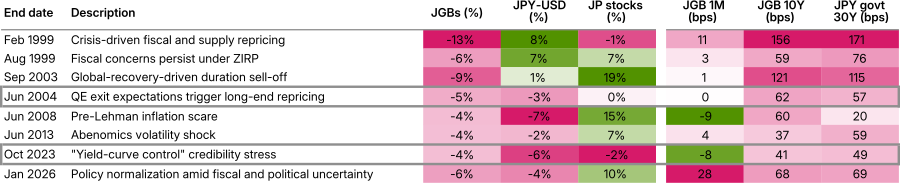
Summary of worst non-overlapping events from the table above. The highlighted periods are most relevant to today’s environment.
Three forward-looking scenarios
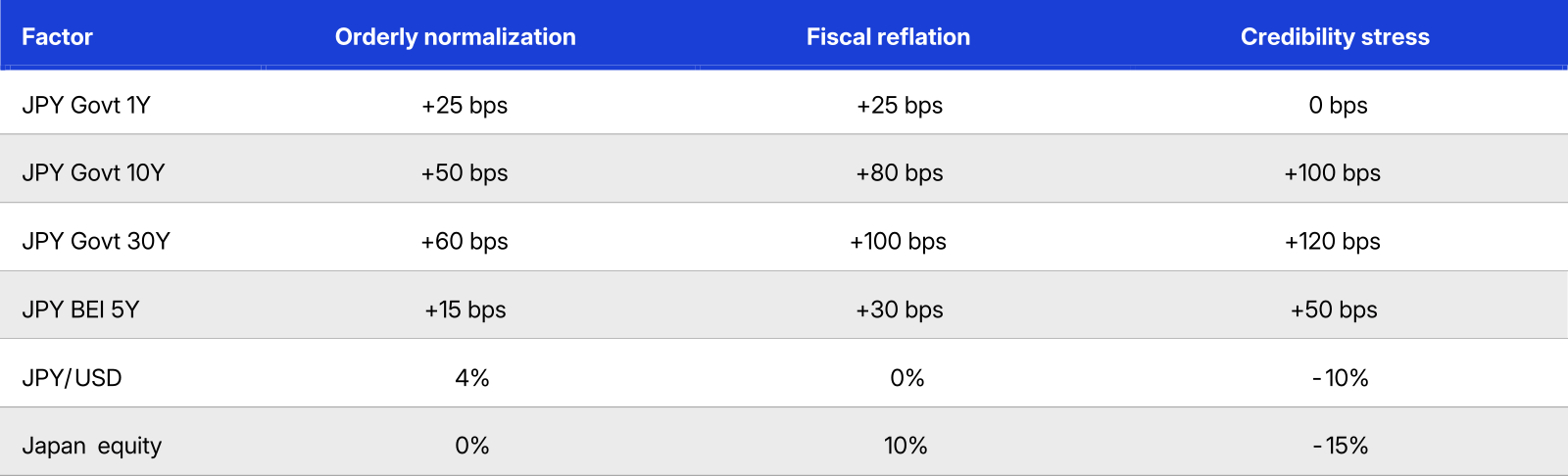
We constructed three scenarios to explore how Japan's policy normalization could unfold — and what it could mean for multi-asset-class portfolios. Under our scenario of “orderly normalization,” the BOJ hikes as expected, narrowing the differential with U.S. rates, while the yen appreciates. Japanese yields rise as the term premium rises — mirroring June 2004, when expectations of a QQE exit alone drove long-end repricing. Equities face headwinds from the stronger yen but avoid risk-off selling. Duration losses are meaningful, but yen gains provide a partial offset.
The “fiscal reflation” scenario assumes fiscal expansion with a surge in JGB yields — particularly at the long end — as investors demand a higher term premium for increased issuance. Equities rally on nominal growth momentum and reflation optimism. The BOJ continues hiking, but cautiously. The yen trades range-bound as higher rates offset fiscal concerns.
Under the “credibility stress” scenario, political pressure keeps the BOJ behind the curve. Markets lose confidence in inflation control and the yen collapses. Yields rise sharply, with losses concentrated in the long end as investors demand higher compensation for fiscal and inflation risk. Equities drop as risk-off market behavior dominates; yen weakness fails to help because the driver is credibility loss, not competitive devaluation. The result is Triple-Red: JGBs, the yen and stocks fall together, eliminating diversification when investors need it most. Note that this scenario does not model global spillover.1
Implications for Japanese portfolios
We applied the scenario shocks to a hypothetical multi-asset-class portfolio, consisting of 60% Japanese equities and 40% bonds.2 Under orderly normalization, JPY-based investors face a modest 2% loss as flat equities don’t compound duration pain; USD-based investors see a 2% gain as yen appreciation offsets the repricing. Fiscal reflation produces the best outcome: The 60%/40% stock/bond portfolio gains 4% in both currencies as equity gains outweigh bond losses. Credibility stress is where diversification fails. The 60/40 portfolio loses 13% in yen terms — but USD-based investors suffer a 23% drawdown as currency collapse compounds local asset losses. This is how the Triple-Red outcome unfolds in practice.
Japan's normalization is underway — the question is whether diversification holds or breaks down. Investors with Japan exposure should stress test portfolios against both scenarios before the next leg unfolds.
The authors thank Zsofia Dabi for her contributions to this blog post.



Subscribe todayto have insights delivered to your inbox.
Investment Trends in Focus: Key Themes for 2026
Markets are moving faster than ever. Explore the research revealing and analyzing the key forces that will shape markets in 2026 — and what these forces could mean for investors.
Fiscal Dominance Lurks Behind Uncertain Central-Bank Policies
Rising debt and policy uncertainty are steepening developed-market yield curves. Fiscal dominance and institutional risk may drive higher volatility, with Europe and Japan signaling risks for the U.S.
Macro Scenarios in Focus: Central-Bank Credibility and Portfolio Risk
Weakening Federal Reserve credibility could fuel stagflation. We model three macroeconomic scenarios and their impact on a multi-asset-class portfolio.
1 Japan's bond sell-off has raised concerns about global spillover. Japanese investors hold nearly 13% of the U.S. Treasury market, and rising domestic yields could trigger repatriation flows that push U.S. yields higher. Others are skeptical: The JGB market is far smaller and less liquid than that for Treasurys, and volatility at home may deter Japanese investors from returning. See: Hakyung Kim and Robert Armstrong, "The Japanese yield panic," Financial Times, Jan. 23, 2026.
2 The results are generated by using model correlations to propagate shocks to the portfolios, using MSCI's BarraOne®. MSCI clients can download the correlated BarraOne stress test and RiskMetrics® RiskManager® stress test.
The content of this page is for informational purposes only and is intended for institutional professionals with the analytical resources and tools necessary to interpret any performance information. Nothing herein is intended to recommend any product, tool or service. For all references to laws, rules or regulations, please note that the information is provided “as is” and does not constitute legal advice or any binding interpretation. Any approach to comply with regulatory or policy initiatives should be discussed with your own legal counsel and/or the relevant competent authority, as needed.