
Scenario Analysis: Tracing Credit Stress Across Private and Public Markets
- Rising defaults and redemption pressure on non-traded business-development companies could transmit stress to public markets, while the rapid growth of hyperscaler debt has introduced new correlated risk in investment-grade indexes.
- We construct two scenarios sharing a stagflationary backdrop but differing in where credit stress originates: private-credit contagion and a repricing of hyperscaler credit in public markets.
- Both scenarios produce roughly 11% portfolio losses, but through different channels: one driven by private credit and high yield, the other by equities and investment-grade bonds. For allocators, identifying which channel dominates matters more than the headline loss.
Mentioned in this blog post:
Credit markets in 2026 face two distinct risks: strain in the roughly USD 2 trillion private-lending market and a repricing of public debt linked to AI investment. Both could unfold against a backdrop of persistent inflation and constrained central banks. The stress can originate in private credit, where rising redemptions, elevated fund leverage and liquidity mismatches in semi-liquid vehicles are already creating pressure, potentially prompting investors to derisk by selling liquid public bonds. Or it can start with a more fundamental reassessment of tech credit risk in public markets that tightens financing conditions for private borrowers, too. We construct two scenarios to assess how different sources of credit stress could propagate through public and private markets and reshape multi-asset-class portfolio risk.
Credit markets are entering a macro environment where inflation pressures linked to energy and supply-chain disruptions remain elevated, while growth expectations have softened across major economies.1 Higher government yields raise refinancing costs, particularly for leveraged borrowers, while weaker growth pressures earnings and credit fundamentals. With spreads still relatively tight by historical standards, parts of credit markets may be increasingly sensitive to shifts in liquidity, growth expectations and investor confidence.
AI disruption has already started repricing software companies, the AI-disrupted part of tech that dominates private-lending portfolios, while floating rates could further squeeze borrowers if rates were to increase again. Even if the initial shock is sector-specific, losses in private-lending portfolios could still lead investors to reassess credit-risk exposure more broadly, especially for leveraged borrowers with similar characteristics in public markets. Public spreads could widen because investors seeking to reduce credit-risk exposure or raise cash typically sell liquid public bonds first. Financials may come under pressure if markets become concerned about bank involvement in fund leverage, financing lines and other forms of intermediation linked to private credit. This is particularly salient for lending to evergreen private-credit vehicles such as business-development companies (BDCs), which are much more levered than drawdown credit funds.
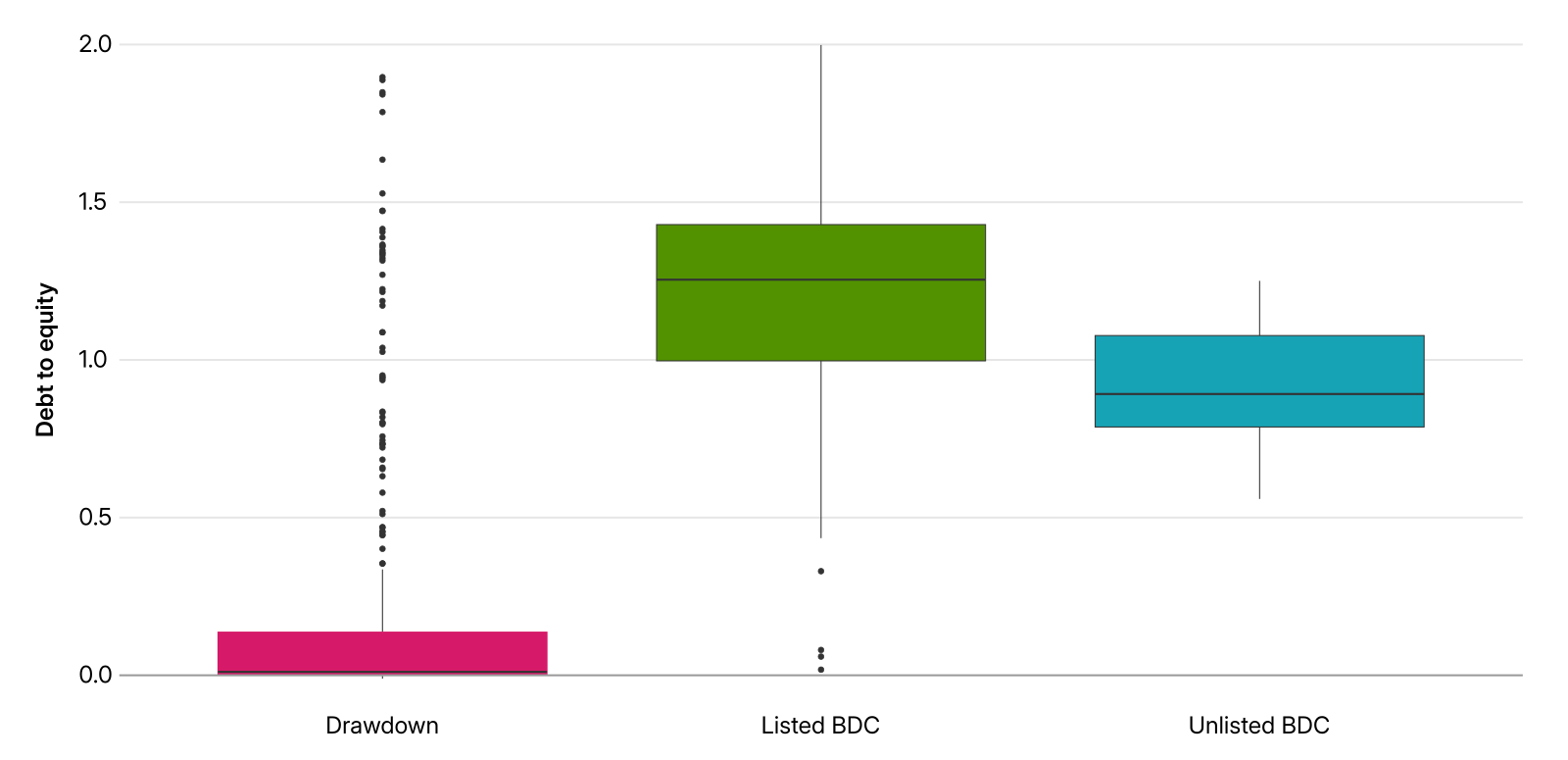
Debt-to-equity ratios by private-credit vehicle type. Source: Securities and Exchange Commission, MSCI
The second potential transmission channel runs the other way, with stress originating in public investment-grade markets and resulting in tightening conditions for private borrowers. Hyperscalers’ debt issuance has scaled nonlinearly alongside capital expenditure, with the cohort adding over USD 180 billion since 2025 as new bond supply tracked capital expenditure closely into 2026 to fund AI infrastructure buildouts.2
This cohort historically raised debt opportunistically, primarily for shareholder returns, acquisition financing and tax-efficient repatriation of offshore cash, supported by strong cash flows and modest capex. Recent issuance has gone toward AI-linked capex, often borrowed at long tenors that raise mark-to-market sensitivity to spread widening. The currency mix has also broadened: Amazon and Alphabet account for most non-USD issuance, mostly in EUR, with Alphabet and Apple also raising debt in GBP and CHF. Meta has issued in USD only. The broader currency footprint also means a repricing of this cohort would feed through EUR, GBP and CHF benchmarks, not just USD investment-grade portfolios.
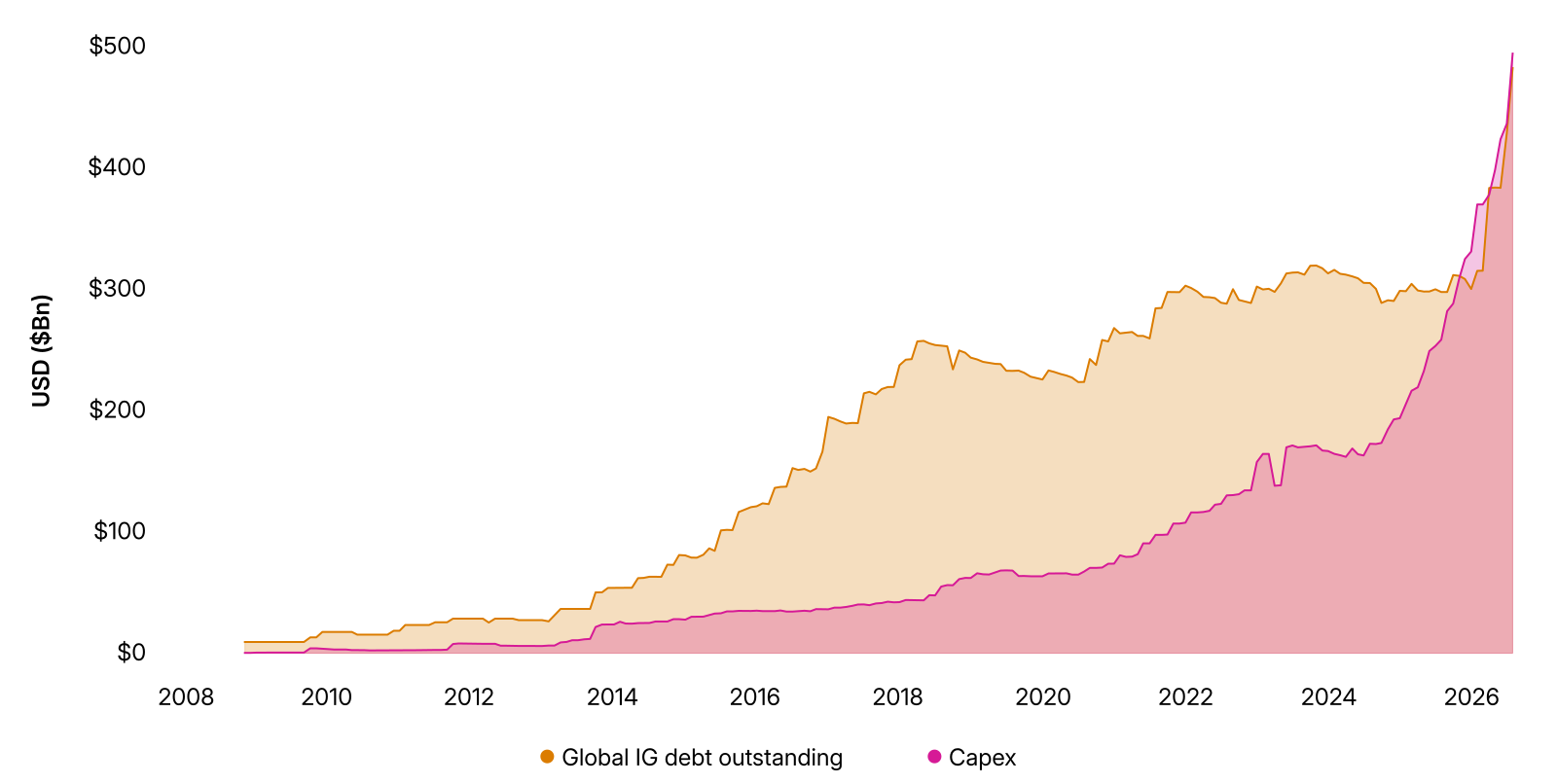
Cumulative USD bond notional outstanding by hyperscalers within the MSCI Global Investment Grade Corporate Bond Index for the sample period from July 31, 2008, through April 30, 2026. Bonds enter at issuance date and exit at maturity. Trailing 12-month capex for all hyperscaler issuers.
Spreads have started to reflect the shift. Hyperscalers traded below the MSCI Global Investment Grade (IG) Corporate Bond Index option-adjusted spread (OAS) for most of the index's history, supported by high-quality balance sheets. That changed in late 2025, with the OAS differential turning persistently positive for the first time since 2006. Yields tell a similar story. While only Oracle and Meta trade wide of the index on OAS, most hyperscalers now sit above the index on yield — suggesting a cohort-wide cost-of-funding reset rather than issuer-specific repricing.
Hyperscalers are a small share of the index, but their issuers are large, widely held and increasingly correlated through their AI capex exposure. The risk for allocators is less about the hyperscalers in isolation and more about how a repricing transmits to the broader IG market.
Hyperscalers’ OAS and yield (yield-to-worst) are calculated based on the MSCI Fixed Income Index Calculation Methodology, weighted by their exposure in the MSCI Global IG Corporate Bond Index.
A sustained repricing of hyperscaler debt could tighten broader public-credit conditions and indirectly pressure private borrowers through higher financing costs and reduced lending capacity.
In our hypothetical credit scenarios, we assume higher near-term inflation expectations and short-term rates driven by persistent inflation and energy disruption, leaving central banks constrained. We then model two scenarios that differ in where credit stress originates.
In the first scenario, stress begins in private credit through rising defaults, redemption pressure and deleveraging in leveraged lending vehicles. As allocators sell liquid holdings to meet redemptions, losses spread to public high-yield and investment-grade markets through liquidity and risk-aversion channels. Bank equity falls sharply as lenders with direct lending exposure come under pressure.
In the second scenario, stress originates in public markets through a repricing of hyperscaler debt linked to AI investment. Wider spreads on the largest IG issuers raise funding costs across the index, and equity losses concentrate in AI-adjacent sectors. Financing conditions tighten.
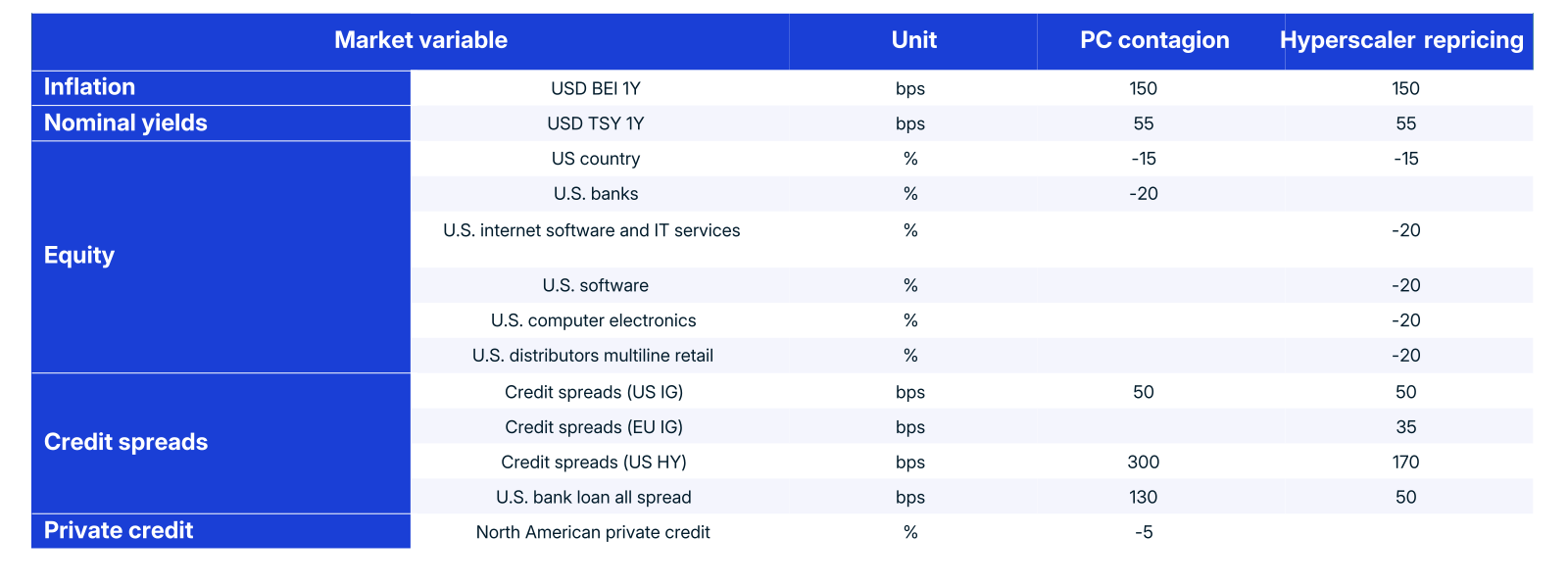
Assumptions about risk-factor shocks are informed by the MSCI Macro-Finance Analyzer and analysis of historical data and judgment. This is not a forecast, but a hypothetical narrative of how the scenario could affect multi-asset-class portfolios. Breakeven inflation (BEI) and spreads are measured in basis points (bps).
To assess the scenarios’ impact, we used MSCI’s predictive stress-testing framework and applied the shocks from the table above to a hypothetical multi-asset-class portfolio consisting of global equities, U.S. bonds, private equity, private credit and real estate.3
Both scenarios produce a similar 11% portfolio drawdown, but the credit impact is different. In the private-credit contagion scenario, North American private credit loses 9%, driven not only by the direct private-credit shock but by loan and high-yield spread widening that accounts for roughly two-thirds of the loss. In the hyperscaler scenario, private credit still loses 3% without any explicit shock to private lending, entirely through contagion from public spread and term-structure channels. In equities, global stocks lose 3 percentage points more under hyperscaler repricing, with the gap widening further in emerging markets (-15% vs. -22%). The difference is driven by EM's higher beta to global equity that amplifies the broader drawdown in the hyperscaler scenario, while the U.S. bank shock in the contagion scenario has limited transmission to EM, narrowing losses there.
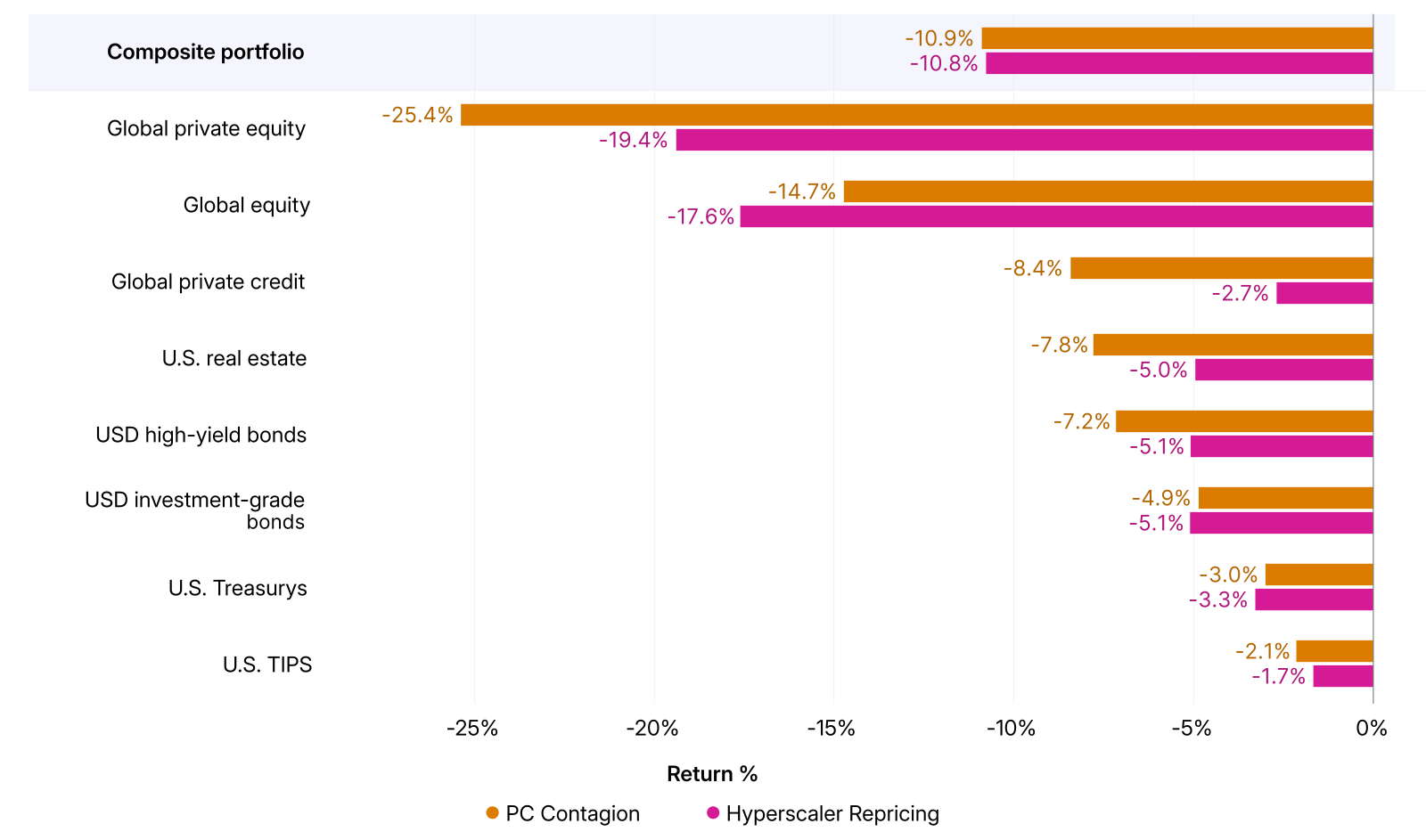
Portfolio impact in USD of the scenario based on market data as of May 20, 2026. Source: S&P Global Market Intelligence, MSCI
For multi-asset-class allocators, the key finding is that credit stress can propagate through fundamentally different channels even under a similar macro backdrop. Portfolios with comparable aggregate credit exposure may experience materially different outcomes depending on whether stress originates in private-lending markets or from large public issuers. Scenario analysis can help investors identify channel-specific portfolio vulnerabilities before market dislocations emerge.
The authors thank Leo Fischler and Zsofia Dabi for their contributions to this blog post.




Subscribe todayto have insights delivered to your inbox.
Agentic AI Widens Tech Spreads, but Hardware Holds Firm
Agentic AI recently reshaped tech credit, with spreads widening in software and services while hardware remained resilient — highlighting a potential emerging divide in AI exposure.
Run Risk or Rational Repricing? Private Credit’s Software Stress Test
The AI update that rattled equity markets in early 2026 also exposed a fault line in private credit. We examine the selloff in business development companies and the wider implications for investors.
Will Private Markets Pass the Test?
After 15 years of uninterrupted growth, private markets face their first real test. Are they ready? Voices from the inaugural MSCI Private Assets Summit.
1 “World Economic Outlook: Global Economy in the Shadow of War,” International Monetary Fund, April 1, 2026.
2 Hyperscalers are defined here as Apple Inc., Microsoft Corp. and Oracle Corp. (information technology); Alphabet Inc. and Meta Platforms Inc. (communication services); and Amazon.com Inc. (consumer discretionary). These six issuers held a combined USD 480 billion in bond notional outstanding in the MSCI Global IG Corporate Bond Index as of April 30, 2026.
3 The results are generated by using model correlations to propagate shocks to the portfolios, using MSCI's BarraOne®. MSCI clients can download the correlated BarraOne stress test and RiskMetrics® RiskManager® stress test. Note that the above stress-test results capture the effect of repricing the assets, not the income component. Treasury inflation-protected securities (TIPS) are represented by the iBoxx TIPS Inflation-Linked Index provided by S&P Dow Jones Indices. U.S. Treasurys, equities and corporate bonds are represented by MSCI indexes. Private equity and private credit are represented by model portfolios. U.S. real estate is represented by the MSCI/PREA U.S. AFOE Quarterly Property Fund Index. The composite portfolio is 35% global public equities, 24% U.S. Treasurys, 2% TIPS, 12% U.S. investment-grade bonds, 2% U.S. high-yield bonds, 10% U.S. real estate and 15% global private assets (13% private equity, 2% private credit).
The content of this page is for informational purposes only and is intended for institutional professionals with the analytical resources and tools necessary to interpret any performance information. Nothing herein is intended to recommend any product, tool or service. For all references to laws, rules or regulations, please note that the information is provided “as is” and does not constitute legal advice or any binding interpretation. Any approach to comply with regulatory or policy initiatives should be discussed with your own legal counsel and/or the relevant competent authority, as needed.