
Singapore’s Equity Market Development Programme: A Sustainability Lens
- Singapore’s initiatives to develop its equity market could reshape capital deployment and company valuations, creating new opportunities for equity investors.
- Japan’s experience shows that stronger sustainability integration can drive long-term outperformance, suggesting similar opportunities may emerge in Singapore’s small- and mid-cap (SMID-cap) segment.
- Baseline sustainability assessments may help investors identify early SMID-cap leaders and engagement targets before these companies gain broader market recognition.
A shift is underway in Singapore’s equity market that could redefine how investors value companies and allocate capital. Launched in February 2025, the Monetary Authority of Singapore’s Equity Market Development Programme (EQDP) 1 aims to channel investment toward the SMID-cap segment,2 which has historically faced challenges with liquidity, coverage and visibility. At the same time, Singapore plans to adopt disclosure rules aligned with the International Sustainability Standards Board (ISSB),3 to be mandated for all listed issuers by 2030, promoting consistent and comparable sustainability reporting across the market.
These developments may reshape how sustainability factors are assessed and priced in Singapore‘s equity market. As the EQDP channels more active capital into SMID caps, forthcoming ISSB-aligned disclosures could enhance transparency around their sustainability profiles. For investors, the combination may open opportunities to identify firms whose sustainability strengths are not yet fully recognized by the market, as well as those where engagement and improved disclosure could support long-term performance.
Japan’s experience may hint at what is ahead for Singapore. The introduction of the Stewardship Code4 (2014) and Corporate Governance Code5 (2015) strengthened accountability and board independence, but the more significant shift came later. Revisions to both codes in 2020 and 2021, respectively, explicitly embedded sustainability as a shared responsibility between investors and companies. For investors, stewardship expanded to include sustainability factors within engagement practices, while companies faced higher governance expectations and clearer requirements to address environmental and social issues.
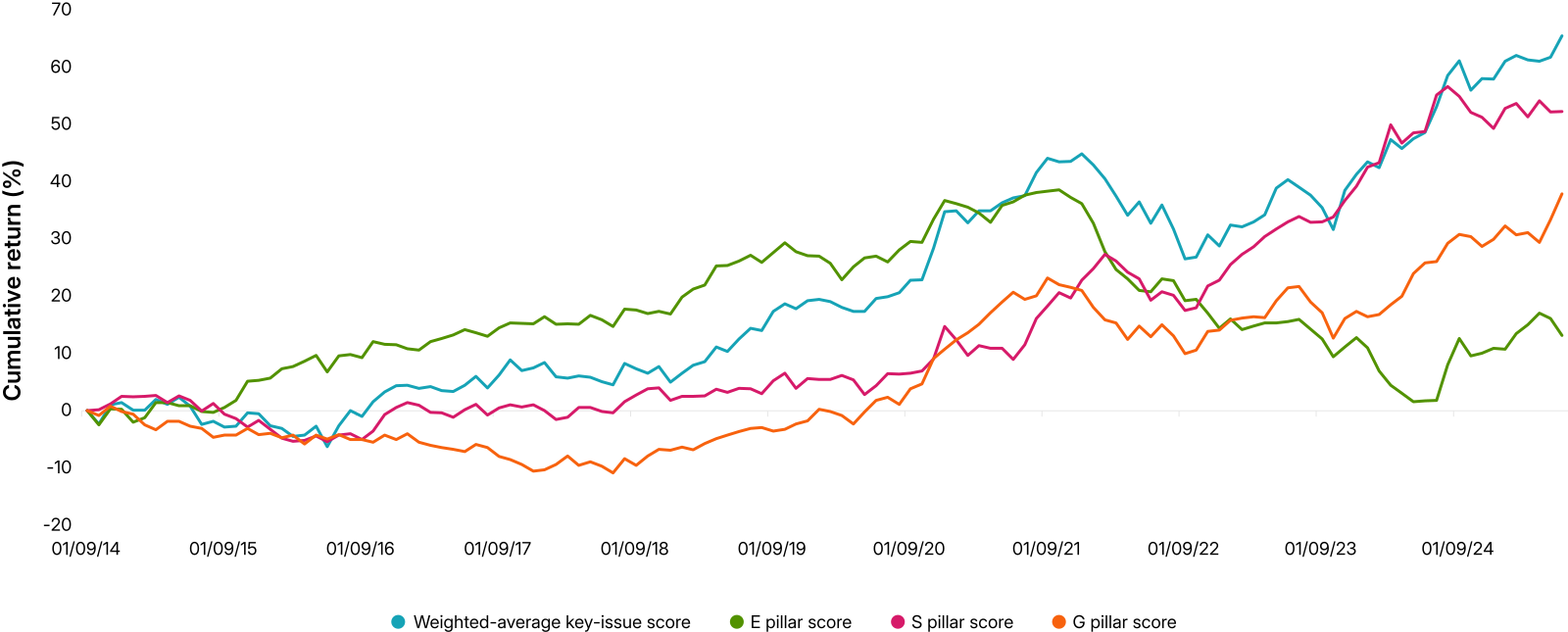
Data from Sept. 30, 2014, to June 30, 2025. Terciles are created monthly based on scores in the MSCI Japan Index. Scores are first standardized by the Global Industry Classification Standard (GICS®) sectors and then size-adjusted (GICS is the industry-classification standard jointly developed by MSCI and S&P Dow Jones Indices). The following month’s performance (in USD) of the terciles is calculated. The chart shows the cumulative performance difference between the top and bottom terciles. Source: MSCI Sustainability & Climate Research Services
Our research has shown that companies with stronger MSCI ESG Ratings have historically outperformed their lower-rated peers in global equity markets. Evidence from Japan over the past decade reinforces this pattern. For Singapore, the combination of the EQDP and upcoming ISSB-aligned disclosures may create similar conditions, particularly within the SMID-cap segment, where investors may benefit from integrating sustainability more deeply into investment decision-making.
Singapore’s SMID-cap companies have traditionally struggled to attract investor attention, often due to limited analyst coverage, lower liquidity and less comprehensive disclosure than larger peers. As a result, investor confidence tends to be weaker and sustainability data for analysis remains sparse.
The EQDP and forthcoming ISSB-aligned disclosures may begin to address these challenges. By channeling capital into the SMID-cap segment through dedicated fund managers, the program could encourage deeper research and more robust evaluation of sustainability profiles, ultimately raising standards of transparency and reporting. ISSB adoption will further support this by providing a consistent framework for all listed issuers to disclose sustainability practices and performance.
Exploratory analysis of Singaporean SMID caps using MSCI Indicative ESG Scores suggests that smaller companies generally exhibit weaker sustainability profiles than larger peers, underscoring the need for deeper company-specific research.6 Nevertheless, extending sustainability analysis across Singapore’s SMID-cap universe can help investors:
- Identify companies with relatively strong sustainability profiles that may attract capital earlier.
- Screen for companies with weaker profiles but potential to improve through engagement and enhanced disclosure.
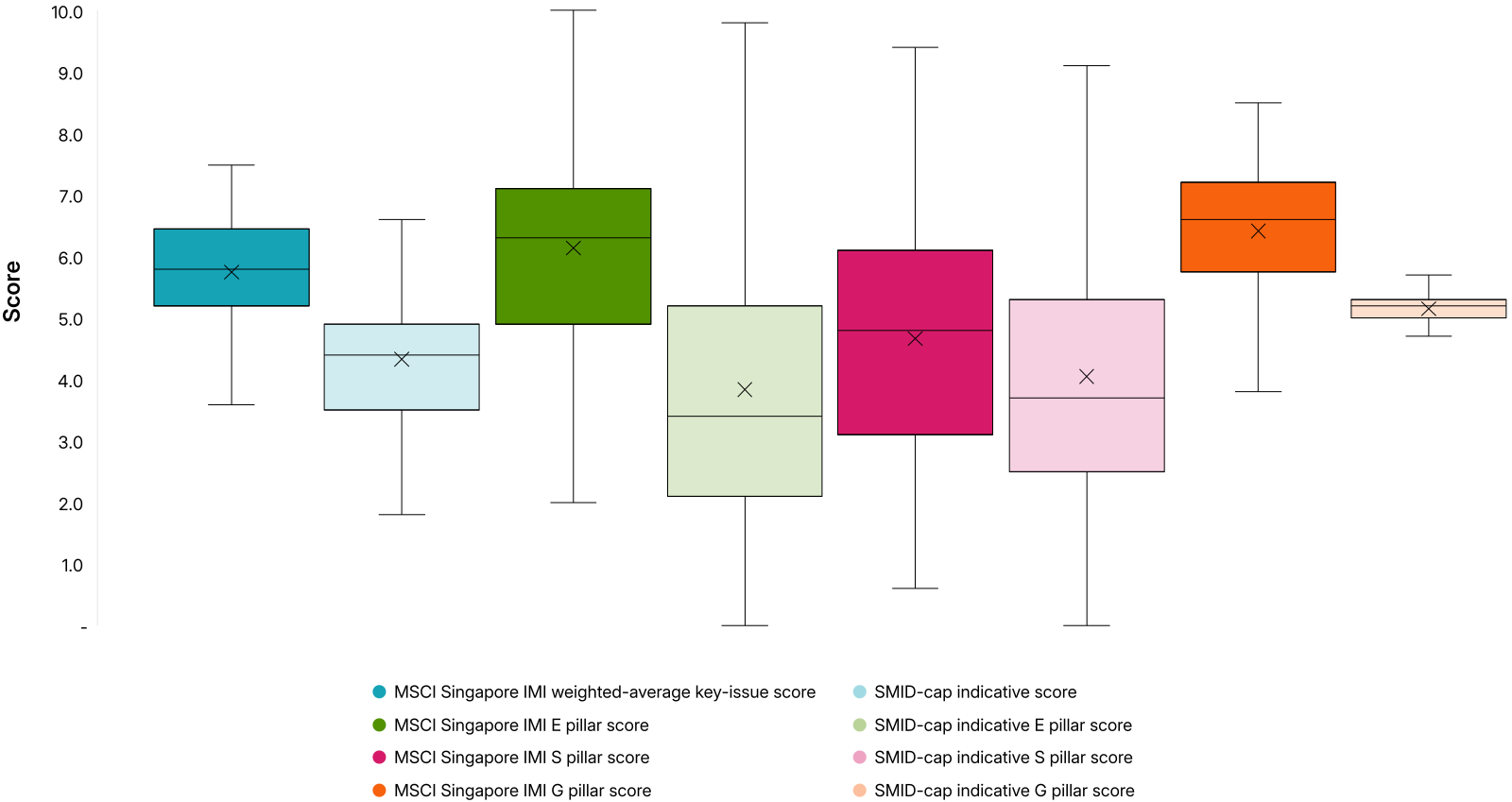
All data as of Sept. 30, 2025. Source: MSCI Sustainability & Climate Research Services
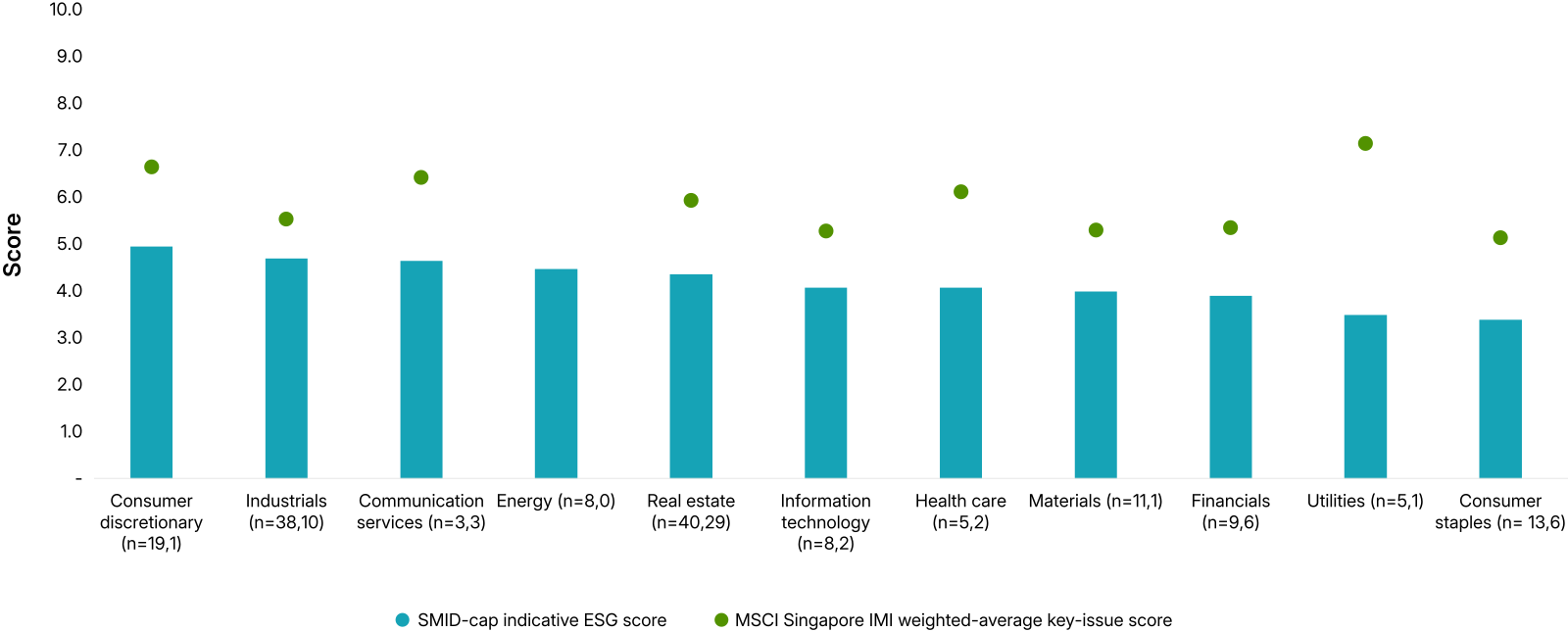
Data as of Oct. 2, 2025. Note: (n = X, Y) represents count of issuers in the SMID-cap segment of the MSCI Singapore IMI universe by sector. Source: MSCI Sustainability & Climate Research Services
The EQDP aims to channel more active capital into SMID caps, while ISSB-aligned disclosure requirements are expected to enhance the quality and comparability of sustainability data. Together, these reforms could reshape how investors assess transparency and sustainability across Singapore’s market.
Japan’s experience illustrates how sustainability-focused reforms can create meaningful performance gaps between leaders and laggards. In Singapore, the combination of the EQDP and forthcoming ISSB-aligned disclosures could foster similar dynamics, supporting more differentiated sustainability performance, particularly among SMID-cap companies.
Subscribe todayto have insights delivered to your inbox.
ESG Ratings in Global Equity Markets: A Long-Term Performance Review
Companies with higher MSCI ESG Ratings outperformed their lower-rated counterparts across two global indexes over more than a decade, we write in the Journal of Impact & ESG Investing.
Long-Term Performance of MSCI ESG Ratings in Japan’s Equity Market
Over the long term, companies with higher MSCI ESG Ratings have outperformed in Japan’s equity markets. Among the three pillars, governance demonstrated the highest outperformance, followed by the social and environmental factors.
MSCI ESG Ratings
Assess companies on their financially relevant sustainability risks and opportunities.
1 “Equity Market Development Programme,” Monetary Authority of Singapore, last updated Dec. 19, 2022, accessed Oct 2, 2025.
2 SMID-cap universe is defined as all issuers listed on the Singapore stock exchange with a market capitalization greater than USD 100 million that are not constituents of the MSCI Singapore Investable Market Index (IMI) as of Sept. 30, 2025, with reported revenues as of FY24 > 0. Source: FactSet.
3 “Jurisdictional Snapshot: Singapore,” IFRS Foundation, June 12, 2025.
4 “Publication of the Draft of the Japan’s Corporate Governance Code for Public Consultation,” Financial Services Agency, Government of Japan, March 21, 2025.
5 “Japan’s Corporate Governance Code,” Japan Exchange Group, June 11, 2021.
6 MSCI Indicative Scores provide a proxy sustainability assessment for companies that currently sit outside the MSCI ESG Ratings universe. For further information, see “MSCI Indicative ESG Scores Methodology,” MSCI Solutions, March 2025.
The content of this page is for informational purposes only and is intended for institutional professionals with the analytical resources and tools necessary to interpret any performance information. Nothing herein is intended to recommend any product, tool or service. For all references to laws, rules or regulations, please note that the information is provided “as is” and does not constitute legal advice or any binding interpretation. Any approach to comply with regulatory or policy initiatives should be discussed with your own legal counsel and/or the relevant competent authority, as needed.