
Sovereign and Corporate Bonds and the Search for Stable Hedges
- After an extended period of decaying diversification, government bonds and corporate bonds began 2026 by hedging one another’s returns, as they did before 2022.
- The question for investors is whether the historical benign relationship returns, or if the post-COVID-19 trend — of simultaneous sell-offs in sovereign and corporate bonds — will continue.
- We derive a distribution of risk estimates to quantify the uncertainty around this hedging relationship by applying a custom range of correlation half-lives.
For most of the era after the 2008 global financial crisis, government interest rates and corporate credit spreads exhibited a reliably negative correlation: When rates fell, spreads widened and vice versa. This relationship served as a natural hedge within bond portfolios, dampening total volatility for investors holding both duration and spread exposure. It was a structural feature of fixed-income risk that many portfolio-construction frameworks took as given.
That relationship broke down during the 2022–2024 hiking cycle. As central banks raised policy rates aggressively, spreads widened in tandem, eliminating the cushion that had defined fixed-income portfolio construction for over a decade. The chart below illustrates this shift using model estimates of rates-spread correlations by model and factor. Across model horizons and sectors the trend is clear, though the force of the trend differs greatly along the term structure: Spreads hedge rates least for long-term bonds and in slow-moving models.
In early 2026, however, this correlation began to revert. The key question for investors is whether this mean reversion in the rates-spread relationship will prove durable, or whether the conditions that defined the 2022–2024 period could reemerge.
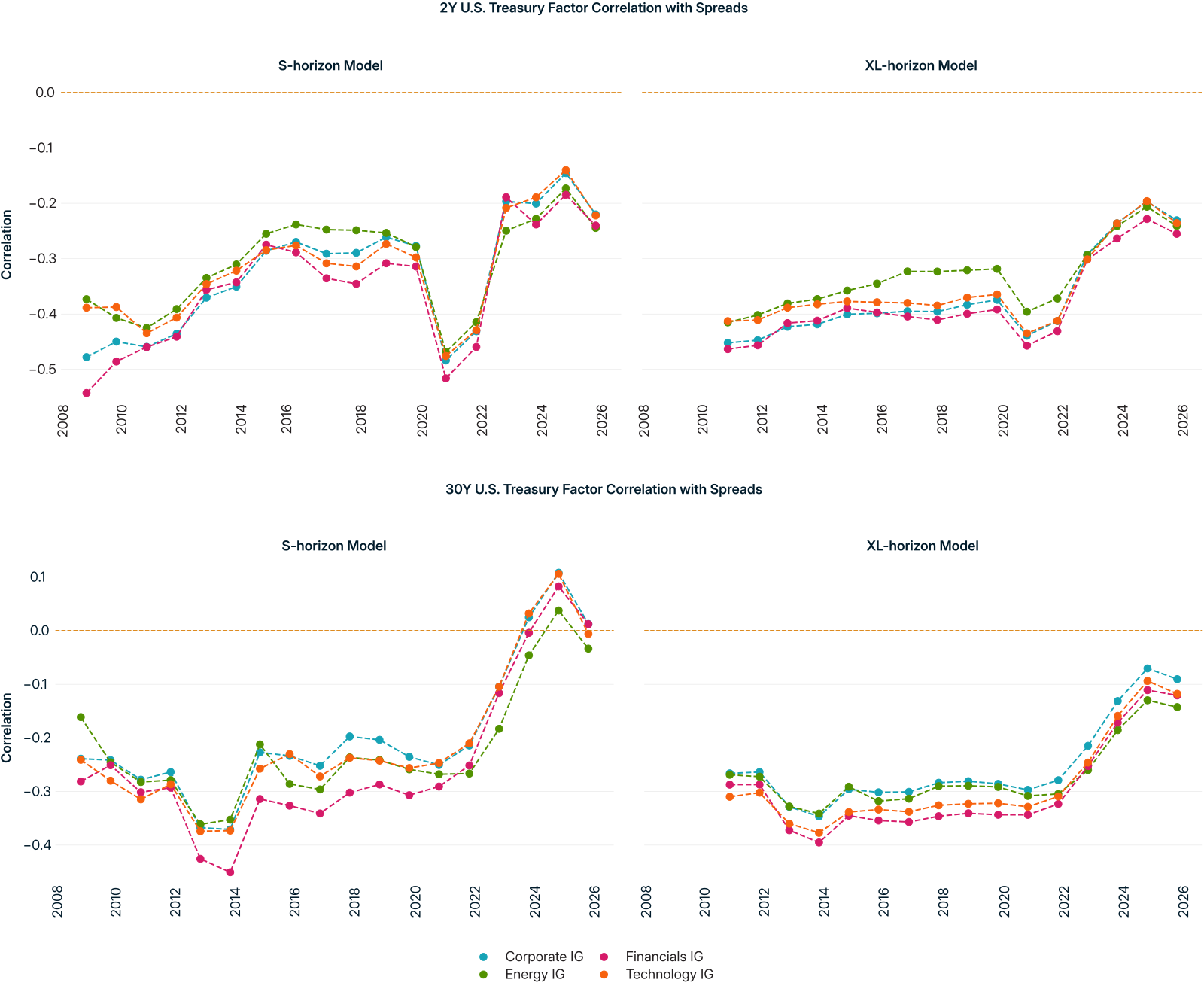
Rates-spread correlations for short- and extra-long-horizon models. Two- and 30-year U.S. Treasury key-rate duration factors and investment-grade spread factors. Factors are from the MSCI Multi-Asset Class Factor Model.
For credit investors, this shift has direct implications for portfolio risk. A standard risk model estimated with typical half-lives is designed to integrate a broad history, providing stability and consistency across market cycles. A shorter half-life puts more weight on recent history. In a period of rapid regime transition, producing a distribution of model-derived risk estimates using an array of short and long half-lives can help bound this very real uncertainty.
With MSCI’s Custom Covariance solution, the MSCI Multi-Asset Class Factor Models now allow investors to customize the volatility and correlation half-lives used to estimate the factor covariance matrix. By varying these half-lives, investors can tilt their covariance estimates toward recent observations. One potential configuration is a short half-life giving more weight to the current reversion and less to the positive-correlation period.
The half-life parameter determines the number of periods it takes for the weight assigned to an observation to diminish by half. A shorter half-life produces a more responsive estimate that emphasizes recent data; a longer half-life yields a more stable estimate that integrates a broader history. The choice reflects an explicit view on which regime is most relevant to current portfolio risk.
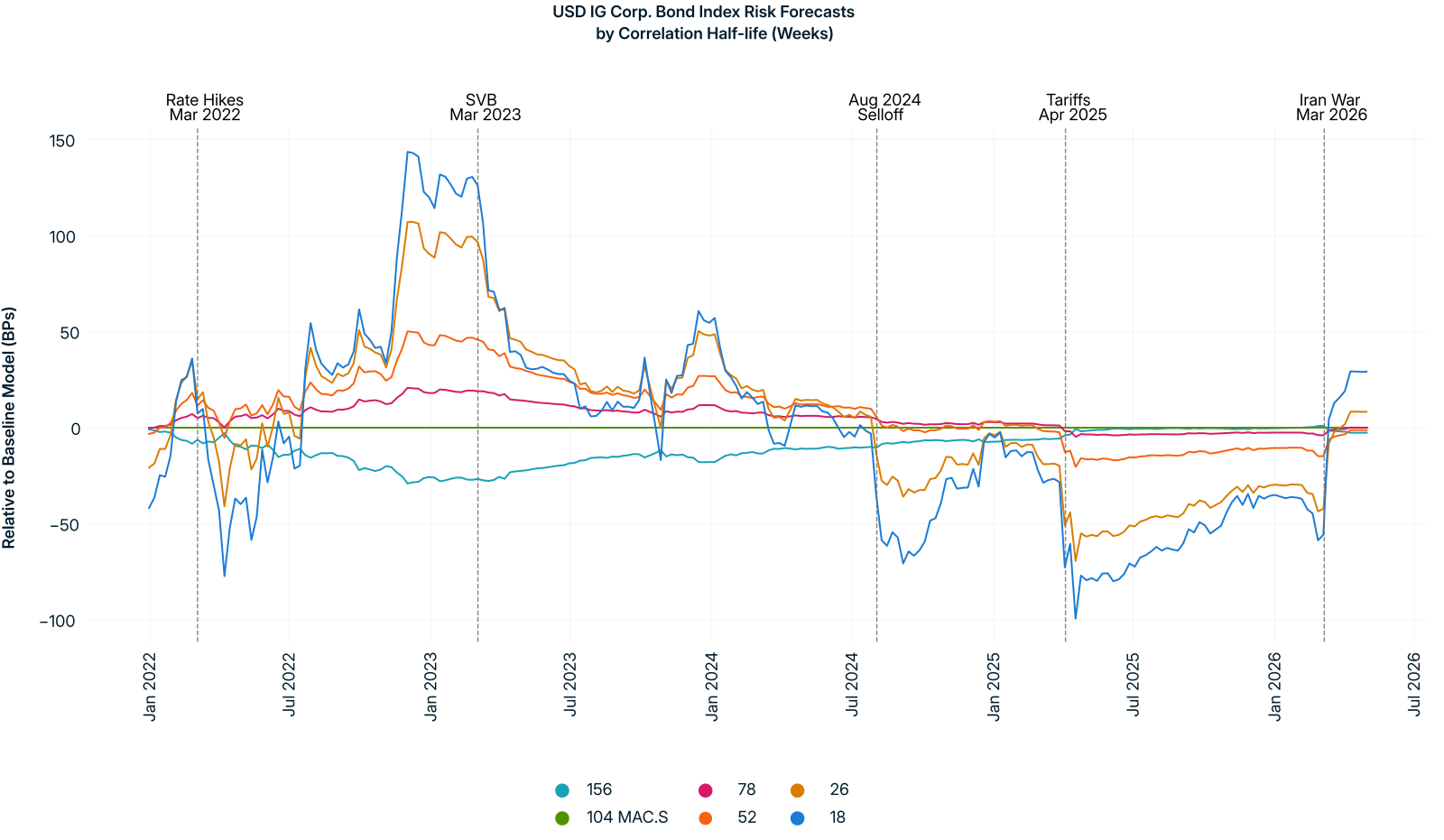
Weekly volatility for the USD investment-grade corporate universe, comparing the standard MSCI Multi-Asset Class Short-Horizon Model (MAC.S, 104 weeks) with custom covariance estimates using shortened half-lives. The dashed lines denote large market events that preceded divergent risk estimates. Source: MSCI Multi-Asset Class Factor Model.
To demonstrate this phenomenon, we estimate risk forecasts using alternate correlation half-lives and compare the results against the MAC.S benchmark. Using more reactive models, those with a half-life less than 104, for the MSCI USD IG Corporate Bond Index produces two notable effects relative to the standard MAC.S model. First, model-derived risk forecasts can deviate by 100 basis points or more, but risk estimates aren’t always ordered by half-life. Second, and perhaps more consequentially, the negative correlation between rates and spreads reemerges as a meaningful source of hedging within the portfolio. The custom covariance helps reveal not only where risk is concentrated, but where diversification may be reappearing.
The post-2022 rates-spread breakdown broke a decade of fixed-income diversification assumptions. In 2026, the correlation seems to be reverting. Long-history risk models will be skeptical of this turn. Reactive models may overfit to it. Custom covariances can help define and quantify this range and put bounds on this inherent market uncertainty.



Subscribe todayto have insights delivered to your inbox.
MSCI Custom Covariance
MSCI Custom Covariance lets you configure MAC Factor Model parameters to reflect your investment approach and market view.
When Regimes Shift: Three Lenses for Managing Regime Shifts in Multi-Asset-Class Portfolios
When market regimes shift, portfolio risk profiles change without any trades. We present a practical framework — combining risk monitoring, scenario analysis and alternative data — to diagnose and respond.
Scenario Analysis: When Stocks, Bonds and the Dollar Fall Together
Triple-Red scenarios — when correlations break down and diversification fails — are back. Drawing on historical lessons, we stress test how economic tensions could hit multi-asset-class portfolios.
The content of this page is for informational purposes only and is intended for institutional professionals with the analytical resources and tools necessary to interpret any performance information. Nothing herein is intended to recommend any product, tool or service. For all references to laws, rules or regulations, please note that the information is provided “as is” and does not constitute legal advice or any binding interpretation. Any approach to comply with regulatory or policy initiatives should be discussed with your own legal counsel and/or the relevant competent authority, as needed.