
Tesla and the Trillion-Dollar Question
- Asset managers and quantitative funds are reassessing large-cap growth allocations as U.S. megacaps stumble in early 2026, raising questions about the expectations embedded in their premium valuations.
- History shows “dual-top-decile” stocks, those both very large and expensive, underperformed their home markets by double digits over the following decade, with most struggling to justify their valuations.
- Fifty years of data reveal that the rare outperformers shared durable profitability and capital discipline — not faster growth — offering fundamentals to evaluate today's megacaps.
U.S. megacap stocks have started 2026 on the back foot, trailing every other major equity segment through January. Yet at over 32x trailing earnings, they still trade at nearly twice the multiples of non-U.S. stocks. Within this cohort sits an even more select group of "dual-top-decile" stocks, which combine the largest market capitalizations with some of the highest multiples globally.
Tesla's board of directors brought this group into focus late last year when it approved a trillion-dollar CEO pay package tied to a USD 8.5 trillion market cap by 2035.1 With a trailing multiple of 300x and a current capitalization of USD 1.5 trillion, that is over five times its size. That raises an empirical question: How often do stocks that are already among the largest and with the highest multiples organically quintuple over a decade? And what distinguishes the rare winners from the many that fall short?
To answer this question, we use MSCI's deep history spanning 30 years of style indexes, 30 years of equity risk exposures and 50 years of stock-level attributes covering roughly 20,000 securities to establish base rates for quintupling events. As we'll see, the record offers historical context for today’s equity market tilted toward megacap-led growth.
We started with MSCI’s value and growth style indexes. We found that starting valuation explains a meaningful share of subsequent 10-year returns, but not uniformly across market segments. The relationship was strongest for U.S. large-cap growth stocks, where initial price-to-earnings ratios explained roughly 70% of the variance in decade-ahead returns.2
This segment of large growth stocks was most sensitive to whether high implied growth expectations proved correct or mean-reverted. For value stocks, smaller companies and markets outside the U.S., the relationship weakened considerably.
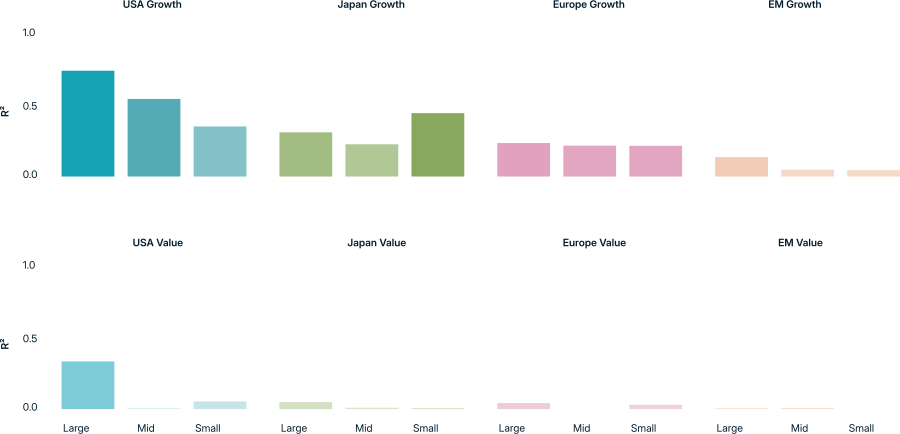
Returns are gross in USD for MSCI value and growth style indexes. Trailing price-to-earnings ratios are measured from December 1995 through January 2026. R² is based on 10-year forward index returns.
We next turned to individual securities, focusing on the large- and mid-cap segments in the U.S. and developed ex-U.S. markets from 1974 through the end of 2025. Across more than a million 10-year return paths, the distribution of wealth creation was heavily skewed.
Almost 30% of paths failed to generate a positive return, though U.S. outcomes were modestly more favorable with a fatter right tail. Fewer than 8% of paths achieved a 5x return in either region. This finding is consistent with earlier research on return concentration, where a small fraction of stocks drive most aggregate wealth creation while the majority of stocks gain modestly.3
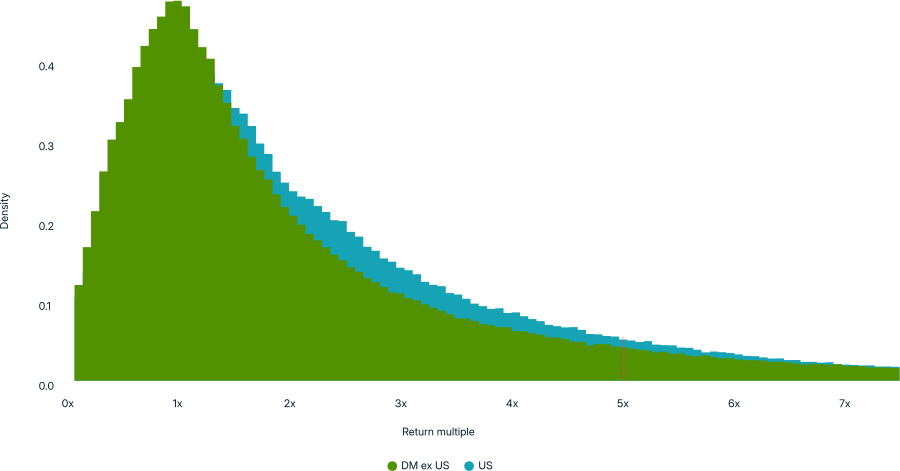
Distribution of return multiples up to a 10-year holding period, gross USD, for large- and mid-cap stocks in the U.S. and developed markets ex-U.S. from December 1974 through January 2026.
By sorting stocks monthly into deciles based on market capitalization and price-to-earnings ratio, creating 100 cohorts in all for each region, we could also identify where winners came from. The corner cohorts revealed two archetypes. Small, expensive stocks were lottery-like, producing quintuplers at higher rates but exiting at higher rates through delisting, bankruptcy and other corporate events.
At the opposite corner, large, expensive stocks proved more resilient with 10-year survival rates three times higher, but they accounted for a smaller share historically of the quintuplers. This pattern held in both U.S. and non-U.S. markets. In all, only 7% of stocks ever flagged in the largest and most expensive cohort eventually quintupled over a 10-year period.
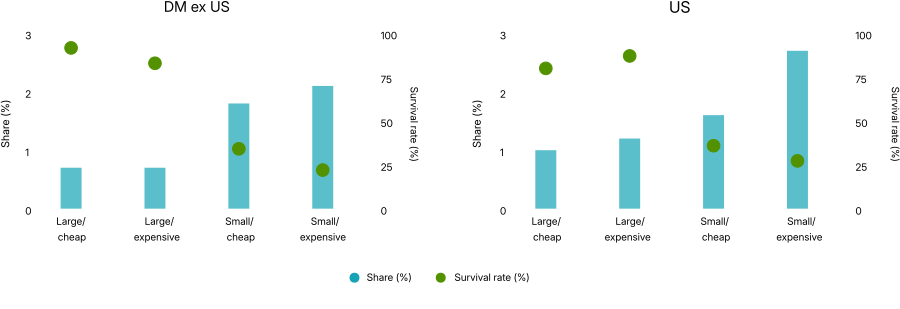
Share indicates percent of quintuplers originating from each size-valuation cohort. Quintuple events measured using compounded gross monthly USD returns. Ten-year survival rates estimated using Kaplan-Meier method. Large- and mid-cap stocks in U.S. and developed markets ex-U.S., December 1974 through January 2026.
The top corner of the largest and priciest firms faces particularly long odds. We traced each stock's fate upon first entry into the cohort over the subsequent five years. On average, these stocks trailed their regional benchmark by 15 to 20 percentage points over that window. The post-financial-crisis run in U.S. megacaps is an outlier against this record, though most started among the largest stocks but at more moderate valuations — not in the most extreme corner.
Embedded in extreme valuations are expectations that the largest firms will increase earnings by ever-larger absolute amounts — yet evidence on firm life cycles indicates that growth decelerates steadily with size.4 This mismatch between expectation and structural reality weighs on subsequent returns.
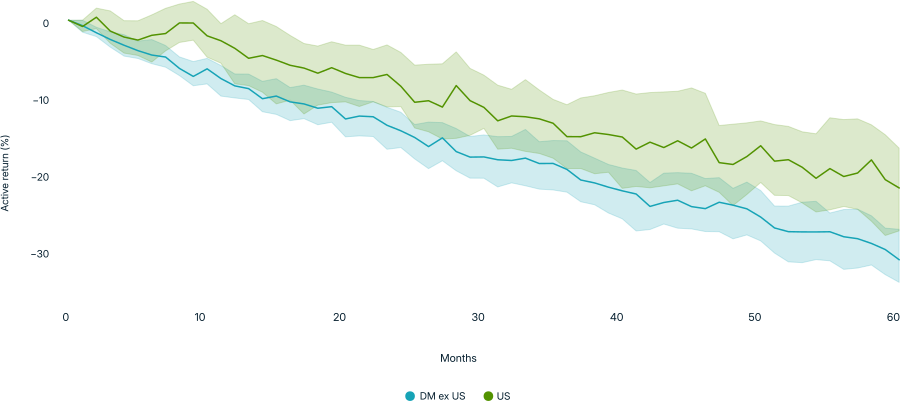
Returns are relative to MSCI USA and MSCI World ex USA Indexes and tracked from each stock’s entry into the largest and most expensive cohort. Median return is shown; band is 95% confidence.
For the handful of dual-top-decile stocks that did quintuple, we tracked their factor exposures before and after the run using the MSCI Global Equity Risk Model.
A distinct pattern emerged: During their run, winners were more profitable with more conservative investments — but not necessarily higher growth — than other stocks in the largest and most expensive cohort. After their run, investor sentiment declined and short interest rose, while earnings growth slowed and became more predictable. The firms pivoted to returning capital through dividends and buybacks, consistent with maturing businesses with disciplined capital allocation.
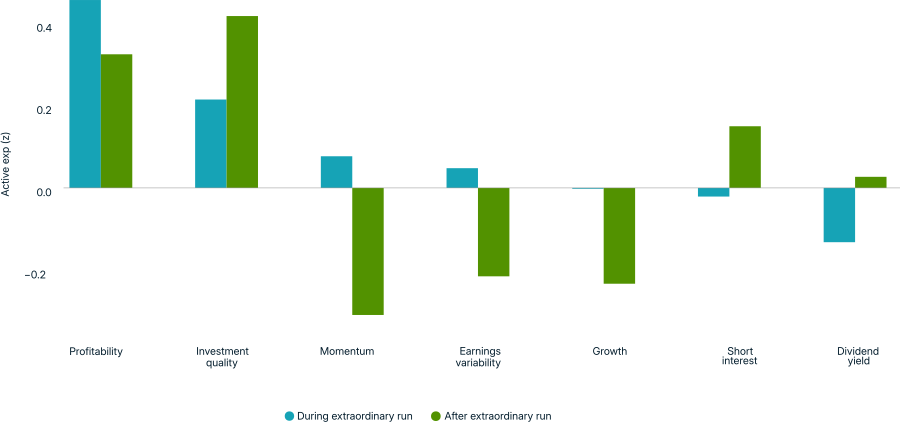
Mean active factor exposure for five years prior to and after quintuple event, relative to other large and expensive stocks. U.S. stocks only, select factors shown. Exposures based on the MSCI Global Equity Factor Model from December 1994 through January 2026.
Large, premium-priced stocks can go on extraordinary runs, but the historical record indicates they rarely do. Winners that did emerge tended to share a common trait we noted last year: durable profitability over aggressive growth.
For investors evaluating whether today's megacap valuations are justified, a half-century of data provides base rates. It also highlights the case for constructing portfolios of resilient, large compounders alongside lottery-like smaller stocks. History does not preclude extraordinary outcomes for either group, but it does allow us to price each accordingly.

Subscribe todayto have insights delivered to your inbox.
How Megacap IPOs in 2026 Could Reshape Global Benchmarks
Potential megacap IPOs in 2026 could reshape global benchmarks — increasing U.S. weight, shifting sectors toward software and aerospace and triggering billions in index flows.
Scenario Analysis: When Stocks, Bonds and the Dollar Fall Together
Triple-Red scenarios — when correlations break down and diversification fails — are back. Drawing on historical lessons, we stress test how economic tensions could hit multi-asset-class portfolios.
1 Aarian Marshall, “Tesla Shareholders Approve Elon Musk’s $1 Trillion Pay Package,” Wired, Nov. 6, 2025.
2 The relationship of starting valuation to forward return has weakened in large U.S. growth stocks over the last fifteen years.
3 Hendrik Bessembinder. 2018. “Do stocks outperform Treasury bills?” Journal of Financial Economics 129 (3): 440–457.
4 Michael J. Mauboussin and Dan Callahan, “The impact of intangibles on base rates,” Morgan Stanley Investment Management, June 23, 2021.
The content of this page is for informational purposes only and is intended for institutional professionals with the analytical resources and tools necessary to interpret any performance information. Nothing herein is intended to recommend any product, tool or service. For all references to laws, rules or regulations, please note that the information is provided “as is” and does not constitute legal advice or any binding interpretation. Any approach to comply with regulatory or policy initiatives should be discussed with your own legal counsel and/or the relevant competent authority, as needed.