
USD 22 Billion Points to Future Carbon-Market Demand
- Capital committed and deployed into the global carbon-credit market reached a record USD 22 billion in 2025, a 72% increase on 2024 and more than five times 2021 levels.
- Buyers contracting today are locking in future price and quality, while opportunities for investors, banks and project developers continue to expand.
- Waiting for spot demand to materialize risks leaving buyers with what remains, rather than what is highest quality. Financing structures to act earlier are becoming increasingly available.
In 2025, the carbon-credit market saw a clear divergence. Demand, as measured by retirements, was broadly flat for a fourth year, even as climate ambition softened in several major economies. At the same time, capital flows into future supply accelerated sharply.
MSCI Carbon Markets tracks publicly announced investment and offtake agreements across the carbon-credit market. The data shows early-stage capital activity reached a record USD 22 billion in 2025, more than five times the 2021 levels and a 72% increase on 2024. The value of offtake agreements, where companies contract to secure future supply, nearly tripled year on year to USD 12.3 billion and, for the first time, exceeded USD 9.7 billion of direct investments into carbon-credit projects. This growth is not driven by purchases for immediate use, but by forward-looking commitments to secure supply years in advance.
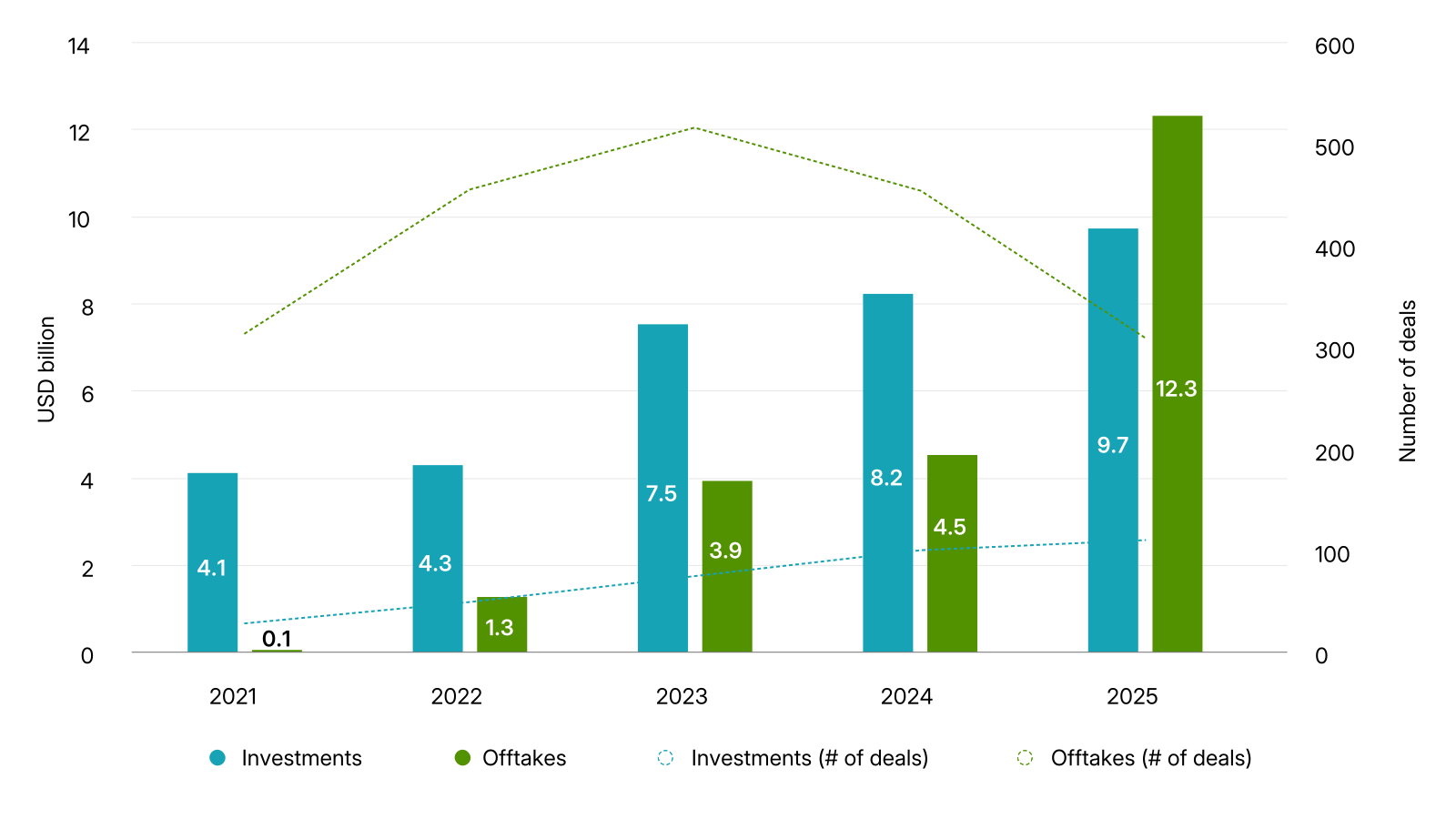
Data as of Dec. 31, 2025. Source: MSCI Carbon Markets, Investment and Offtake Trends in the Global Carbon Credit Market (client access only)
Quality is a central driver of this shift. Only around one-third of available credits achieve a BBB rating or above under MSCI Carbon Project Ratings, pointing to a limited pool of high-integrity supply. As scrutiny increases, corporates are moving to secure access to, and take greater control over, the projects that generate those credits.
Projects covering carbon engineering (USD 10.3 billion) and nature restoration (USD 10.1 billion) together accounted for 93% of 2025 investment and offtake activity. More than 95% of carbon-engineering projects and half of nature-restoration projects achieve an MSCI rating of BBB or above, compared with a global average of roughly one quarter. As a result, the average quality of these future projects is likely to be materially higher than that currently seen in the market.
From transactions to commitments
The structure of the market is also evolving alongside this shift. In offtake markets, pre-purchase and forward agreements now dominate, accounting for roughly two-thirds of value in 2025, up from less than a quarter in 2022. Memoranda of understanding (MoU) and early-stage commitments, which dominated as recently as 2023, have largely receded.
This reflects a fundamental change in how corporate buyers engage with the market. Rather than outsourcing project and delivery risk to developers and intermediaries, buyers are increasingly taking on that risk by committing capital to the projects expected to generate their future credits.
A similar shift in risk allocation is visible on the investment side. Direct equity remained dominant, accounting for 86% of investment value, while loan financing accounted for 10% in 2025, establishing itself as a recurring feature of the market. A notable example was the USD 210 million non-recourse project-finance facility structured by JPMorgan Chase & Co. for Chestnut Carbon, funding delivery of a 25-year forestry credit agreement with Microsoft Corp. — an early application of traditional project-finance techniques to a U.S. carbon-credit project.
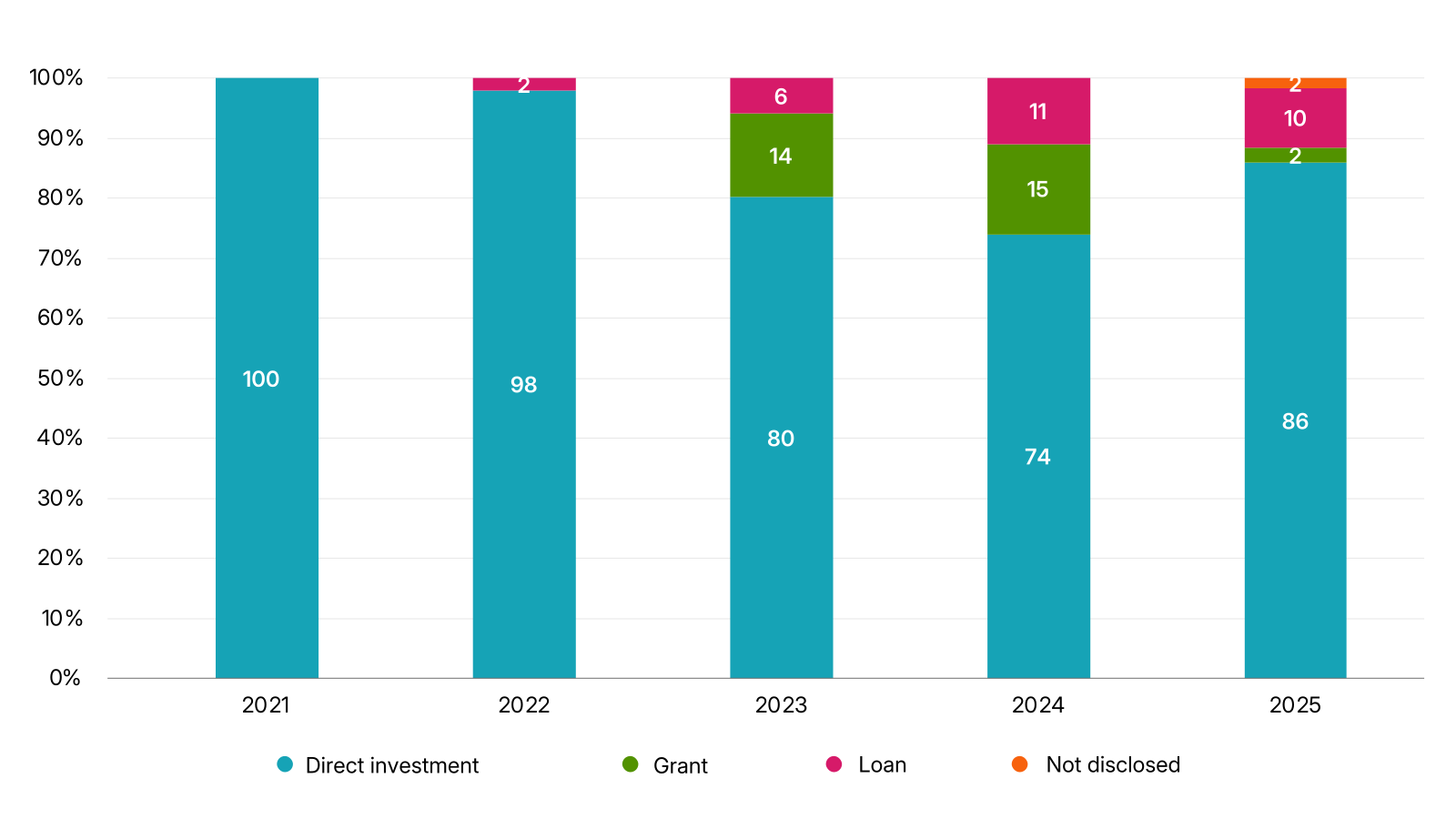
Data as of Dec. 31, 2025. Charts show the composition of investments and offtake agreements by deal sub-type as a percentage of total value each year from 2021 to 2025. Source: MSCI Carbon Markets, Investment and Offtake Trends in the Global Carbon Credit Market (client access only)
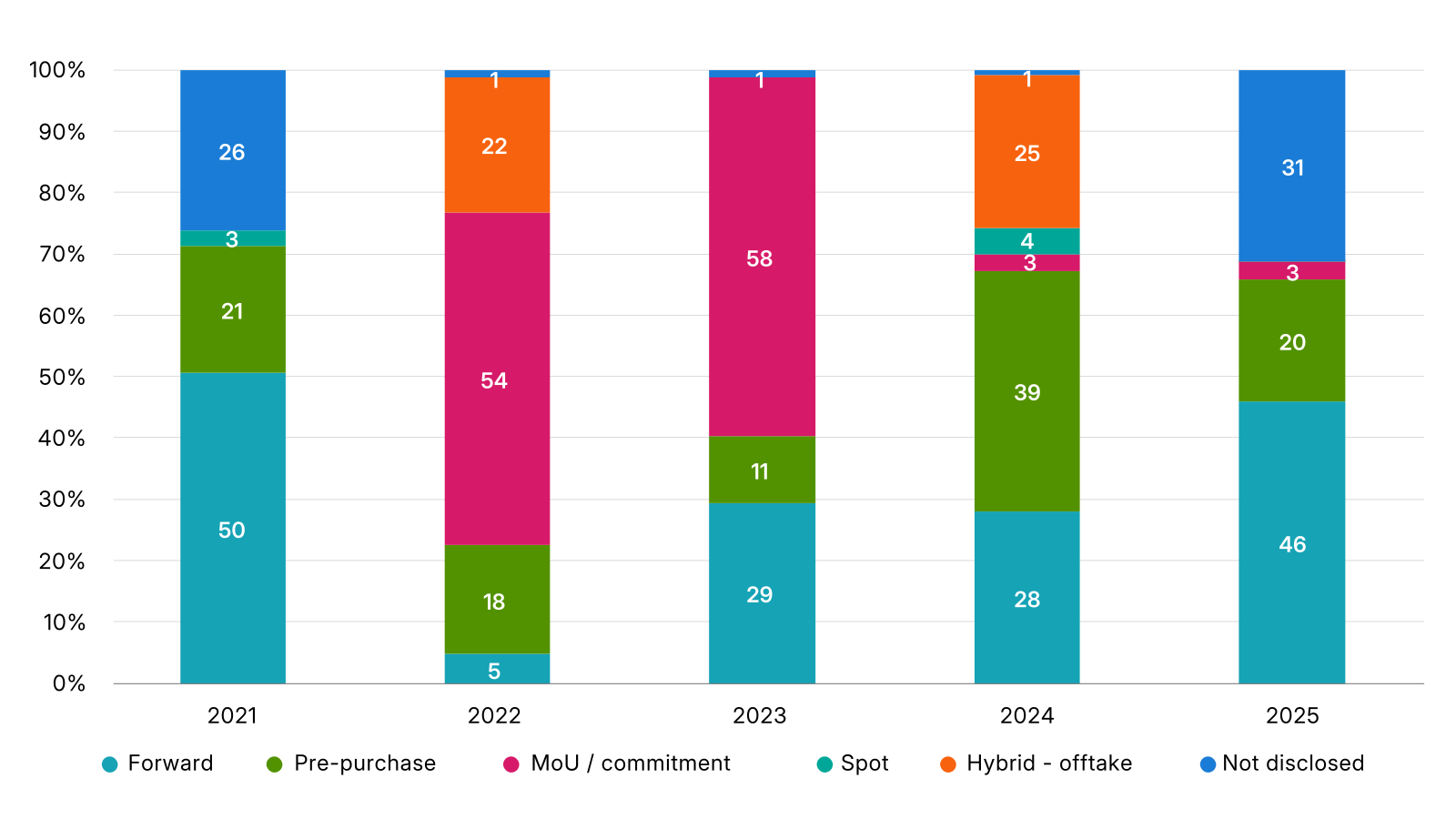
Data as of Dec. 31, 2025. Charts show the composition of investments and offtake agreements by deal sub-type as a percentage of total value each year from 2021 to 2025. Source: MSCI Carbon Markets, Investment and Offtake Trends in the Global Carbon Credit Market (client access only)
Confidence growing, even as participation narrows
The steady increase in capital deployed suggests growing confidence in the long-term role of carbon markets — even after accounting for the concentration of that capital. Corporate capital alone reached USD 14.2 billion in 2025, more than tripling year on year, with over 100 corporates contributing to that total.
Concentration remains a counterpoint. The total number of deals declined from 555 in 2024 to 467 in 2025, even as total value increased, indicating a market increasingly shaped by a smaller number of larger transactions.
Yet the broader picture appears more resilient than the headline concentration may suggest. The number of unique investors has remained broadly stable and, even excluding the largest single buyer, total capital committed and deployed would still represent a record year, at more than USD 11 billion committed — almost three times the 2021 total. This expansion is not solely dependent on any single participant.
Future demand is building
At the same time, the pipeline of future demand continues to build. More than 12,000 companies now have near-term science-based targets, collectively covering approximately 27 gigatonnes of emissions.1 These commitments imply a steep emissions-reduction trajectory through 2030 to 2035. For many sectors, meeting those targets will require not only internal decarbonization, but also access to high-quality carbon credits.
The acceleration in investment and offtake activity suggests that corporates are beginning to act on this reality. Securing supply early may offer both price certainty and access to higher-quality projects that could become scarce as demand materializes.
Positioning for future demand
The current market can be seen as being in a transition phase. Demand today, as measured by companies buying and retiring credits, appears flat; however, the capital and commitments to meet future demand are scaling.
In 2025, capital was deployed into projects expected to deliver credits over the coming decade, while financing structures continued to evolve to support that build-out. Buyers have shifted from opportunistic purchasing toward longer-term, strategic procurement.
The central question is no longer whether demand will emerge, but whether sufficient high-quality supply will be available when it does.



Subscribe todayto have insights delivered to your inbox.
Carbon Credits Come of Age in 2025
Carbon-credit markets held steady in 2025, while growing demand for higher-quality and removal credits is reshaping pricing, demand and long-term growth prospects.
2025 State of Integrity in the Global Carbon-Credit Market
Our 2025 report on the global carbon-credit market shows rising demand for high-integrity credits with stronger ratings, higher prices and new risk frameworks are shaping a more credible market.
Carbon Markets
Gain a deeper understanding of carbon markets with our investor-grade data, analytics and insights for companies, banks, investors, project developers and others.
1 Science Based Targets initiative, Target Dashboard, 2026
The content of this page is for informational purposes only and is intended for institutional professionals with the analytical resources and tools necessary to interpret any performance information. Nothing herein is intended to recommend any product, tool or service. For all references to laws, rules or regulations, please note that the information is provided “as is” and does not constitute legal advice or any binding interpretation. Any approach to comply with regulatory or policy initiatives should be discussed with your own legal counsel and/or the relevant competent authority, as needed.